

Ascent Passport
- Pamir-Alay, Turkestan Range, Karavshin valley, 5.4.3.
- Peak 4810, 4810 m, via the center of the North-West wall, Kritsuk route
- 6B cat. diff. (first winter ascent, combination)
- Route type: combined
- Route height difference: 1180 m
Route length: 1515 m Section lengths:
- V cat. diff. – 521 m
- VI cat. diff. – 884 m Average steepness:
- main part of the route (3630 m – 4450 m) — 80°
- entire route (3630 m – 4810 m) — 77°
- Hooks left on the route: total – 14; including pitons – 12
Hooks used on the route:
- stationary pitons – 58 (46*); including AIDs – 9*
- removable pitons – 63; including AIDs – 40 Total artificial aids (AIDs) used – 698
- Team's working hours: 156 h, 14 days.
- Team leader: Korobkov Alexander Alexandrovich, Master of Sports
Team members:
- Dashkevich Sergey Alexandrovich, Candidate for Master of Sports
- Litvinov Kirill Pavlovich, Candidate for Master of Sports
- Timofeev Sergey Vladimirovich, Master of Sports
-
Coaches: Timofeev Sergey Vladimirovich, Master of Sports Pershin Valery Nikolaevich, Honored Master of Sports, Honored Coach
-
Route entry: 8:00, February 22, 2008 Reached the summit: 15:35, March 6, 2008 Returned to Base Camp: 16:00, March 9, 2008
* — previously driven
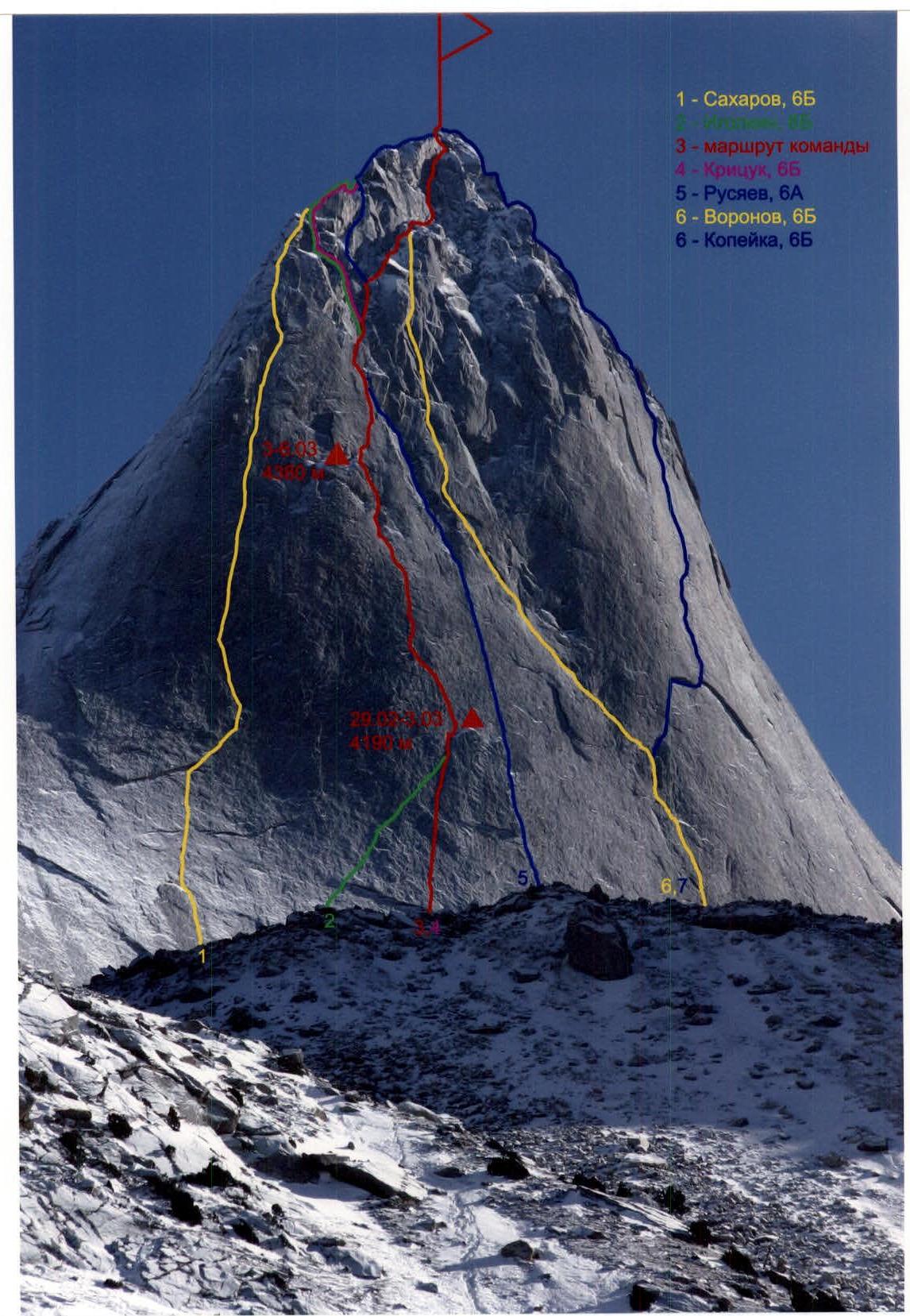
General photo of the summit. February 10, 2008, bank of the Kara-Su river.
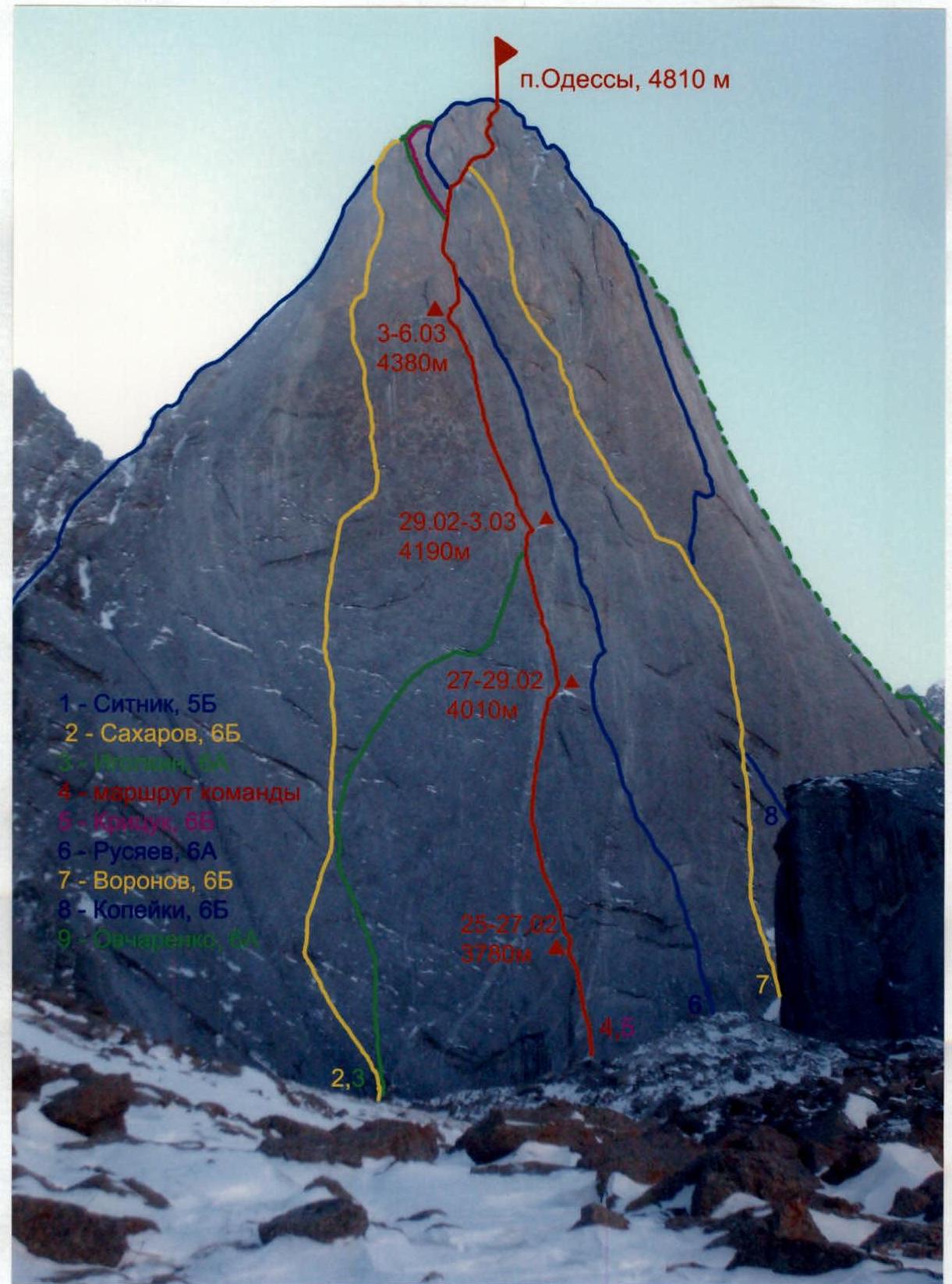
General photo of the summit. February 11, 2008, moraine approach.
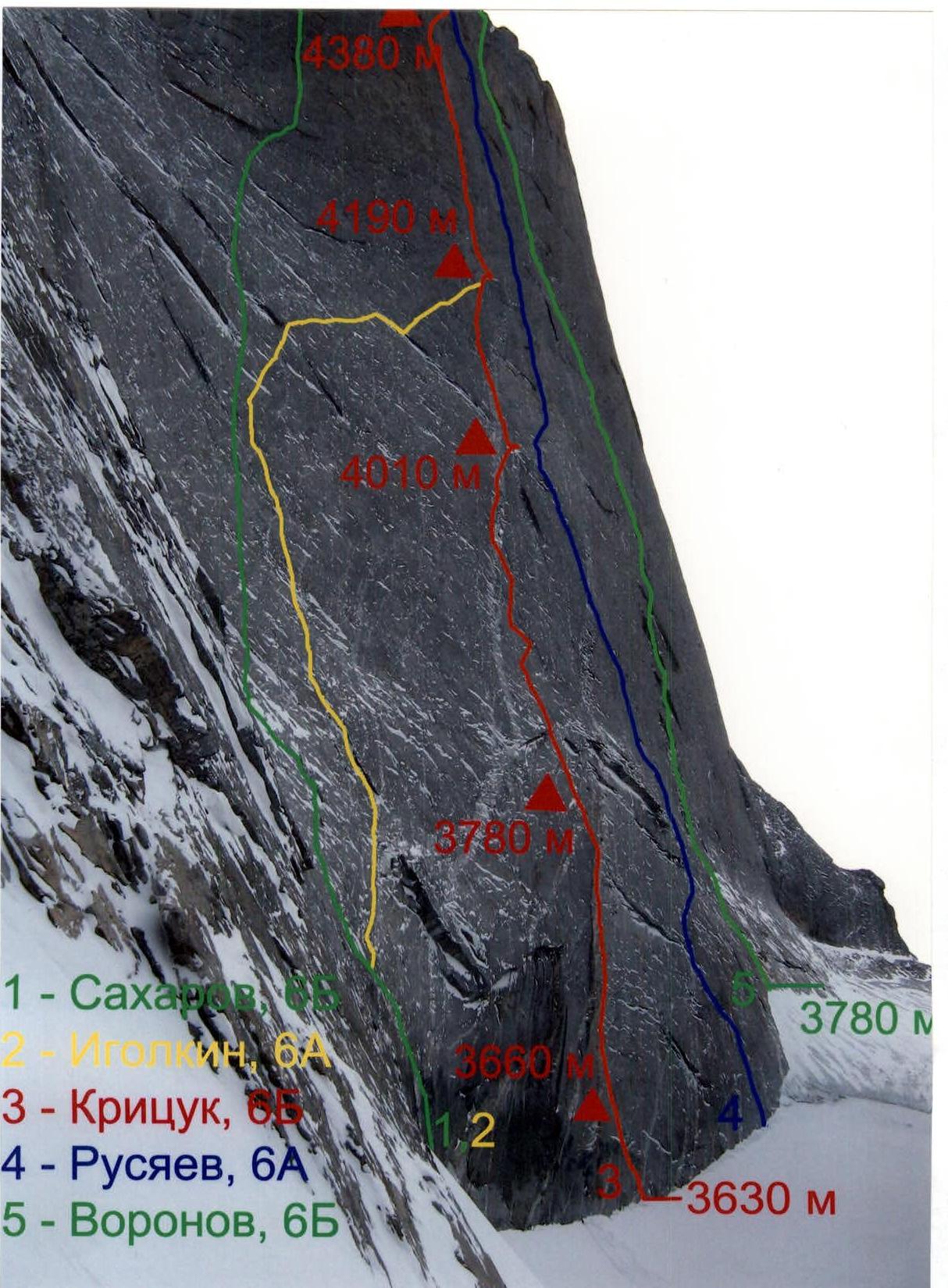
Photo of the wall profile from the left
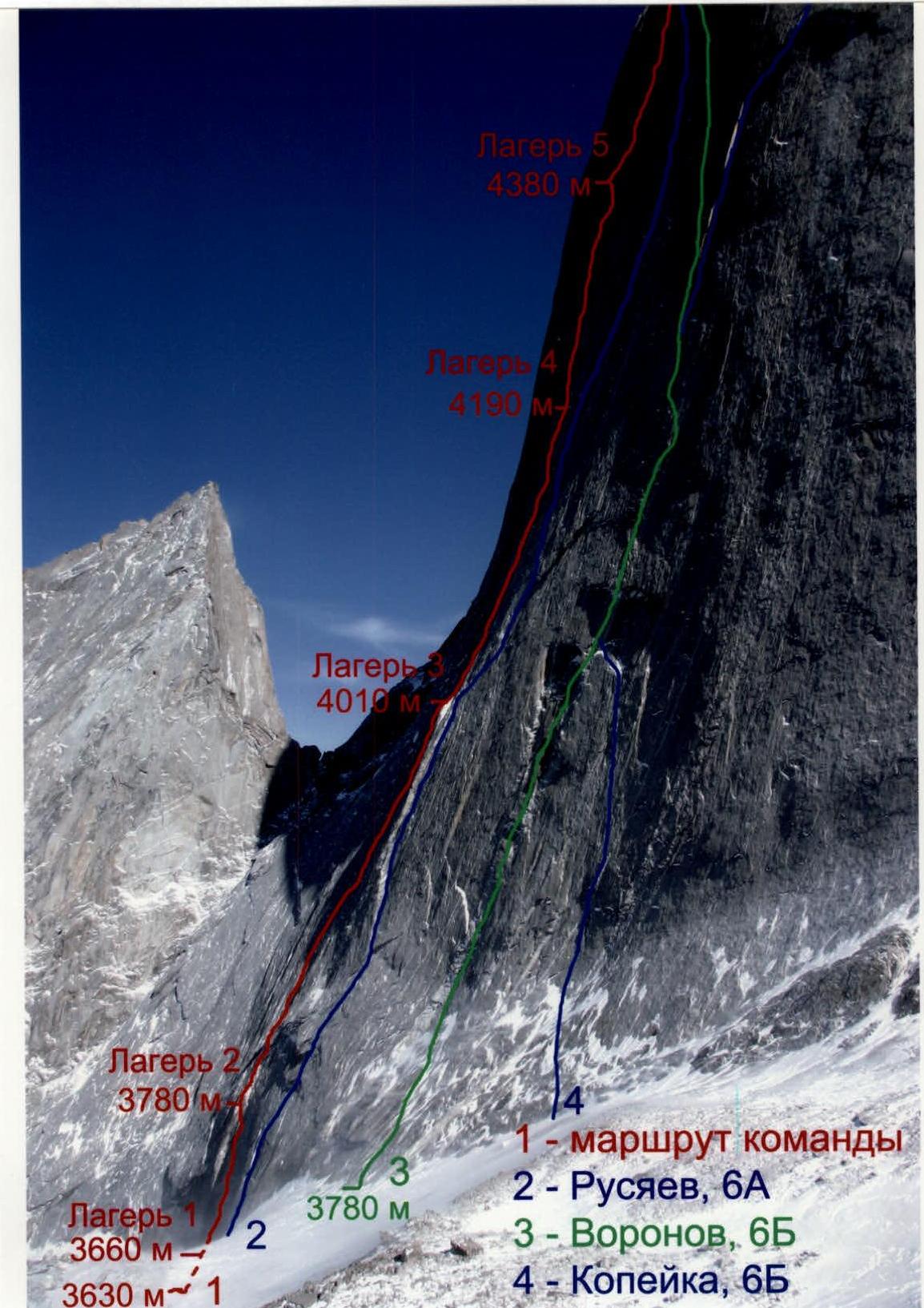
Photo of the wall profile from the right

Ascent Graph
| Day | Height (m) |
|---|---|
| 1 | 3660 |
| 2 | 3730 |
| 3 | 3780 |
| 4 | 3780 |
| 5 | 3930 |
| 6 | 4030 |
| 7 | 4130 |
| 8 | 4190 |
| 9 | 4330 |
| 10 | 4380 |
| 11 | 4480 |
| 12 | 4630 |
| 13 | 4780 |
| 8750 |
Ascent Days, February 22 – March 6, 2008
- Time spent on the route (h)
- Hours of bad weather during work on the route (h)
- Route heights
| Section # | Ice screws | Rock screws | Placement elements | Special AIDs | Section difficulty | Length (m) | Steepness (degrees) |
|---|---|---|---|---|---|---|---|
| 15 | 0 | 4 / 0 | 10 / 0 | 0 | VI–20 m V–30 m | 50 | 73 |
| 14 | 0 | 5 / 3 | 12 / 7 | 0 | A2 V–30 m | 45 | 73 |
| 13 | 0 | 18 / 13 | 8 / 5 | 0 | A2 V–10 m | 45 | 73 |
| 12 | 0 | 2 / 1 | 9 / 4 | 3* 2# | A2(e) V–10 | 15 | 77 |
| 11 | 0 | 6 / 5 | 6 / 3 | 5* 2# | A3(e) V–17 m | 35 | 77 |
| 10 | 0 | 8 / 5 | 14 / 10 | 2# | A2 V–15 m | 40 | 75 |
| 9 | 0 | 5 / 4 | 0 | 16* | A2(e) | 25 | 75 |
| 8 | 0 | 10 / 10 | 2 / 1 | 3* 2# | A3(e) V–5 m | 20 | 80 |
| 7 | 0 | 5 / 3 | 9 / 5 | 1* | A2 V–10 | 20 | 80 |
| 6 | 0 | 3 / 2 | 10 / 9 | 6* | A2(e) IV–5 | 25 | 81 |
| 5 | 0 | 1 / 1 | 11 / 11 | 10* | A2(e) | 25 | 85 |
| 4 | 0 | 5 / 3 | 19 / 19 | 0 | V | 30 | 83 |
| 3 | 0 | 6 / 4 | 28 / 27 | 4* | A3(e) | 35 | 85 |
| 2 | 0 | 5 / 5 | 23 / 22 | 2# | A3 | 30 | 85 |
| 1 | 0 | 4 / 3 | 4 / 3 | 5* 6# | A3(e) | 35 | 85 |
| 27 | 0 | 8 / 6 | 9 / 6 | 5# | A2 V–20 m | 40 | 85 |
| 26 | 0 | 11 / 10 | 13 / 9 | 0 | A2 | 25 | 80 |
| 25 | 0 | 11 / 8 | 3 / 1 | 0 | A2 | 25 | 80 |
| 24 | 0 | 30 / 29 | 20 / 19 | 0 | A2 | 50 | 83 |
| 23 | 0 | 7 / 3 | 13 / 8 | 3* 3# | A2(e) V–14 m | 50 | 85 |
| 22 | 0 | 25 / 25 | 7 / 7 | 3# | A4(e) | 50 | 83 |
| 21 | 0 | 2 / 1 | 7 / 3 | 0 | A1 V–15 m | 40 | 80 |
| 20 | 0 | 15 / 15 | 7 / 5 | 8* 3# | A2(e) | 45 | 78 |
| 19 | 0 | 8 / 7 | 0 | 8* 8# | A3(e) | 30 | 75 |
| 18 | 0 | 7 / 6 | 9 / 9 | 4* 3# | A2(e) | 20 | 79 |
| 17 | 0 | 24 / 19 | 4 / 4 | 7* 3# | A3(e) | 45 | 75 |
| 16 | 0 | 9 / 9 | 2 / 2 | 12* | A2(e) V–10 m | 50 | 75 |
| 40 | 0 | 8 / 2 | 8 / 2 | 0 | A2–2 m | 40 | 75 |
| 39 | 0 | 5 / 0 | 4 / 0 | 0 | V | 15 | 78 |
| 38 | 0 | 0 | 12 / 12 | 0 | A2 V–10 m | 35 | 75 |
| 37 | 0 | 3 / 1 | 4 / 1 | 0 | V | 50 | 70 |
| 36 | 0 | 2 / 0 | 0 | 0 | IV | 45 | 65 |
| 35 | 3 | 1 / 0 | 1 / 0 | 0 | V | 45 | 60 |
| 34 | 3 | 1 / 0 | 0 | 0 | V | 25 | 70 |
| 33 | 2 | 0 | 0 | 0 | V | 25 | 70 |
| 32 | 4 | 1 / 0 ш | 0 | 0 | V | 45 | 75 |
| 31 | 0 | 15 / 14 | 25 / 24 | 0 | A2 V–5 m | 50 | 78 |
| 30 | 0 | 4 / 4 | 10 / 8 | 2* 1# | A2 | 15 | 85 |
| 29 | 0 | 10 / 9 | 5 / 4 | 5* 4# | A3(e) | 35 | 87 |
| 28 | 0 | 8 / 6 | 9 / 6 | 5* 3# | A3(e) V–15 m | 45 | 85 |
| 42 | 0 | 0 | 2 / 0 | 0 | II–III | 60 | 35 |
| 41 | 0 | 4 / 2 | 4 / 0 | 0 | V A1–8 m | 40 | 65 |
Ш — pitons; * — hole hooks; # — skyhooks.

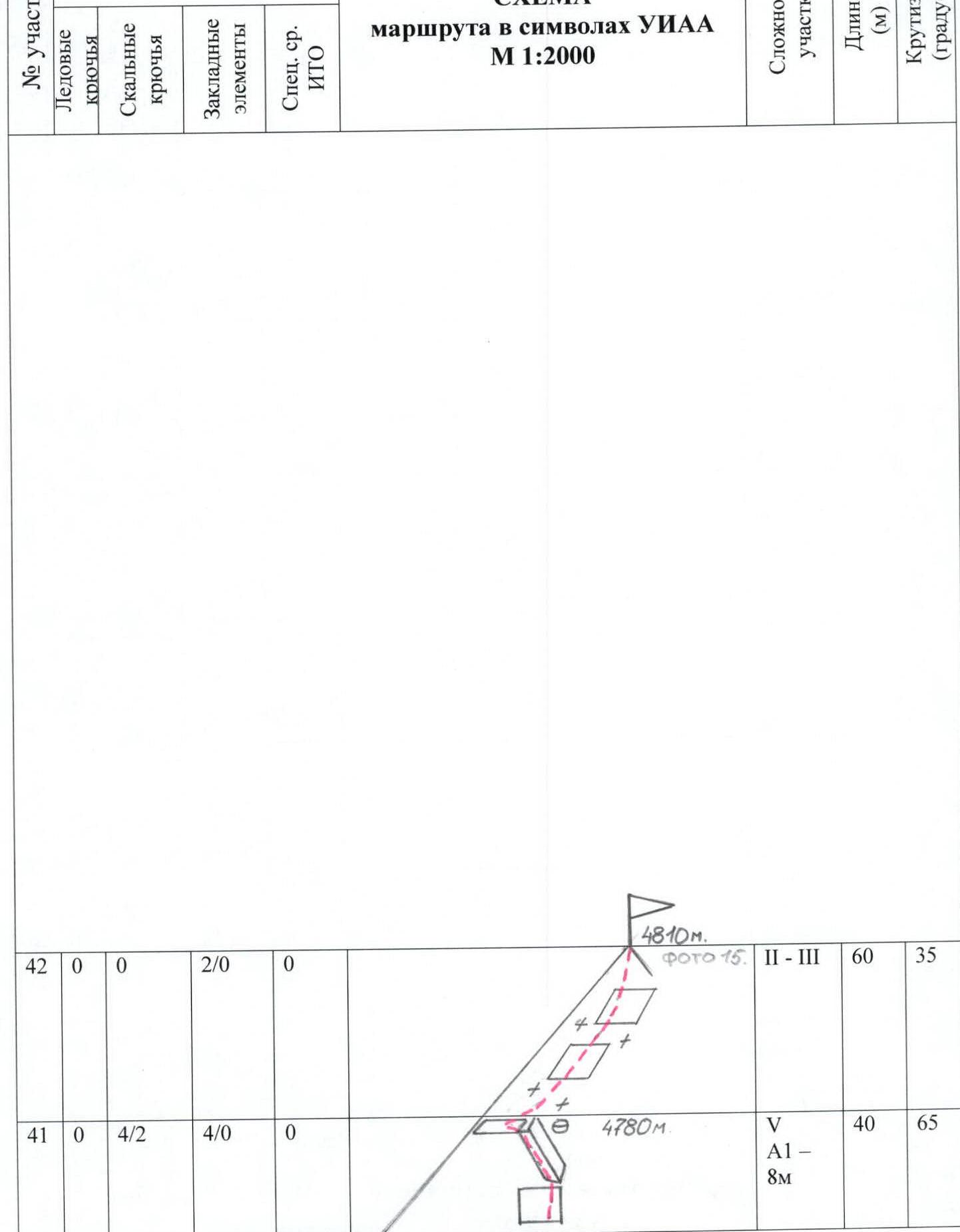
Description by Sections
R0–R1. Start by following the well-defined path of old VCSSP pitons. Move across the slabs from right to left to the base of the internal corner. Utilize hole hooks, relief skyhooks, hatchets, small friends, and anchors. Very diverse and interesting AIDs. Encounter 6–8 mm holes. For protection, drive a removable 8 mm piton (1 piece). Station on a ledge at the base of the corner on a local and personal (removable) piton. In summer, possibly challenging climbing with partial AIDs. 35 m, A3e.
R1–R2. Climb the corner 8 m upwards and then move right (the corner turns into a cornice) on small friends to a VCSSP piton with a loop. Perform a 4 m pendulum right to the start of the ringing nail patches, which run right from a huge internal corner. The series of nail patches forms another internal corner, going from left to right. Move under the cornice on medium friends. There's a VCSSP piton on the section. Station on 3 removable 8 mm pitons. In summer, much of it can be climbed. 30 m, A3.
R2–R3. Continue moving rightwards on ringing off-holds right of the corner, on medium and large friends, as well as on small and medium stoppers, under a series of small cornices. Under the first cornice and behind it, there are 2 removable 8 mm (2.5 cm) pitons. The cornice is passed head-on using hole hooks. Further movement is right to left through a series of ringing cornices on friends along the internal corner. There's a local piton there. Station reinforced with an anchor and a placement. Extremely tense AIDs due to the rock's non-monolithic nature. Everything rings and falls. Advancement is partly done by climbing. 35 m, A3e.
R3–R4. Climb the corner to a PETZL piton on anchors, small friends, and placements. Very careful AIDs (everything falls onto the station). To the left, a piton with a carabiner is visible — incorrect direction. Then, traverse right from the central piton and, via strongly ringing off-holds, move right and up on small and medium friends under a chimney formed by a huge nail patch. Station on a ledge on a local central piton and a removable 8 mm piton. Very challenging psychological AIDs. Feeling that everything might fall at any moment. 30 m, A3, IV.
R4–R5. Move left to right across the wall under the cornice. At the top, there's an old placement. Drive a removable 8 mm piton. Further, on small friends, then through a three-stage cornice on large friends. Friends are placed in shaky off-holds. Then, move right of a quartz vein across a monolithic wall on skyhooks. Station on 2 removable and 1 central piton. 25 m, A2e.
R5–R6. Climb 8 m upwards and right through a nail patch on skyhooks. Then, through ringing nail patches on friends. At the end of the internal corner, move left and climb 10 m to a ledge lined with stones. 25 m, A2, IV.
R6–R7. Climb straight up on placements, friends, and anchor hooks. Through off-holds upwards across very non-monolithic crevices to a chimney, climbed by moving right to left. Protection on loops and off-holds. Station on a good ledge. 20 m, A2, IV.
R7–R8. From the ledge, climb straight up on hole hooks, relief skyhooks, and anchor hooks under the left part of a large "M"-shaped cornice. The cornice is passed on medium friends from left to right. Then, traverse right by climbing on balance to 2 stationary pitons. 20 m, A3e, V.
R8–R9. From the station, first move right on anchors, then left and straight up on hole hooks. Station is hanging. 25 m, A2e.
R9–R10. Climb slightly up on relief skyhooks and, by climbing on balance, traverse right to an internal corner formed by nail patches. Climb the corner on anchors and medium friends. Much can be climbed. 40 m, A2, V.
R10–R11. Climb up and right across non-obvious relief on AIDs and by climbing. After 4 m, perform a pendulum right. Orient towards a deep crevice on the right. Climb on hole hooks to a ledge with a good crevice on the right. Local piton. On halfway through the section, the leader put on rock shoes and climbed much of it. 35 m, A3e, VI.
R11–R12. Climb straight up the crevice 7 m under the cornice on medium friends. The cornice is passed on the left and then by climbing along a vein. Protection is poor. Work in rock shoes. 15 m, 77°, A2e, VI.
R12–R13. Climb left across the internal corner on AIDs and by climbing, using medium friends and anchors. The corner leads to a diagonal ledge. Climb across it rightwards under another internal corner, passed on anchors. Move to an old piton. Station reinforced with a removable piton. 45 m, A2, VI.
R13–R14. From the piton, climb up and right across slabs by climbing. Then, perform a pendulum right from a removable piton and further right and up across slabs by climbing. Protection is sparse but good. Holds are mostly passive. Rock shoes were used for this section. 45 m, A2, VI.
R14–R15. From the station, climb right and up towards a large internal corner by climbing. Climbing is interesting, V–VI. Station in the internal corner at the level of the "Glove" ledge. Work in rock shoes. 50 m, V–VI.
R15–R16. Traverse to a large ledge. Good bivouac here. Then, climb straight up, crossing a quartz vein across slabs. Encounter crevices for anchors. 50 m, 75°, A2e.
R16–R17. Climb straight up under a diagonal (right to left) cornice. Station under it on a local hook and a removable piton. Utilize anchors, relief skyhooks, medium friends, and hole hooks. Interesting and challenging AIDs. 45 m, A3e.
R17–R18. Under the cornice, move left and up diagonally on friends. After 10 m, climb up on anchors and hole hooks. Station on an anchor and a removable piton. 20 m, A2e.
R18–R19. Climb up and right on relief skyhooks and hole hooks. Sometimes, encounter spots for anchors under nail patches. Protection is unreliable. 3 removable pitons were driven. Station on 2 local pitons. 30 m, A3e.
R19–R20. Climb up right across a nail patch on hole hooks and skyhooks, and then on anchors and friends across unreliable rocks. Increased danger of falling stones onto the ledge below. 45 m, A2e. Here, the route converges with Igolkin's route.
R20–R21. From the station, climb straight up and then right by climbing across good off-holds to a diagonal ledge. Walk across it to a good "Breasts" ledge. The ledge has many loose stones. 40 m, A1, V.
R21–R22. Right of a local piton, start encountering unreliable thin flakes. Climb up and left under a crevice. Danger of falling onto the ledge. Very careful AIDs. 50 m, A4e.
R22–R23. From the station, perform a pendulum left towards a chimney and then move towards it on hole hooks and skyhooks. Climb the chimney by climbing and on AIDs. The chimney ejects. Use anchors and medium friends. 50 m, A2e, V.
R23–R24. Climb the chimney on AIDs on friends and placements. 50 m, A1.
R24–R25. Climb up the internal corner on friends. After 20 m, a small ledge. Station there. 25 m, A2.
R25–R26. To the left, a large internal corner with characteristic weathered smooth holds is visible. Climb up and right across a crevice on AIDs and by climbing to a ledge on the right. 25 m, A2.
R26–R27. From the ledge, climb straight up 30 m to a PETZL piton across crevices on AIDs. From it, perform a pendulum left and then climb and move on AIDs to the summit of an off-hold, where there's a convenient large ledge. Control cairn on the ledge. 40 m, A2, V.
R27–R28. From the ledge, climb up and right across the left part of the internal corner to a narrow ledge 10 m. Then, traverse right across it to a rightward and upward crevice like a "snake" 10 m. Climb the crevice on medium friends. After 10 m, the crevice ends, and further climb right and up across non-monolithic relief on hole hooks and skyhooks, sometimes on anchors, for unreliable small flakes. Station on a slab on two removable pitons. Direction is under the left part of a triangular cornice. 45 m, A3e, V.
R28–R29. From the station, climb up and right to an internal corner left of the cornice. Climb the corner up under a small cornice on small and medium friends and anchors. Move to a large internal corner on the right on hole hooks across a slab under the cornice. Station on a local piton and friends. Intersection with Rusyaev's route. 35 m, A3e.
R29–R30. Climb up the corner to its end. 15 m, A2.
R30–R31. From the corner, climb up under a cornice left of a chimney and further across a series of walllets to a small ledge at the top of the chimney. Movement is on friends and anchors. From here, Kritsuk's and Igolkin's routes turn left to the ridge. 50 m, A2, IV.
R31–R36. Climb across a system of chimneys, internal corners filled with ice, interspersed with small walllets and diagonal ledges right and up along the ridge by climbing. Not keen on going left to the ridge. On R33, the route intersects with Voronov's route and further follows it to the ridge, practically directly to the summit. 185 m, IV–V.
R36–R37. Traverse right under the summit tower. Station at the base of an internal corner. 50 m, A1, V.
R37–R40. Climb up and right across the corner and chimney by climbing and partially on AIDs. Reach a ledge. Climbing involves stem moves and balance. 85 m, A2, V.
R40–R41. Climb across a wall right into a couloir, transitioning into an internal corner, which leads to the ridge. The top of the internal corner is blocked by a cornice. Crevices are blind. 40 m, A1, V.
R41–R42. Climb across a simple ridge to the summit. 60 m, II–III.
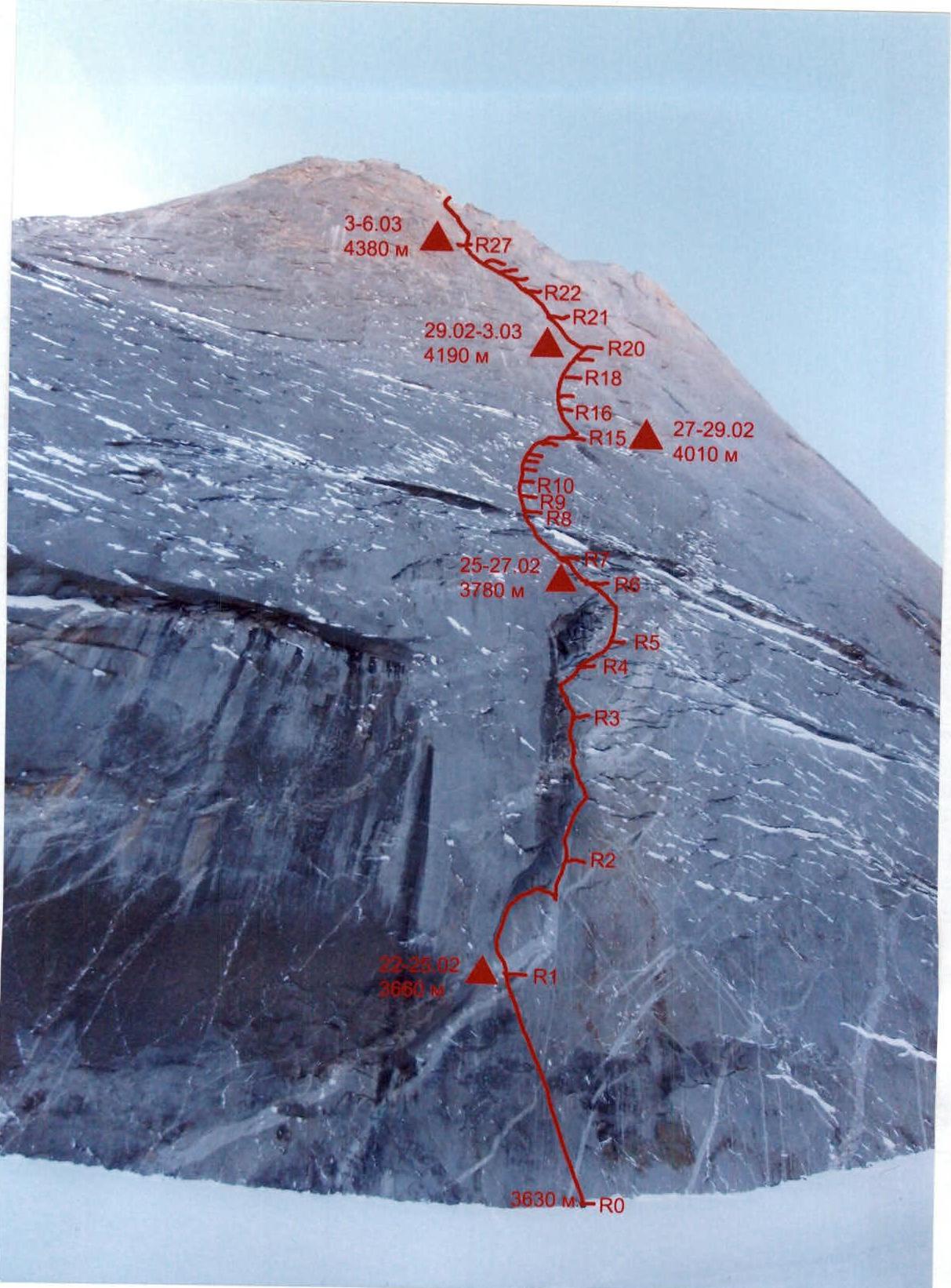
Technical photograph of the route
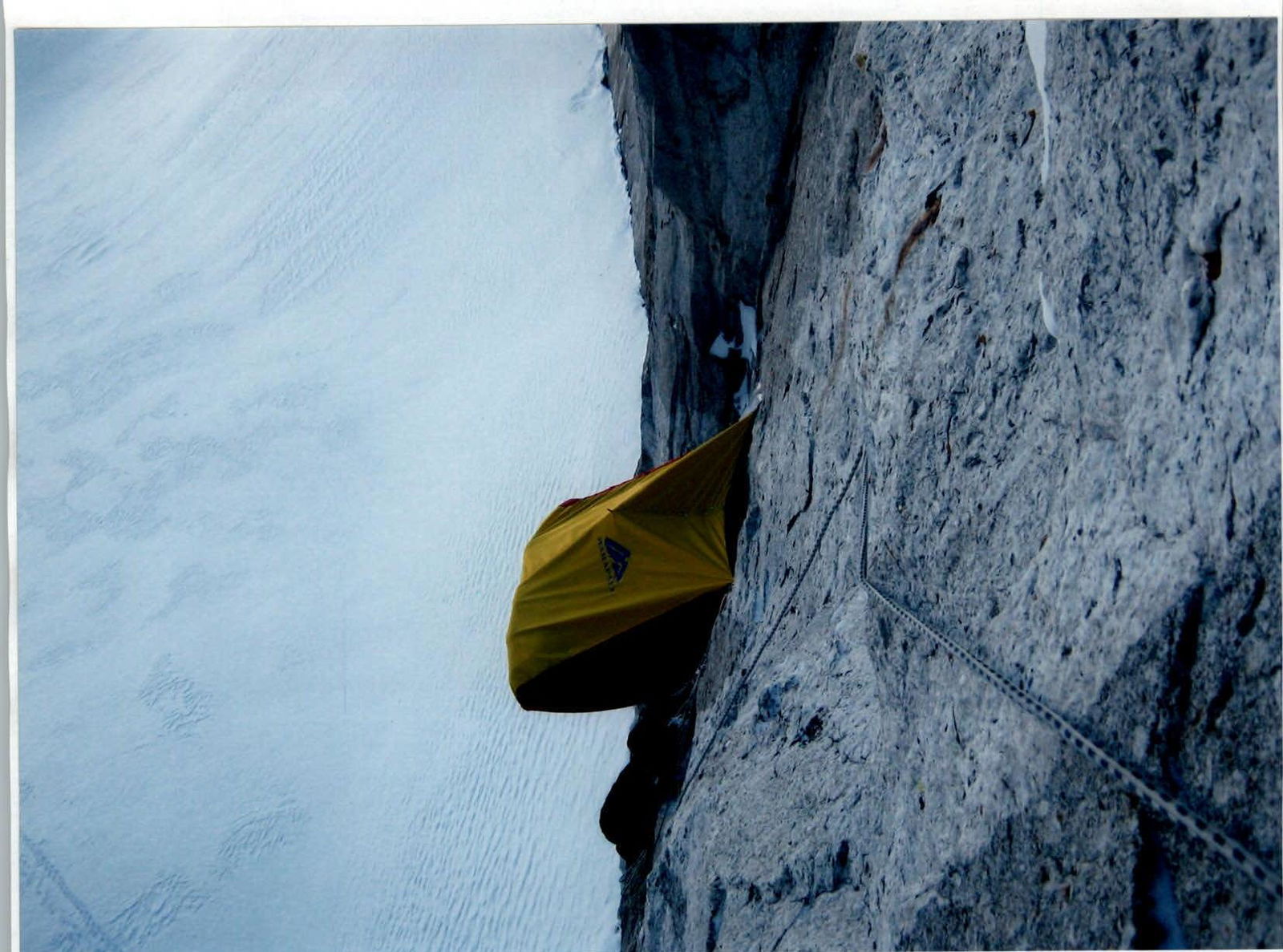
Photo 1. R1–R2. Bivouac № 1
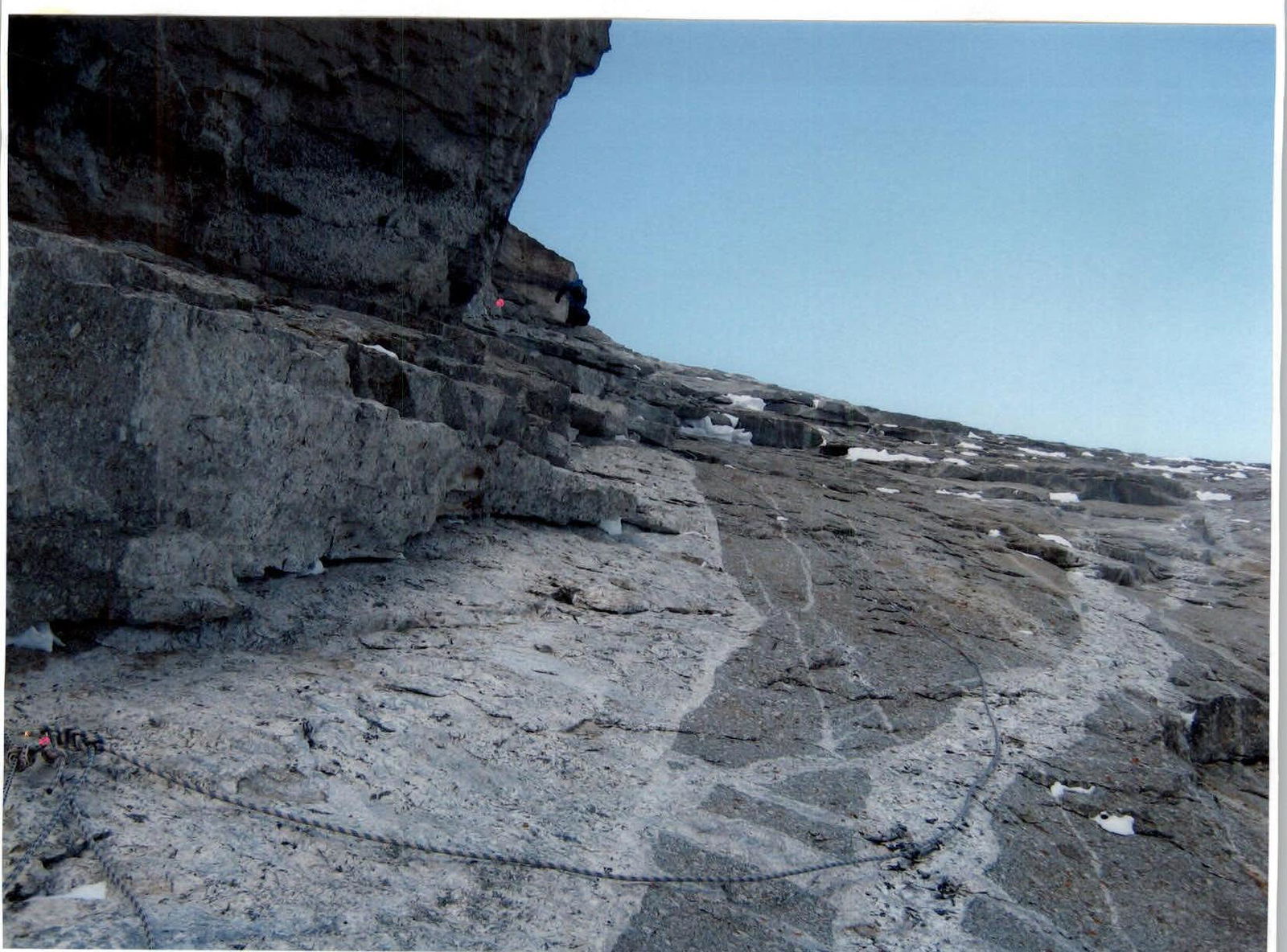
Photo 2. R3–R4. Railing
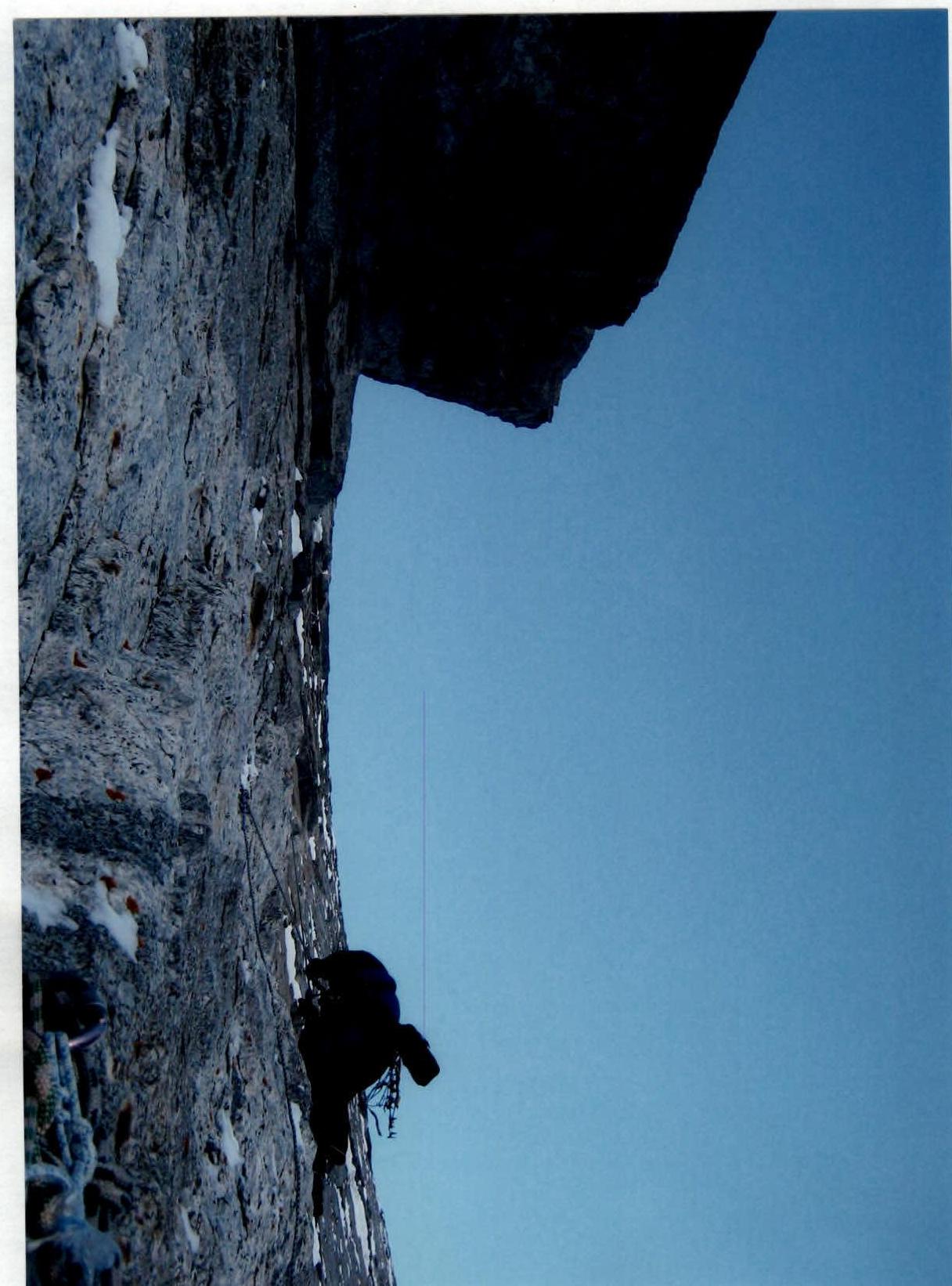
Photo 3. R4. Second's approach
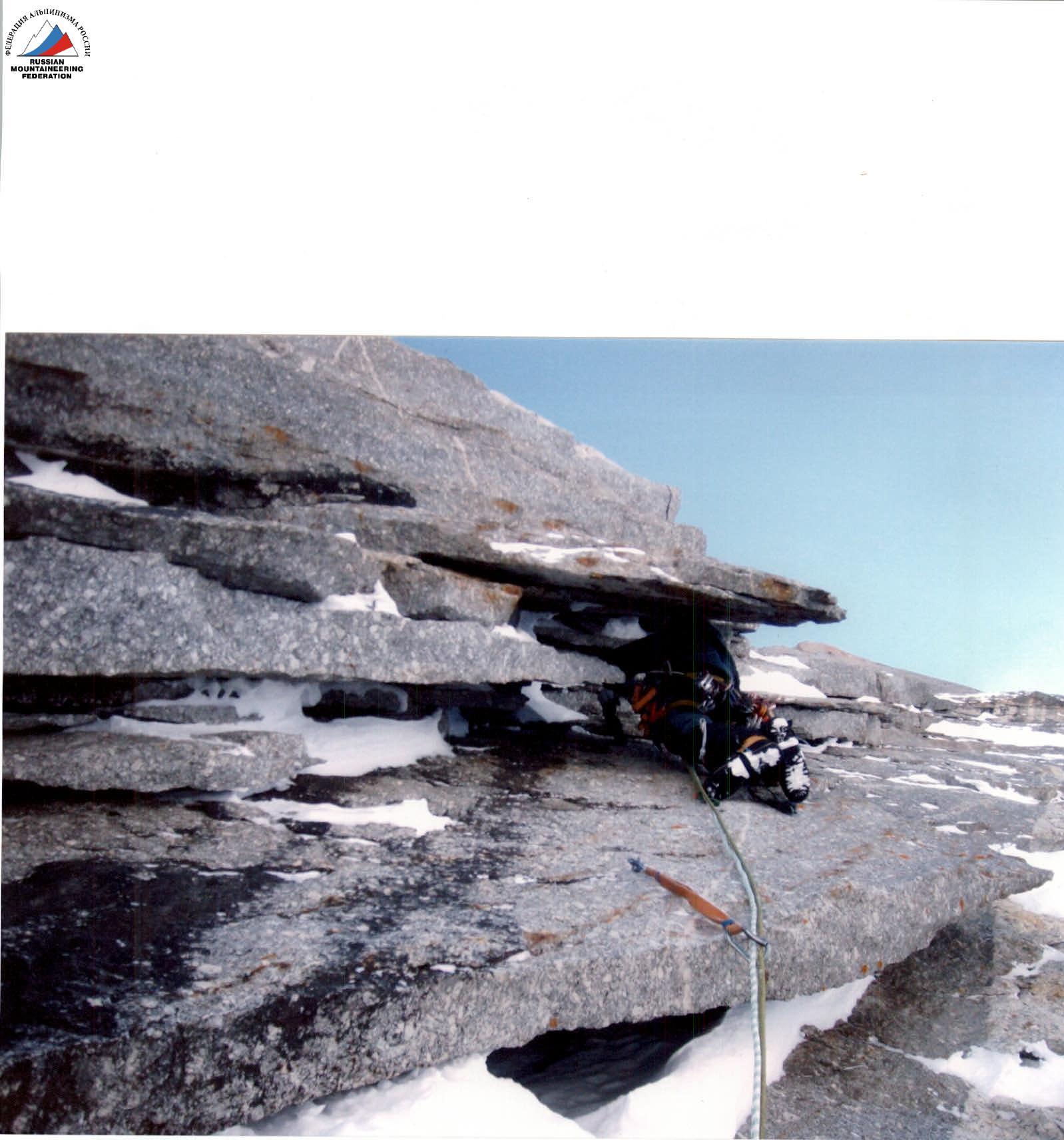
Photo 4. R6. First's work
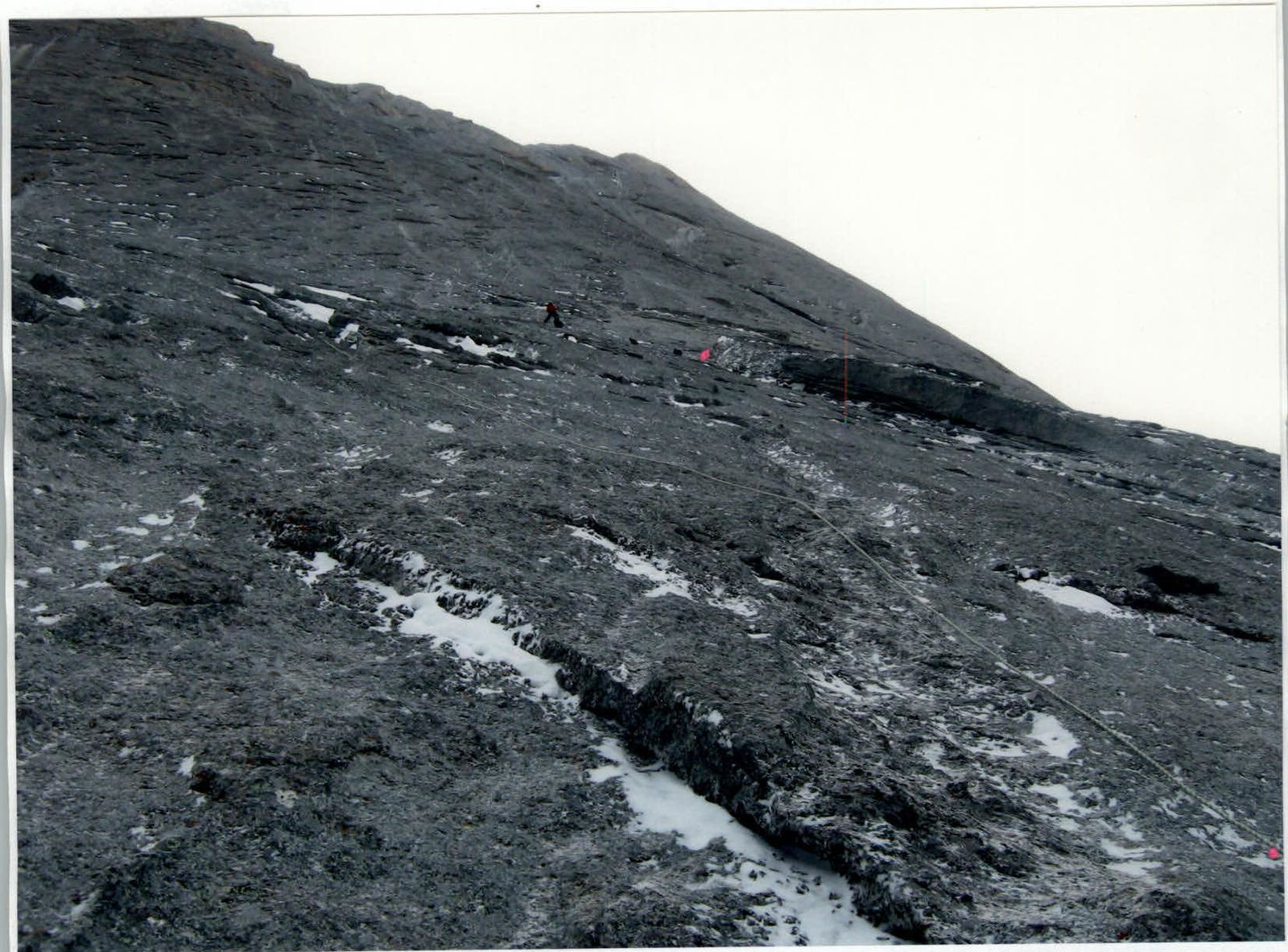
Photo 5. R10–R16. Relocation to "Glove" ledge
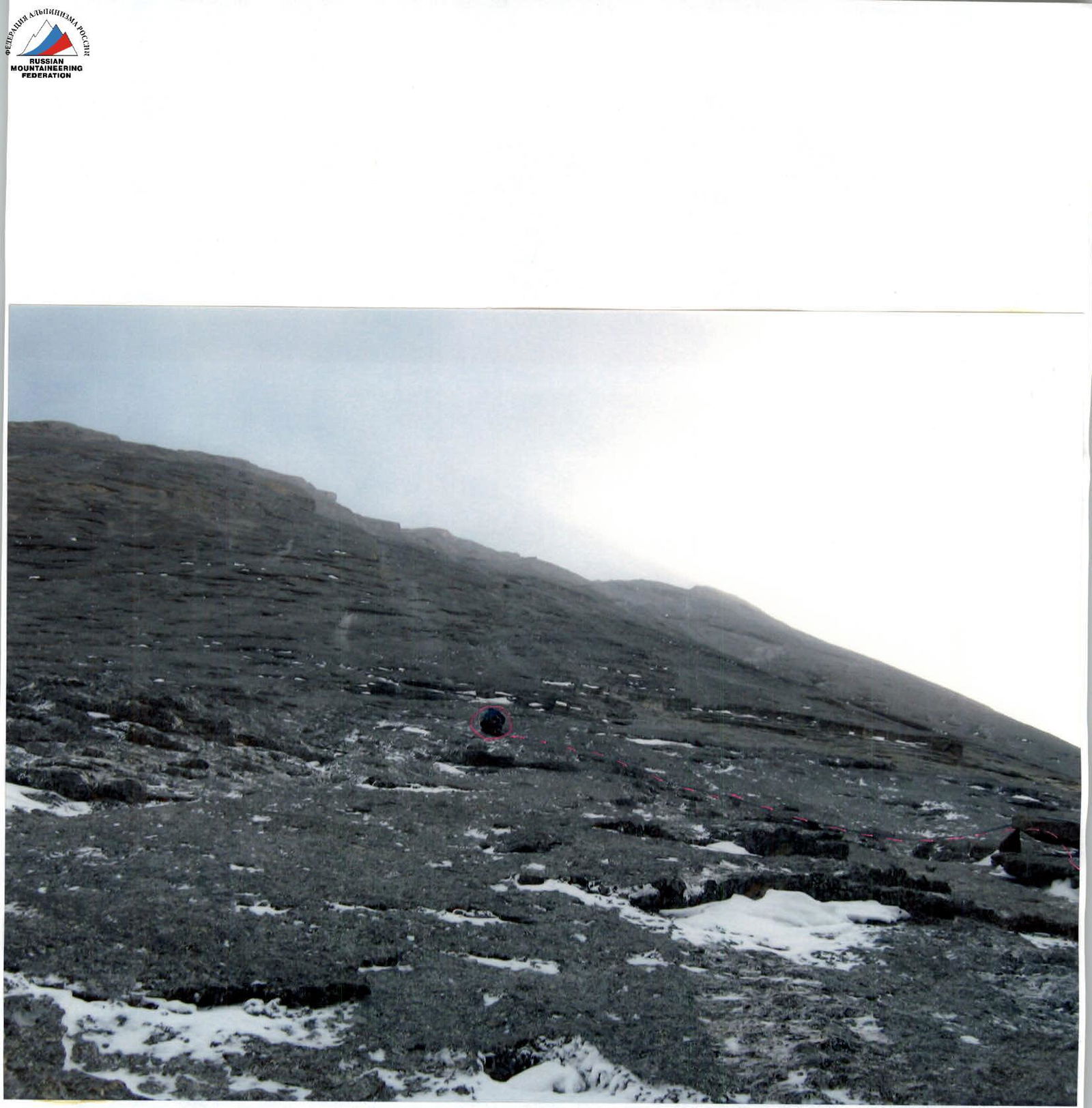
Photo 6. R16. First's work
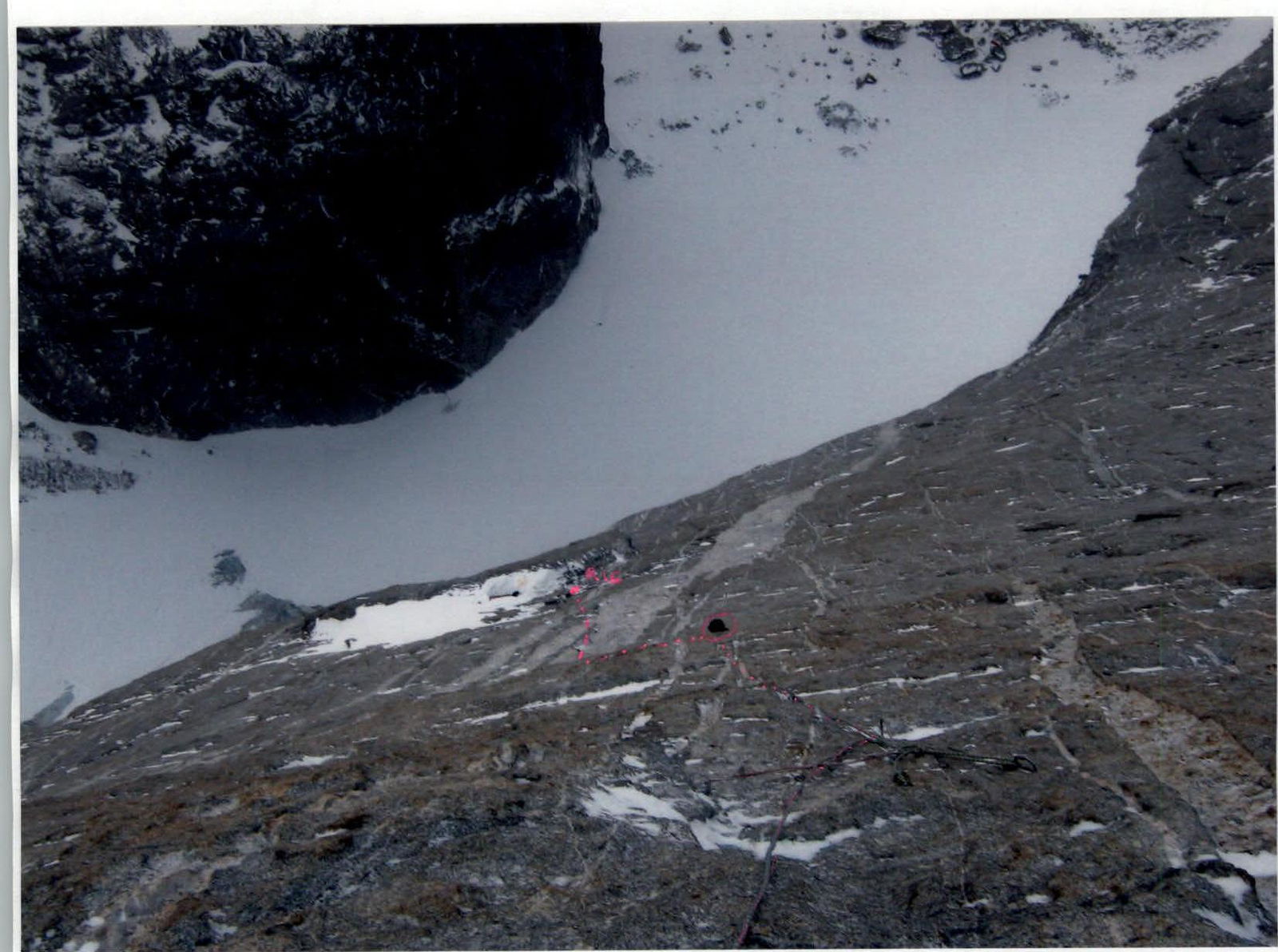
Photo 7. R16–R19. "Glove" ledge
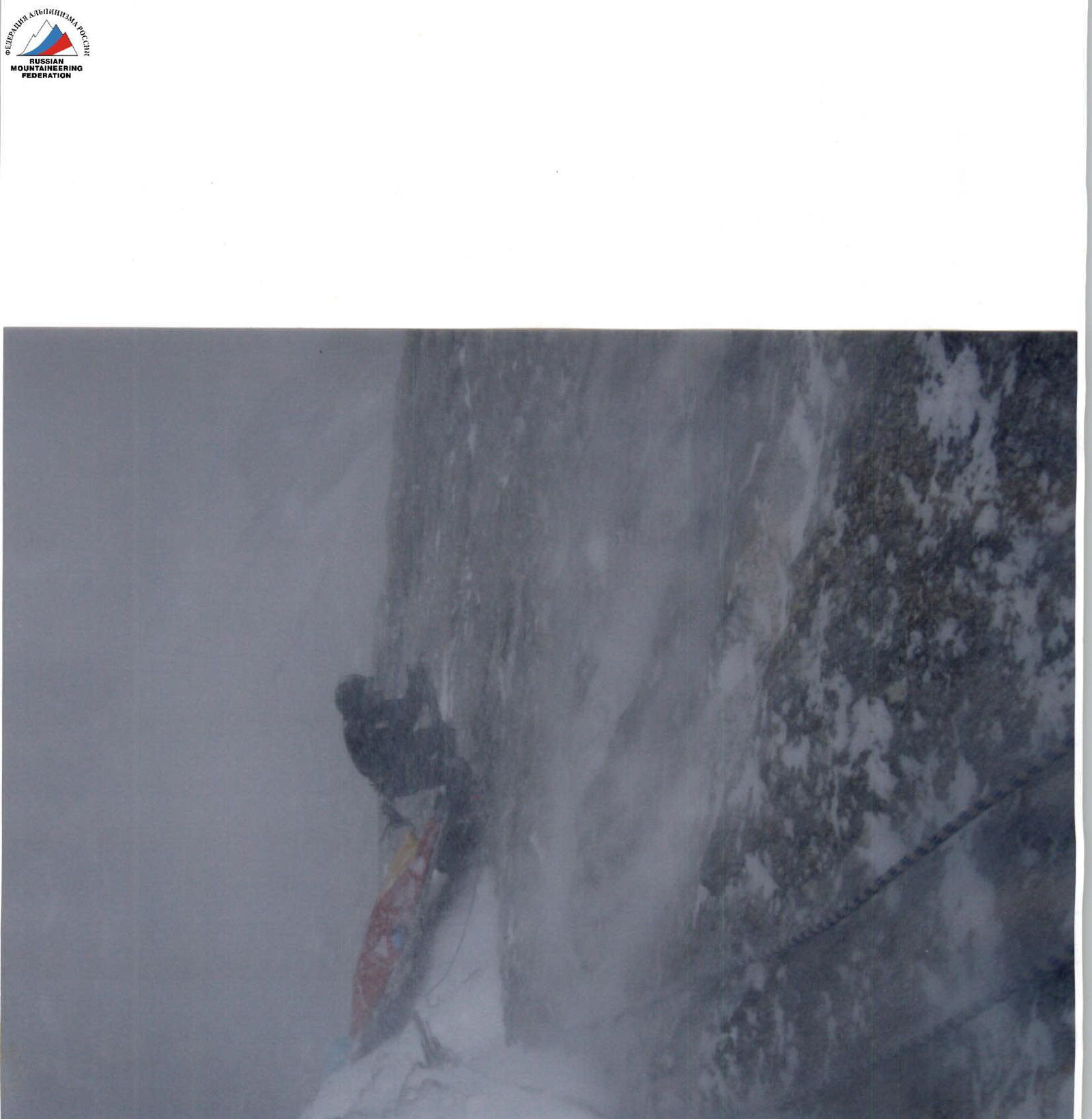
Photo 8. R21. "Breasts" ledge — relocation higher
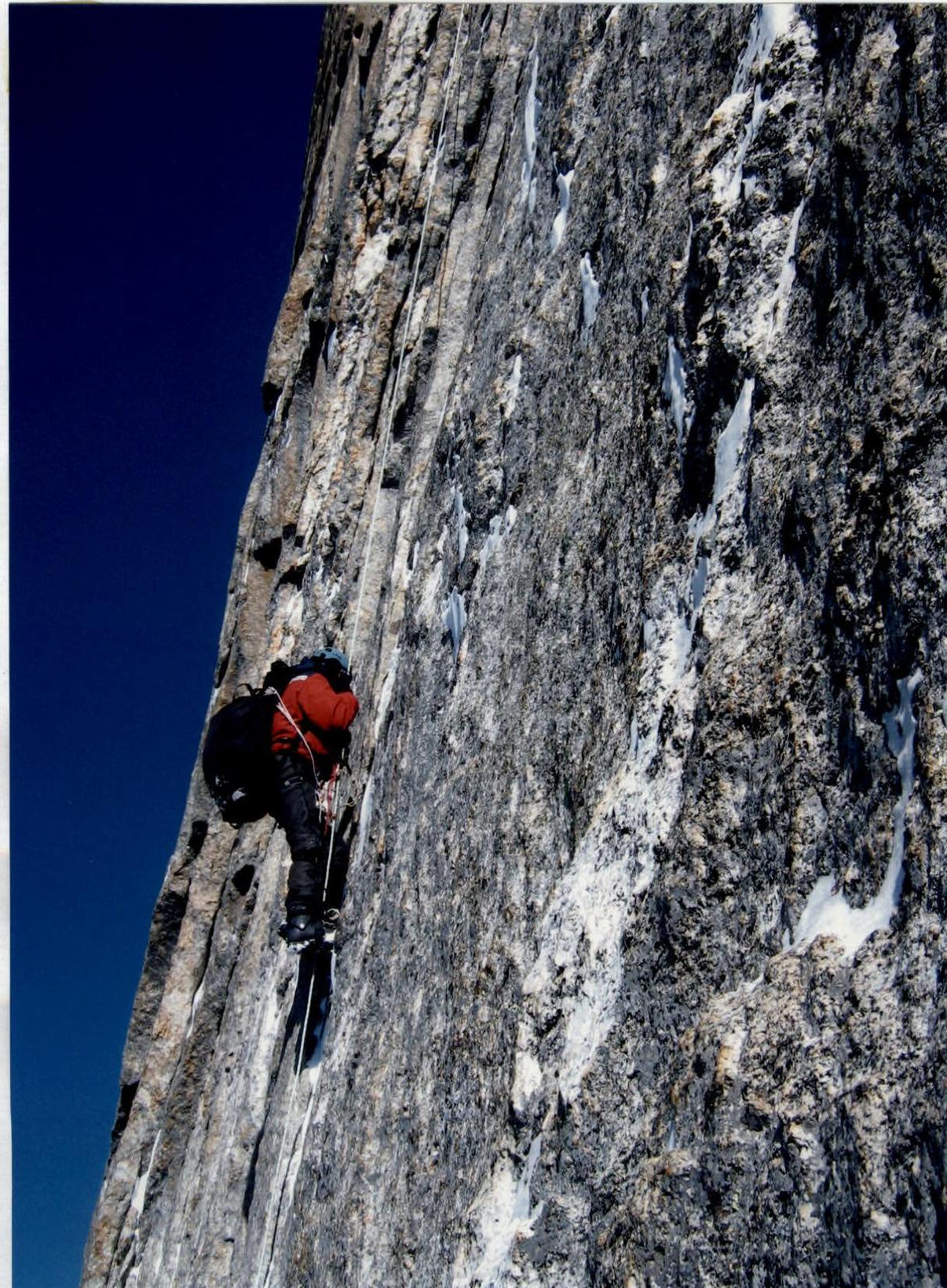
Photo 9. R22. Transporting pitch
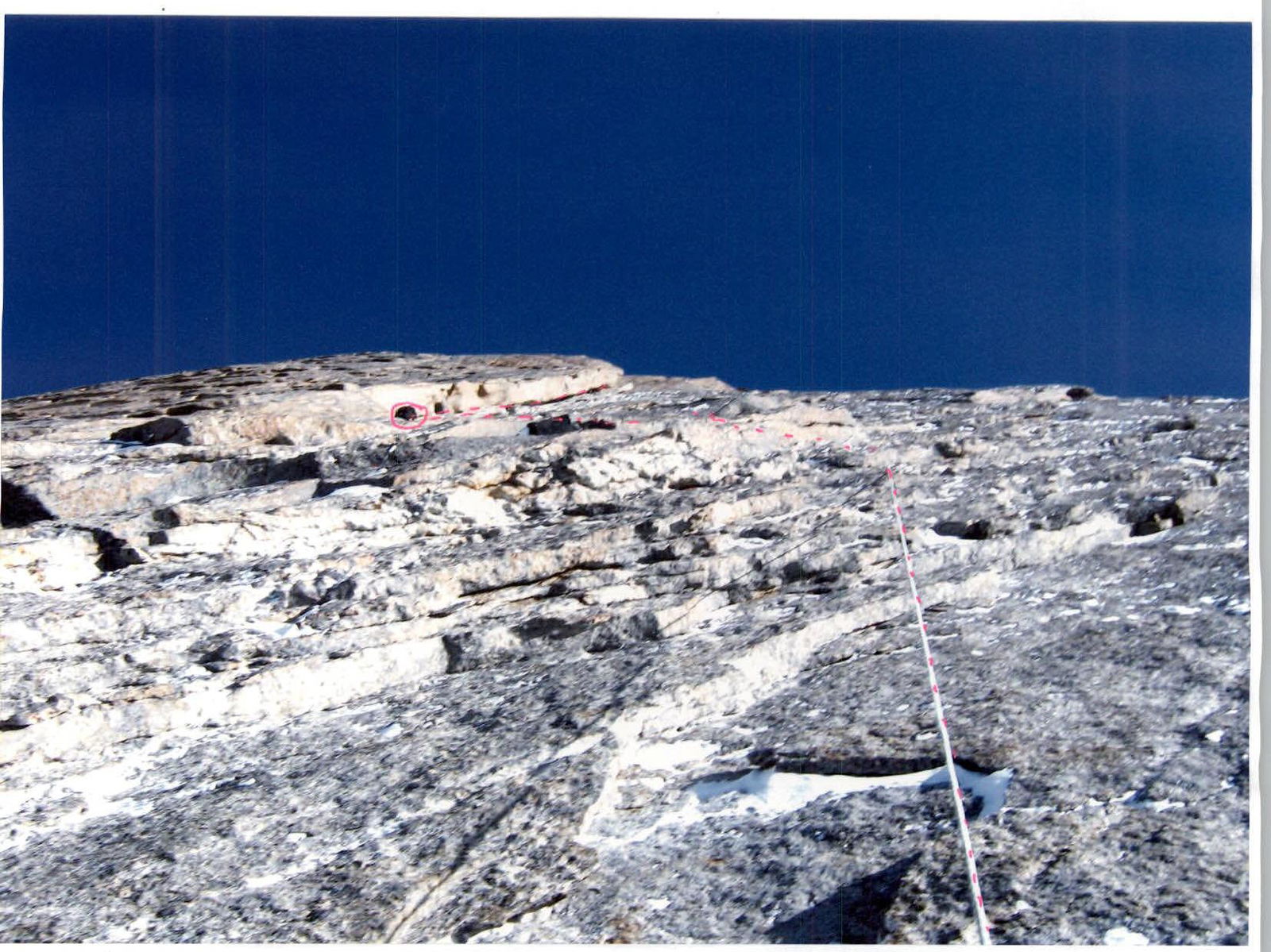
Photo 10. R23–R24. First's work
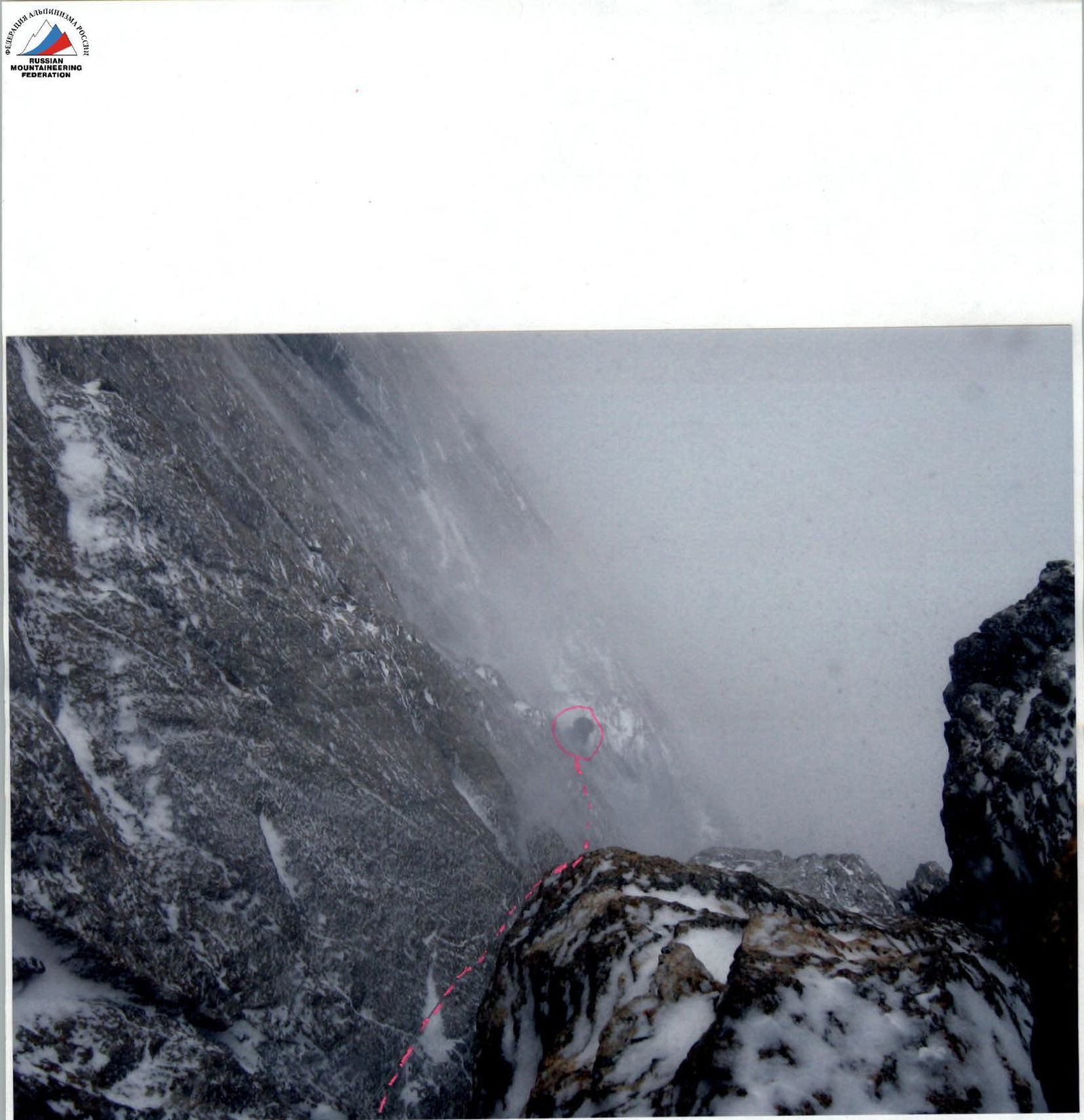
Photo 11. R26–R27. Railing. Shot from R27
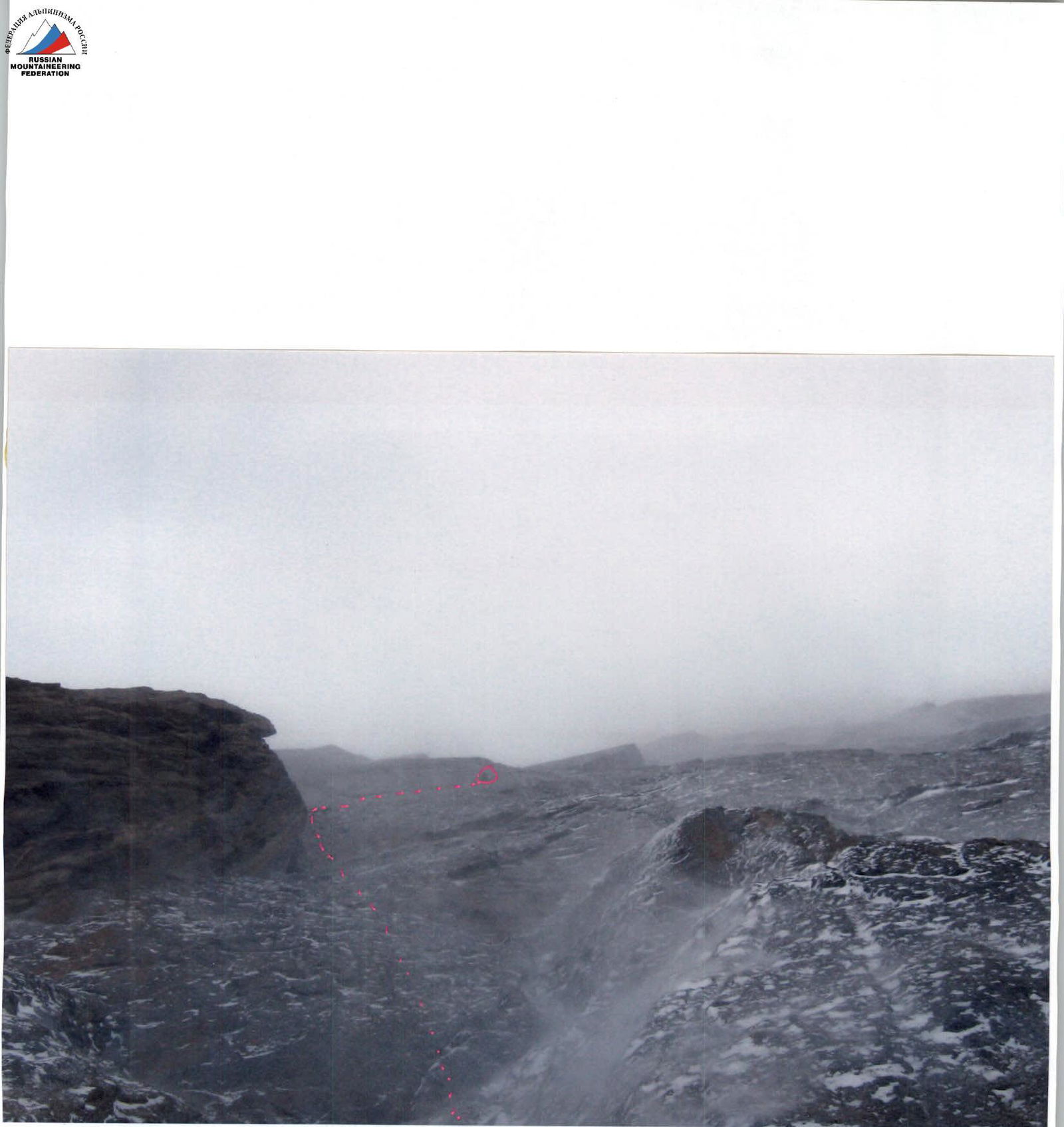
Photo 12. R26–R28. First's work
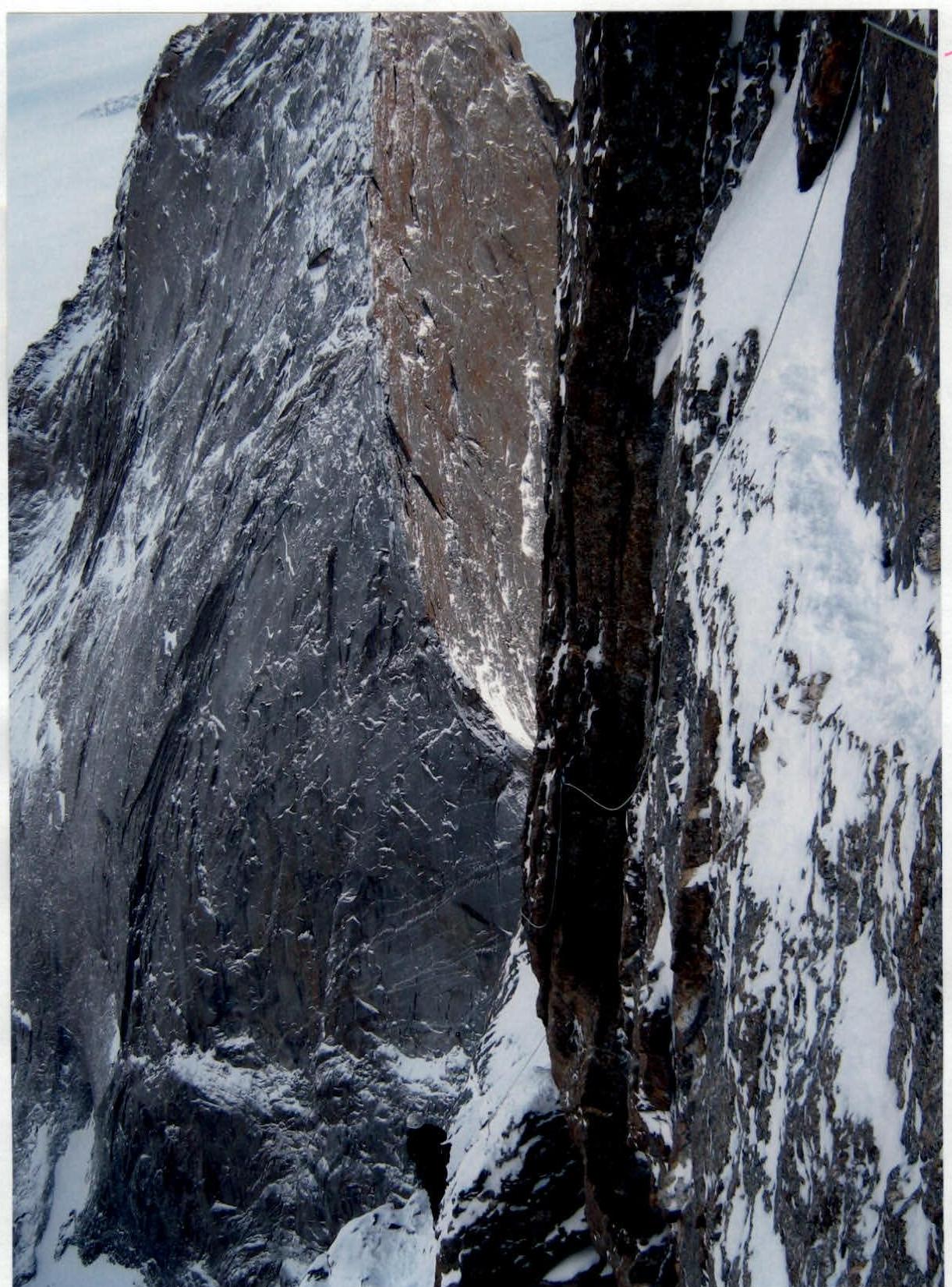
Photo 13. R28.
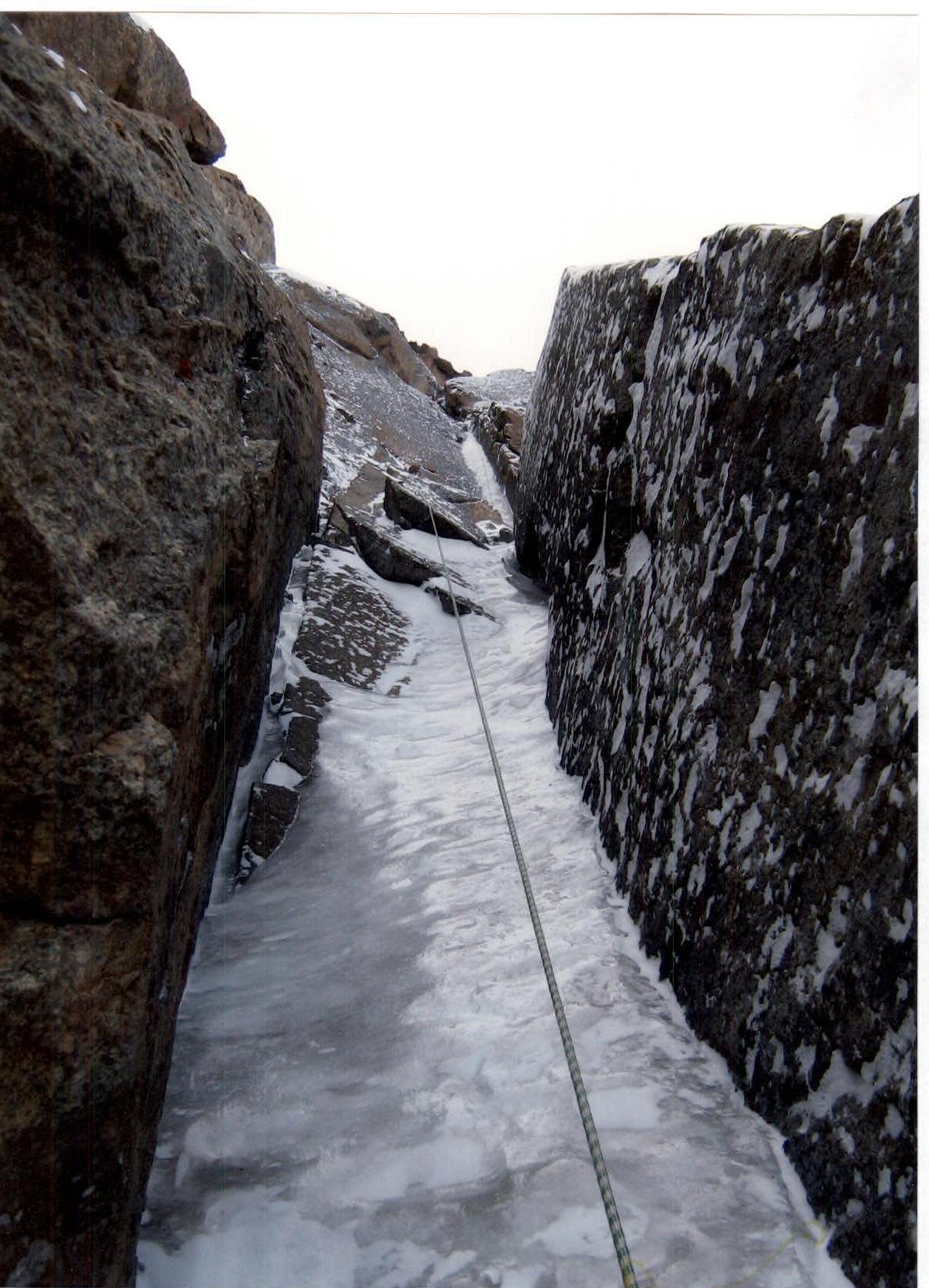
Photo 14. R32.