

Passport
- Climbing category: technical
- Climbing area: Pamir-Alay, Turkestan Range, Ak-Suu valley.
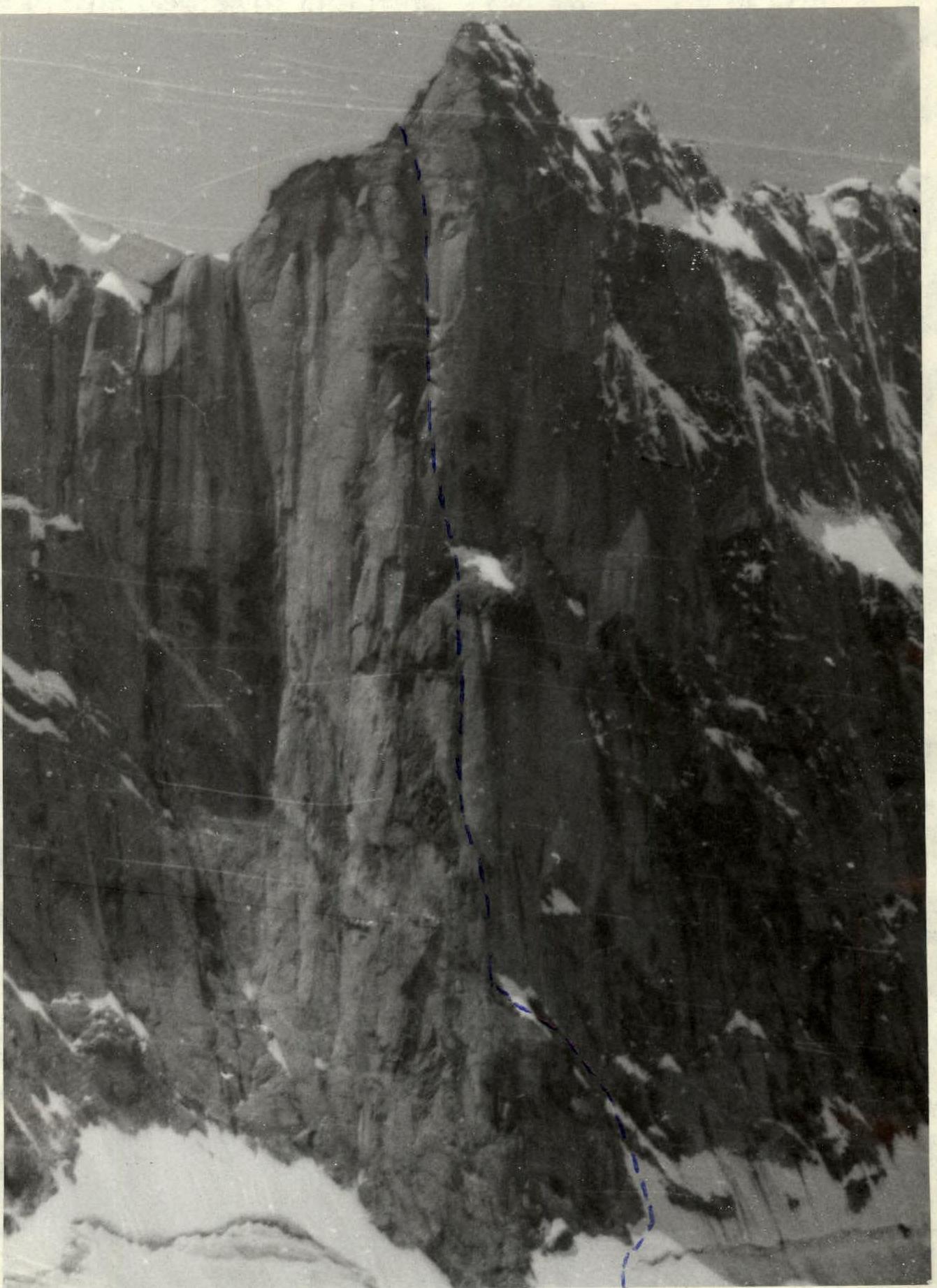
- Peak, route: peak Admiralteets 5090 m via "Bashkirov's Pillar" route, 6A category.
- Elevation gain:
- "Pillar" elevation gain – 740 m
- Main part of the "Pillar" elevation gain – 560 m
- Total route length – 2860 m
- "Pillar" length – 920 m
- Main part of the "Pillar" length – 675 m
- Length of 5th category section – 245 m
- 6th category section – 465 m
- Average slope of the route – 71°
- Average slope of the main part of the "Pillar" – 80°
- Pitons: rock 41/17, ice 10/0, chocks 298/71, bolted 29x/15x
- Total climbing time 46 hours / 5 days
- Overnight stops:
- 1 – semi-sitting, on a ledge
- 2 – semi-reclining, on a small ledge
- 3 – lying down, on a ledge
- 4 – lying down, on a ridge
- Team leader: Ravilov Raif Abdrakhmanovich – Candidate for Master of Sports
Team members:
- Korobkov Alexander Alexandrovich – 1st sports category
- Popovich Vadim Vitalievich – Candidate for Master of Sports
- Shkabora Boris Vadimovich – Candidate for Master of Sports
- Chernyavsky Alexander Nikolaevich – 1st sports category
- Coach: Ravilov Raif Abdrakhmanovich
- Departure to the route – August 9, 1995 Summit – August 13, 1995 Return – August 14, 1995
- Organization: TOO SPO "Promalp", Nizhny Tagil
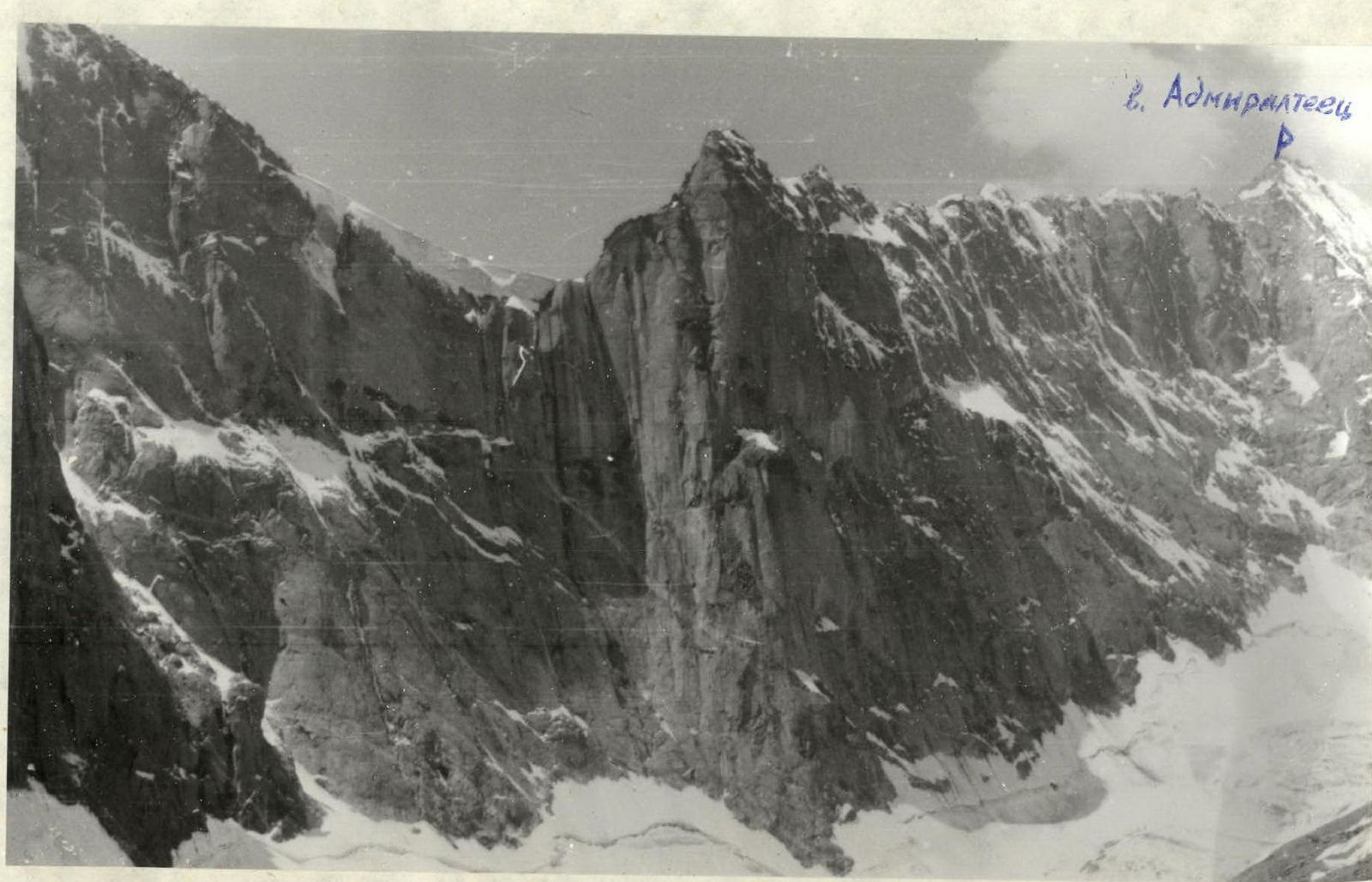
General photo of peak Admiralteets with the "Pillar".
Photograph of the "Pillar".
Technical actions of the team
August 9, 1995, 7:00 – departure from the camp at the moraine under peak Iskander. 9:00 – approach the bergschrund of the "Pillar" and the snow-ice couloir, belay via ice screws. The first rope team, Chernyavsky – Shkabara, works first. Chernyavsky goes first. Movement starts simultaneously, followed by the use of running belays. By 12:00 – reach the start of the rock section. The first rope team, Shkabara – Popovich, works first. Shkabara goes first. At 20:00 – stop for the night. Overnight stop is sitting.
August 10, 1995, 9:00 – continue on the route. The first rope team, Shkabara – Popovich, works first. Shkabara goes first. Climbing is difficult, frequent use of artificial aids. At 12:00 – first control point. By 17:00 – reach a sloping ledge with snow (4330 m), prepare a bivouac. The team Popovich – Shkabara processes the route. Popovich goes first. By 20:00 – return to the overnight stop.
August 11, 1995, 8:30 – continue on the route. The first rope team, Popovich – Shkabara, works first. Popovich goes first. Climbing is difficult, much use of artificial aids. By 18:00 – reach a sloping ledge, some snow, start setting up a bivouac (2nd control point, 4580 m). The team Popovich – Shkabara processes the route.
August 12, 1995, 9:00 – continue on the route. The first rope team, Popovich – Shkabara, works first. Popovich goes first. At 13:00 – reach the "pillar" to the third control point (4700 m). Descend down to the plateau (3 rappels of 100 m) to the base of the East Ridge. Move along the East Ridge to the South Ridge. Move to the saddle on the South Ridge via a large snow couloir and broken rocks. By 18:00 – reach the South Ridge, to the descent point into the Kara-Suu valley. Stop for the night.
August 13, 1995, 8:30 – depart from the overnight stop. Move along the South Ridge via heavily broken rocks towards the summit. Movement is alternating, sometimes simultaneous. The first rope team, Popovich – Korobkov, works first. Popovich goes first. At 14:00 – reach the summit of Admiralteets (5090 m), start descending. At 20:00 – descend into the Kara-Suu valley.
August 14, 1995 – return to the base camp in the Ak-Suu valley.
The route was completed through teamwork, with the lead climber going without a backpack. Teams worked on double ropes. During the wall ascent of the "pillar", an observation group was set up. At the base camp:
- a rescue team with the right to intervene on a 6th category section
- a doctor
Data by sections
Pitons by sections
| Section | Rock | Chocks | Bolted | Ice |
|---|---|---|---|---|
| R9–R10 | 5/3 | 8/1 | ||
| R8–R9 | 3/0 | 4/0 | ||
| R7–R8 | 10/10 | 30/30 | 8x/6x | |
| R6–R7 | 3/3 | 2/2 | ||
| R5–R6 | 3/0 | 5/0 | ||
| R4–R5 | 3/0 | 3/0 | ||
| R3–R4 | 2/0 | 3/0 | ||
| R2–R3 | 3/0 | 3/0 | ||
| R1–R2 | 2/0 | 6/0 | 2/0 | |
| R0–R1 | 8/0 |
Difficulty of sections (UIAA scheme)
| Category | Length, m | Angle, deg |
|---|---|---|
| VI A1 | 40 | 80 |
| V | 20 | 70 |
| VI A2 | 80 | 85 |
| VI A2 | 10 | 90 |
| IV | 30 | 70 |
| V | 20 | 80 |
| IV | 15 | 70 |
| V | 25 | 80 |
| IV | 120 | 45 |
| III | 120 | 45 |
Pitons by sections (continued)
| Section | Rock | Chocks | Bolted | Ice |
|---|---|---|---|---|
| R17–R18 | 1/0 | 13/10 | ||
| R16–R18 | 19/18 | |||
| R15–R16 | 15/18 | 1x/4x | ||
| R14–R15 | 16/12 | 1x/0 | ||
| R13–R14 | 1/0 | 8/0 | ||
| R12–R13 | 1/1 | 19/18 | 2x/1x | |
| R11–R12 | 2/0 | 20/18 | 2x/2x | |
| R10–R11 | 3/8 | 5/0 |
Difficulty of sections (UIAA scheme) (continued)
| Category | Length, m | Angle, deg |
|---|---|---|
| VI A2 | 30 | 75 |
| VI A2 | 35 | 85 |
| VI A2 | 30 | 90 |
| VI A2 | 40 | 75 |
| V | 40 | 75 |
| VI A2 | 40 | 85 |
| VI A2 | 40 | 85 |
| V | 40 | 65 |
Pitons by sections (continued)
| Section | Rock | Chocks | Bolted | Ice |
|---|---|---|---|---|
| R21–R22 | ||||
| R20–R21 | 0/0 | 9/0 | 1x/0 | |
| R19–R20 | 19/17 | 6x/1x | ||
| R18–R19 | 2/0 | 38/29 | 7x/0 | |
| R17–R18 | 1/0 | 13/10 |
Difficulty of sections (UIAA scheme) (continued)
| Category | Length, m | Angle, deg |
|---|---|---|
| V | 20 | 75 |
| VI A2 | 40 | 75 |
| VI A2 | 80 | 85 |
| VI A2 | 30 | 75 |
Pitons by sections (continued)
| Section | Rock | Chocks | Bolted | Ice |
|---|---|---|---|---|
| R30–R31 | 2/0 | |||
| R29–R30 | 2/0 | 9/0 | ||
| R28–R29 | 4/0 | 6/0 | ||
| R27–R28 | 9/0 | |||
| R26–R27 | 12/0 | |||
| R25–R26 | 15/10 | |||
| R24–R25 | 5/0 | |||
| R23–R24 | 12/0 | |||
| R22–R23 |
Difficulty of sections (UIAA scheme) (continued)
| Category | Length, m | Angle, deg |
|---|---|---|
| III | 80 | 45 |
| V | 40 | 70 |
| IV | 40 | 35 |
| IV | 80 | 60 |
| IV | 60 | 60 |
| V A1 | 40 | 75 |
| III | 40 | 30 |
| III | 120 | 45 |
| I | 200 | 0–40+ |
Description of the route by sections
R0–R1. The route begins from the bergschrund, which is crossed via a snow bridge to the left of the snow-ice couloir. Traverse right along the bergschrund and enter the snow-ice couloir. Then, ascend the couloir until it narrows. Movement is in teams, alternating. (120 m 45° III category) Belay via ice screws.
R1–R2. From the couloir, transition to a snow-ice shelf with rocky outcrops. Traverse left along the shelf, upwards towards the wall, to the end of the shelf, under the base of a wall with a cleft. Movement is in teams, alternating, belay via pitons and ice screws (120 m 45° IV category).
R2–R3. From the upper left corner of the shelf, the rock section of the route begins. Ascend the wall with a cleft straight up for 25 m to the start of a sloping ledge that goes left upwards. (25 m 80° V category).
R3–R4. Along the ledge for 15 m (15 m 70° IV category).
R4–R5. From the ledge, ascend 20 m straight up the wall with a smooth relief. Reach a red rocky patch (20 m 80° V category).
R5–R6. Ascend 20 m up simple rocks of the red patch and traverse 10 m right to a small grey wall with a narrow slit, leading to the base of an 80-meter internal angle (30 m 70° IV category).
R6–R7. The grey wall is climbed from left to right via an oblique crack (A2 – pitons, chocks), reaching a small ledge at the base of the angle. (10 m VI A2 90°) August 9, 1995 – overnight stop is sitting.
R7–R8. Ascend 80 m up the angle (VI A2 category, 80° – large chocks, friends, in the upper part – small chocks, pitons). Belay points are hanging – 8x bolted pitons. местами во внутреннем углу лёд. Reach the second red patch. (80 m, 85°, VI A2 category).
R8–R9. Ascend via broken rocks of the red patch left upwards to a ledge, which can serve as an overnight stop. First control point. (20 m, 70°, V category).
R9–R10. From the right edge of the ledge, ascend straight up – difficult climbing. Enter an internal angle closed by a grey overhang, under the overhang left, a bolted piton. Bypass the overhang left, then ascend right upwards via a non-obvious crack to a sloping ledge under a snow patch. (40 m 80° VI A1).
R10–R11. From the ledge, bypassing a small ledge on the right, ascend right upwards via broken rocks. Reach a large snow patch. August 10, 1995 – site of the second lying overnight stop. Along a sloping ledge with snow, to the base of the wall in the upper left corner of the patch, under the start of an internal angle. (40 m 60° V category).
R11–R12. Ascend straight up the internal angle, bypassing overhangs on the right (VI A2 category, 85°, 40 m, small chocks) to a small sloping ledge at the base of the next angle. On the ledge and angle, 2x bolted pitons. (40 m 85° VI A2).
R12–R13. Ascend the angle (VI A2 category, 85°, 40 m, chocks, pitons), leaving the overhang on the left. At the end of the angle, move left 3 m, reach a ledge that can serve as a semi-reclining overnight stop. (40 m 85° VI A2).
R13–R14. From the ledge, initially ascend left upwards, then right upwards via broken red rocks for 40 m, to a good ledge. (40 m 65° V category).
R14–R15. From the right edge of the ledge, ascend 8 m right upwards via an internal angle, then move left 4 m to a large concave internal angle with a cleft on its right wall. Ascend 25 m up the angle (VI A1 category, 75° – friends, hexes), towards yellow streaks on a band of overhangs, to the base of a small sloping ledge. (40 m 75° VI A1 category).
R15–R16. From the ledge, ascend left upwards through overhangs (VI A2 category, 90°, 4x bolted pitons, chocks, loose rocks). The upper overhang is bypassed on the left. Then, move right along a smoothed wall (1 bolted piton) to a small ledge at the base of a large internal angle with a grey rectangular overhang. (30 m 90° VI A2 category).
R16–R17. From the ledge, ascend 5 m up the right wall of the angle, difficult climbing. Move to the left wall with a cleft, ascend 30 m up (VI A2 category, 85° – friends, hexes, chocks) under the rectangular grey overhang. (35 m 85° VI A2 category).
R17–R18. Bypass the overhang on the left, ascend 30 m right upwards via the internal angle (VI A2 category, 75°). Reach a good ledge with snow. Second control point. August 11, 1995 – site of the third semi-reclining overnight stop. (30 m 75° VI A2 category).
R18–R19. From the right edge of the ledge, enter an internal chimney (80 m VI A2 category, 85°, 8x bolted pitons) through individual overhangs, to a small ledge under a yellow wall. (80 m 85° VI A2 category).
R19–R20. From the ledge, ascend 20 m left upwards via an oblique angle (VI A2 category, 75° – cleft is quartzified, damp, small chocks), to a sloping ledge, at the exit to the ledge 2x bolted pitons. Ascend left upwards to the next angle (20 m VI A2 category, 80°, 5x bolted pitons, damp) to a non-obvious ledge. (40 m 75° VI A2).
R20–R21. Ascend 20 m left upwards via a wall and angle to the top of the "pillar". Third control point. (20 m 75° V category).
R21–R22. Descend 90 m to a snow plateau (3 rappels) under the base of the East Ridge.
R22–R23. Traverse along the East Ridge via a snow plateau and moraine to the South Ridge. Reach the South Ridge, ascend via a snow couloir and broken rocks to a saddle on the South Ridge, to the descent point into the Kara-Suu valley. Site of the fourth lying overnight stop.
- 2000 m
- 1A category
- 0°–40°
R23–R24. From the saddle (from the overnight stop), ascend via a heavily broken rocky ridge (120 m 45° 3A category), movement is simultaneous, alternating, chocks, stoper – to the base of a gendarme. (120 m 45° 3A category).
R24–R25. Bypass the gendarme on the left side via a sloping rocky- scree ledge. Alternate belay (stoper). Movement is towards the base of an internal chimney on the gendarme, leading to the ridge. (40 m 30° III category).
R25–R26. Then, ascend via a wall to the chimney, ending in an overhang (plug). Ascend up the left wall of the chimney (20 m V A1). Move right 3 m, ascend via a crack under an overhang with an ice formation. Climbing is in stem. The overhang is overcome head-on, reach slabs. Equipment: friends, hexes, large chocks. (40 m 75° V A1 category).
R26–R27. Then, ascend via rocky slabs, sometimes heavily broken, to the ridge (60 m 60° IV category).
R27–R28. Then, ascend along the ridge and rocky slabs, towards a grey pre-summit tower wall with red streaks from water. Belay is simultaneous, alternating. (80 m 60° IV category).
R28–R29. Ascend 3 m up the wall with small holds (towards a couloir), reach a rocky sloping ledge under the grey wall with streaks. Traverse right along the ledge around the corner. (40 m 35° IV category, piton belay).
R29–R30. Then, ascend via wall-slab formations to the base of a snow couloir with heavily broken rocks, leading to the summit. Careful climbing, pitons, chocks. (40 m 70° V category).
R30–R31. Ascend 80 m up the couloir with snow and outcrops of simple rocks to the summit. (80 m 45° III category).
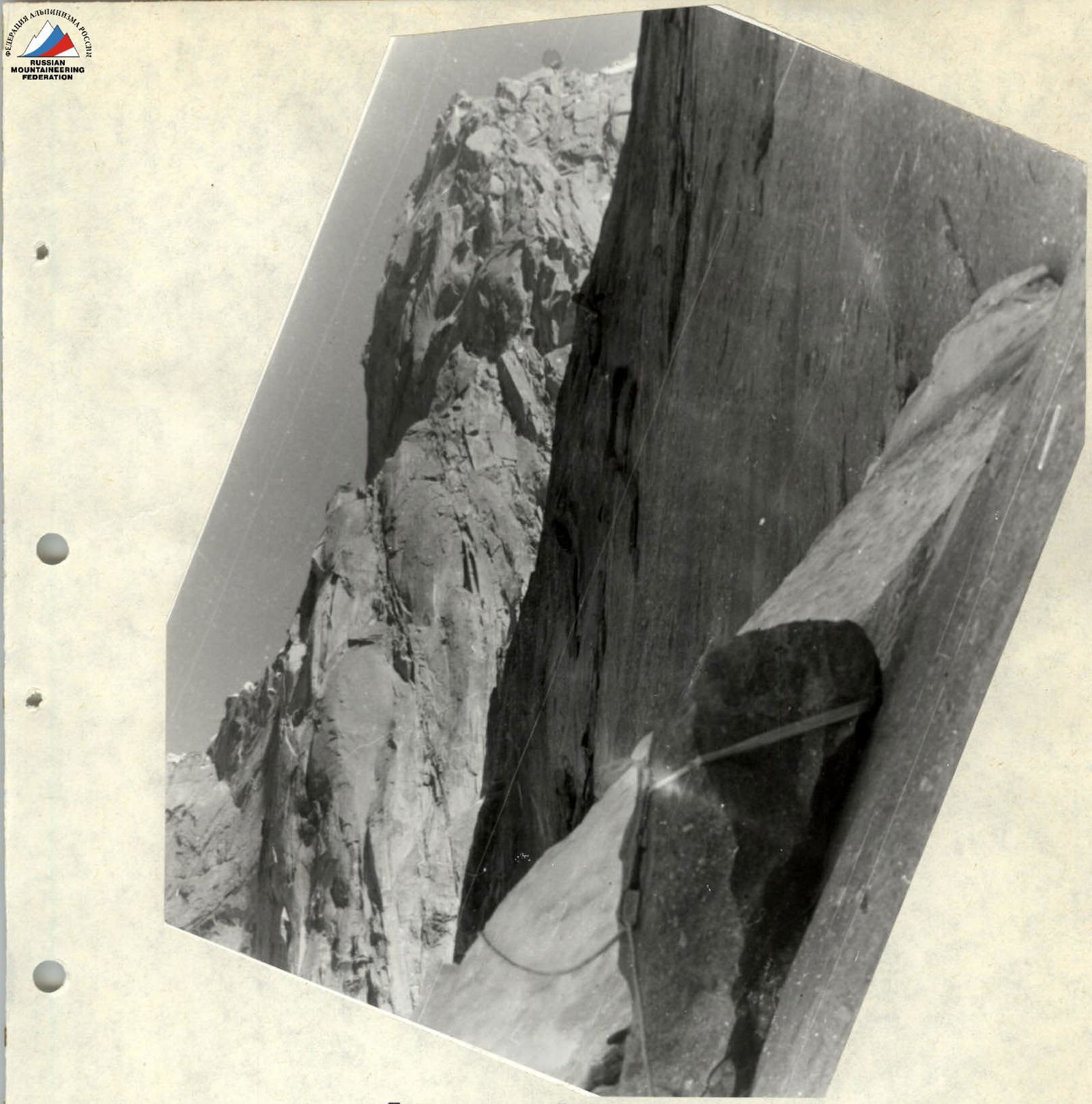
Technical photograph. Section R2–R3.
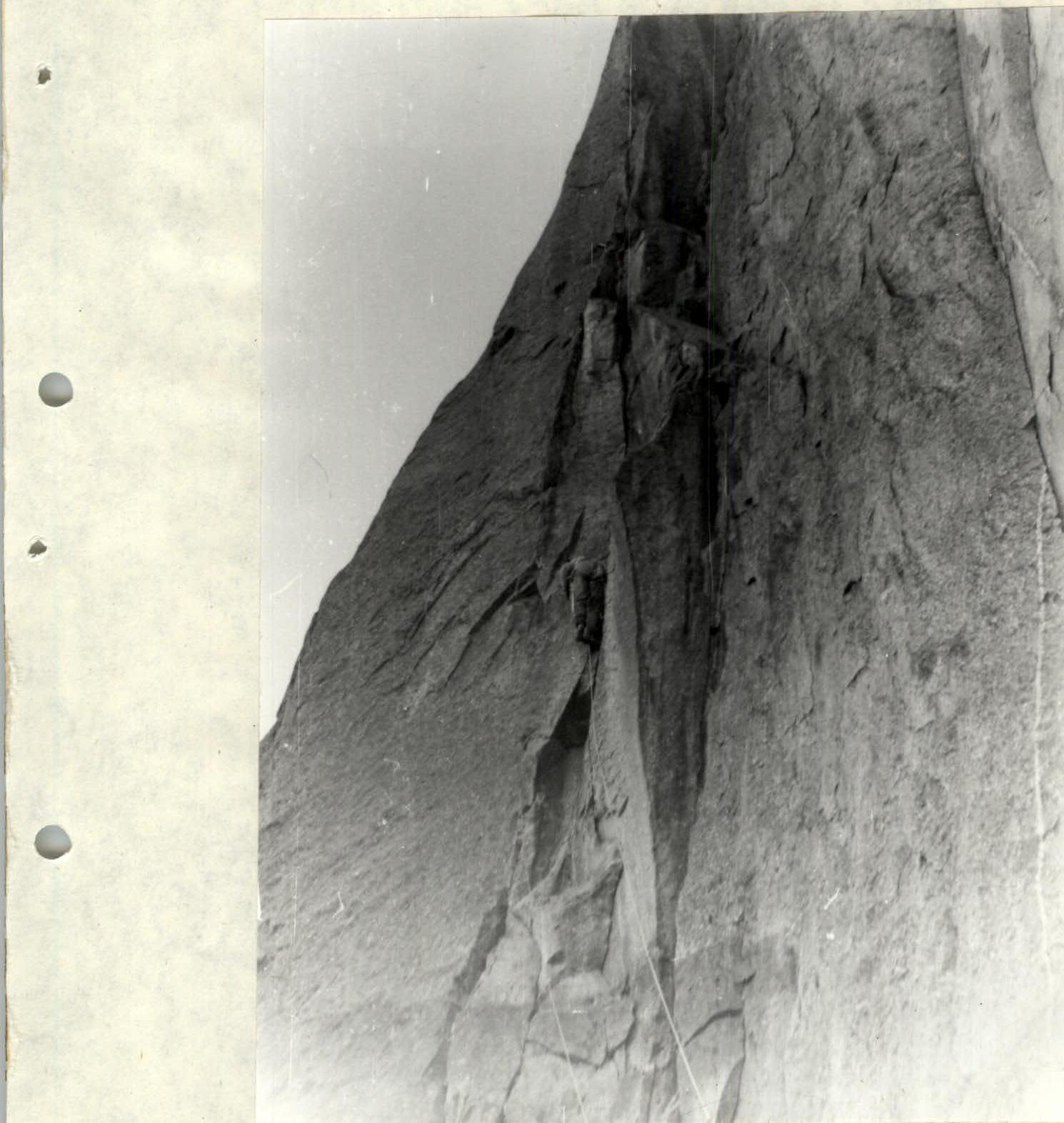
Technical photograph. Section R2–R12.