

Ascent Logbook
Climbing Pass Details
I. Climbing category — technical 2. Climbing area — Gissar Ridge 3. Climbing route
First ascent via the shortest path on the NW wall of the I Western peak of Zamin Karor (Yaghnob wall) — 4303 m.
- Climbing characteristics:
height difference 1350 m, average steepness 87.5°, length of complex sections 1000 m.
- Pitons used:
rock 302 pcs., ice none, bolted 29 pcs.
- Total climbing hours — 78 h.
- Number of nights — 6 on the route, all in hammocks and sitting, and one on the summit lying down.
- Team
The ascent was made by a team of instructors from the Varzob alpine camp under the Central Council of the Tajikistan Sports Society.
- Participants
Kapitanov Oleg Viktorovich, CMS, team leader Lavrukhin Vyacheslav Ivanovich, CMS, deputy leader Yaroslavtsev Vladimir Fedorovich, CMS, participant Gusev Viktor Sergeevich, CMS, participant Bezverkhov Sergey Nikolaevich, CMS, participant
- Team coach
Sogrin Sergey Nikolaevich, Master of Sports of the USSR
Ascent Chronicle
July 26, 1974
Today we sleep in till 9:00. We decided to rest, having completed a rather tiring journey from the alpine camp to the base camp under the wall yesterday. Our "father" and observer, Anatoly Konstantinovich Dadonov, welcomed us warmly. After feeding us a magnificent borscht yesterday, he put the team to bed and started preparing supplies for the next day.
Following our tactics, today we are to process the wall section up to the intended first night's halt on a slanting ledge to the left of the giant flake, resembling a "petal". Initially, the Kapitanov — Lavrukhin pair is to work, and at 16:00, they will be replaced by Yaroslavtsev — Bezverkhov. We plan to work until 21:00.
Weather:
- overcast;
- grey sky;
- no wind;
- a huge front on the horizon.
At 10:00, the first pair sets out to process the wall. The wall appears to be close, but it takes about an hour to reach it due to traversing scree and a 30-degree snowfield with an anchor at the wall.
The beginning is quite straightforward (sections R1, R2, R3), 50 m along firm rocks of medium difficulty to an internal corner. The corner is 90° steep, but there are many handholds. Oleg works first, progressing fairly accurately and quickly, though it's clear he's nervous. Yes, this is just the start of a long and challenging journey.
From a ledge above the internal corner, the team moves to a second internal corner via rocks of medium difficulty and, traversing it diagonally, reaches the base of a 20-meter chimney with a plug. The chimney is damp and widens downwards. At 13:00, the sky opens up, and a light drizzle starts. After consulting, the pair decides to climb the chimney and wait out the rain on a ledge above it, hoping the rain will be short-lived, as is typical in these areas. However, the weather worsens significantly. A proper downpour ensues. The wall turns black from water seepage. Oleg and Slava reach a small ledge, cover themselves with ponchos, and wait out the storm.
14:00. Lightning flashes between the ridges. No hope for improvement. The pair, instead of processing, descends. They're unhappy, not because they got soaked to the bone, but because they didn't make much progress, effectively losing the day. It doesn't take long for their gloom to lift. They have an evening of joke-telling.
Before bed, we have a brief meeting. We decide that tomorrow, the Yaroslavtsev — Bezverkhov pair will process the wall. At 17:00, the entire team is to be under the wall with their rucksacks.
July 27, 1974. Day Two
At 6:00, Yaroslavtsev and Bezverkhov set out to process the wall. The sky is overcast but not gloomy. A gentle breeze blows. The wall is drying — all's well. Today is going to be hard work. Ahead lies a 40-meter overhanging internal corner, followed by a smooth grey wall about 50–60 meters long. The corner is wet. The team reaches the processed sections by 9:00 and starts tackling the internal corner at 9:30. Hands are freezing, and the climbing is extreme and desperate. Volodya leads, working calmly and confidently in his abilities and technique. They use:
- pitons;
- ladders;
- wooden wedges.
Progress is slow — very challenging.
13:00. Yaroslavtsev completes the internal corner (section R7). The weather worsens again. The same ominous, dirty-black clouds from yesterday appear. "What's going on here, anyway? This is sunny Tajikistan, after all!" the team complains, eyeing the wall uneasily.
Meanwhile, an orange dot is making slow, agonizing progress using petal-shaped holds, bolted pitons, and a ledge.
Volodya tackles the grey "mirror" (section R8) — an 85-degree wall. They couldn't complete it entirely.
15:00, as scheduled, the skies open, thunder booms, and a downpour ensues, occasionally turning to sleet.
17:00. The "storming" pair returns, wet and gaunt. In the evening, during another planning session, they decide to set out on the route tomorrow. Kapitanov and Lavrukhin will depart early in the morning. The rest will follow at 11:00–11:30, after drying their gear. The first pair carries only personal items. The Gusev, Yaroslavtsev, Bezverkhov trio takes everything else. They will maintain radio contact on the hour. They plan to reach the chimney with the plug with their rucksacks to save time. They'll use an ice axe to set up belays.
Radio contact with observers:
- 8:00 am;
- 8:00 pm.
Emergency contact:
- 2:00 pm;
- 6:00 pm.
Light signal at 10:00 pm to confirm the time. At 20:00, they receive a message from Kapitanov: Oleg has become a father! Congratulations!
July 28, 1974. Day Three
At 7:00, Anatoly Konstantinovich Dadonov rouses the team with a loud, rich voice: "Rise, knights of the wall! The sky above you is blue!" Wonderful words! The team quickly pops out of their tents, disbelieving their eyes. Not a cloud in the sky — just a vast blue expanse. Morale is high. They pack quickly.
At 8:00, they see off the first pair. Kapitanov — the new father — and Lavrukhin, with light rucksacks, reach the ledge under the overhanging internal corner by 10:00. They leave their rucksacks and continue upwards.
From 10:30 to 13:00, Kapitanov slowly makes his way to the slanting ledge using ladders and various pitons. To save time, Oleg decides to pendulum across to a crack below the ledge and climb up it. He chooses 8 m of rope, descends vertically, and begins to move right. Twice he's pulled back to the vertical, but on the third attempt, he manages to secure himself in the crack and reaches the ledge by 13:00. He pulls Slava up. They quickly set up a belay station to receive rucksacks. Meanwhile, Yaroslavtsev, Gusev, and Bezverkhov climb the fixed ropes to the lower ledge. Leaving Bezverkhov on this ledge, Volodya and Viktor climb higher to the ledge. It's about 2–3 m wide, with a 45° slope. To make the night more comfortable, they'll have to do a lot of work.
From 14:00 to 16:00, Sergey packs the rucksacks — five in total. He's prepared everything for hauling and urges them on via radio. They decided to haul the rucksacks as a group initially due to the many overhangs on the route.
From 16:00 to 17:00, they haul the rucksacks in fours.
They establish a rhythm. Everything goes smoothly and quickly. They manage in 45 minutes. The strike team, Volodya Yaroslavtsev and Oleg Kapitanov, is tasked with further processing.
They face a challenging task — processing the complex internal corner of the flake, or "petal". The corner is wet and starts with a 6-meter overhanging ledge, from which water pours. They don't envy the pair. Meanwhile, they start setting up camp. There's a lot of work to be done.
Sergey climbs up from below. The weather unexpectedly worsens:
- wind brings clouds;
- light rain.
Volodya gets soaked processing the overhang and has to descend. Oleg takes Lavrukhin as a partner, and they quickly climb the fixed rope.
The climbing is very challenging, cold, and wet. They process the entire "petal", with an average steepness of 95°. The difficulty is extreme (section R10). At 20:30, the exhausted and wet pair descends.
During the radio check, observers advise dressing more brightly. They have a simple meal. They worked hard, and the night's accommodation is semi-reclined. It's better than nothing!
It's raining. They really aren't having much luck with the weather. Where's that hot Tajik sun?
July 29, 1974. Day Four
They wake up to the hum of a turbine aircraft — an air corridor passes overhead. With thanks to this unusual alarm clock, they begin to pack up. The aroma of roasted meat wafts through the air. It rained lightly during the night.
From 9:00 to 12:00, the strike pair climbs the fixed ropes, retrieving the ropes and necessary gear. Ascending a sloping ledge leftwards and upwards, Oleg (leading today) and Volodya:
- set up a rucksack reception station;
- process the next section of the route.
The weather isn't kind. It's overcast, and rain is imminent. They're fairly calm, having grown accustomed to it.
They carry an 8-liter water tank, but thanks to the rain, water is always available. If it weren't for the rain, it would be very tough. So, there's some benefit to the constant grey sky.
Lavrukhin works below. Viktor and Sergey haul the rucksacks. Hauling with two is harder, but if they're not in a hurry, using jammers and a block-and-tackle system, it works out fairly well.
Oleg tackles a 60-meter internal corner (section R12) and receives Volodya.
This pair is strong. The rocks are like an intriguing book to them. They seem to find no challenge insurmountable; they always climb calmly, confidently, and with a significant reserve of strength. Watching them work is a pleasure, and sometimes they feel a twinge of envy.
Volodya leads next. A 30-meter wall with a 90° slope. There are handholds, but they're far apart. However, this doesn't bother Volodya — he's tall. He climbs the wall in an arc, first right, then left to a small ledge. Oleg follows, removing some pitons and straightening the rope. Yaroslavtsev sets up a rucksack reception station, hammering in a bolted piton for a block. He radios that everything's ready, and they're heading higher (section R14).
The rocks are somewhat fragile — perhaps the only such section on the entire route. Oleg leads, proceeding very cautiously. He hammers in pitons sparingly, seemingly having nowhere to place them, or perhaps not wanting to "cut the branch he's standing on". Finally, after 20 m, the captain enters an internal corner between the flake and the main wall. The climbing is challenging due to the corner sometimes turning into deep crevices.
From 15:30 to 18:00, the remaining trio below hauls the rucksacks. Lavrukhin works below. They rotate on each rope:
- whoever worked below goes on the haul;
- one from the hauling pair stays below.
They haul the rucksacks 90 m. It's somewhat tiring, but the saved time more than justifies it. At 18:00, they hear a voice. They turn on the radio. The team reports that everything's ready. They're heading under a stepped overhang to set up camp (section R16).
Lavrukhin climbs up. They leave him with the rucksacks to rest.
Viktor and Sergey climb to the ledge on top of the flake.
Kapitanov and Yaroslavtsev descend to the same ledge via simple rocks.
19:00. After hauling the rucksacks and shouldering them, they climb to the night's halt. There are no ledges, but there's everything needed for hammocks. They quickly hammer in the necessary pitons, set up hammocks while there's still light.
Meanwhile, Oleg fetches Slava's rucksack and hangs it on the fixed ropes. Sergey starts "cooking" under the ledge on a primus stove, while they hang all five hammocks.
Slava arrives, immediately inquiring about water. "Not plenty, but there's some" — they reply. Fortunately, the weather is overcast; in sunny conditions, there wouldn't be water on this night's halt.
During the radio check, they confirm their location and time. They receive a weather forecast — overcast, possible thunderstorms.
Towards evening, there was an "Afghani wind". The air was filled with dust (despite the high humidity!). Even Slava Lavrukhin, who has lived in Tajikistan for a long time, doesn't recall anything like it. Pressure is dropping.
What will the coming day bring?
July 30, 1974. Day Five
From 7:00 to 8:30, they rise. It rained heavily during the night. They contact the observers. The team is very sympathetic. Over breakfast, they have a brief plan. Their goal is to reach the base of the rock funnel leading to the snowfield.
Yaroslavtsev and Kapitanov lead.
In case of bad weather, they gather together. Sergey works below. Slava and Gusev are on the haul.
8:45 — Volodya and Oleg start processing. They pack up the tent. The first tent is left on the lower night's halt. There are many pitons on this night's halt.
Volodya climbs an 80-meter wall that ends in a huge red crack with a chimney in the middle. He climbs elegantly — free solo. The wall's steepness is 85° (section R17). They imagine how much time they would have spent on this section using artificial aids. It's great when the team has climbers with high individual technique. Volodya and Oleg have been climbing together for a while, competing in events, and it's no surprise they work in sync, quickly, and without unnecessary words.
11:15. Something happens. Volodya freezes on the rock and shouts to Oleg: "Secure yourself! Earthquake!" Kapitanov, 45 m below, didn't feel the tremors as he was belaying his partner from a sitting position. The trio on the lower ledge, feeling strong tremors, becomes agitated. They shout. Oleg radios and calms them down: "All's well. Be careful of falling rocks!" Observers call on the radio — very frightened. Well, these things happen. There weren't any strong rockfalls — just small ones.
After this:
- the captain orders a rope check.
- The ropes are intact.
- They calm down and get back to work.
- They haul the rucksacks.
From 13:30 to 14:30.
Oleg decides to tackle the crack via the chimney but descends after 10 minutes. He says there's too much "live" rock — not worth the risk. He goes around instead. He reaches the crack and climbs up its central slab (section R18). After 20 m, he stops on a ledge under a sheer 60-meter wall. He sets up a belay station. Volodya joins him via the fixed ropes, removing pitons. Then he throws the rope directly to the wall. The fixed ropes become vertical. Oleg radios that he's at the snowfield and congratulates them on the sunshine. It's been a while since they've seen the sun!
From 17:00 to 18:00, they haul the rucksacks and dry off. Sergey is on his way. The weather is superb. The upper part of the route looms above them. They can see a logical path from the base of the rock funnel to the wall under the "book".
Using the remaining daylight, Kapitanov sends the Gusev — Bezverkhov pair to process a 50-meter snow slope with a 45° angle. They create a trail leading left and upwards to the base of a system of cracks, crevices, and chimneys, then descend to camp. Each sleeps on their personal ledge.
July 31, 1974. Day Six
They follow their established routine, rising at 7:00, well-rested and cheerful. Everyone is preoccupied with the serious work ahead. The Kapitanov — Lavrukhin pair leads, climbing the fixed ropes on the snow slope and starting to process the wall. The beginning is moderately difficult — 10 m up the wall at about 80°, followed by a small (about 10 m) traverse left along a sloping ledge to an overhanging cornice, which they face head-on. It's complex and emotional. After 10 m of cornice (about 120° steep), Oleg reaches a narrow ledge (section R22), from which the route continues up a sheer wall with a crevice. 8 m up, then 20 m along rocks of moderate difficulty at about 80°, leading to the base of a rock outcrop. The exit to the outcrop is via a 3-meter hanging crevice on the right (section R25).
Again, they face a hanging section — an internal corner about 95° steep, 10 m of which lead to the base of an 8-meter expanding chimney. The climbing is challenging, with frequent use of artificial aids and wooden wedges. Avoiding the hanging section on the right via a sloping ledge (about 6 m), Oleg climbs another 25 m along a wall about 85° steep to the base of a large, expanding chimney. The rope runs out; they descend, yielding to the second shift — the Yaroslavtsev — Bezverkhov pair.
At 15:00, Volodya and Sergey, having overcome the processed section, start further processing. Meanwhile, 100 m or more below, the remaining team members repair gear and watch their colleagues' work with concern. Volodya tackles a chimney with a large plug, using very challenging climbing techniques, and covers 20 m (section R28); the overhang is up to 110°, and the rocks are fragile, making it even more difficult.
Next, they encounter a sloping ledge, 3 m with an average steepness of 120°. Using complex climbing techniques and sometimes entering the chimney, Volodya covers 60 m, overcoming an overhang in the upper part of the chimney and reaching a ledge (section R29).
It's already time for dinner, and the rope is running out. Volodya finishes his work and descends to join Sergey and the others, who treat them to exquisite dishes — space rations. They spend the night on the previous camp.
August 1, 1974. Day Seven
They rise at 7:00, as before. Today, they plan to reach the "balcony" — a ledge above the system of cracks, crevices, and chimneys, partially processed the previous day. By 14:00, the group completes the processed section and hauls the rucksacks. Oleg leads further processing, released by Slava. Following the general direction upwards through the system of crevices and chimneys, after 3 hours of psychologically and technically tense work, Oleg covers 90 m of wall with an average slope of about 100° and reaches a small ledge, where he is joined by Slava (section R30). Above the ledge is a large 20-meter overhanging cornice, which is bypassed on the left. Using a rope provided by Slava, Oleg traverses left and upwards for 5 m, then another 5 m left along slabs to the base of an internal corner about 90° steep. Climbing the corner upwards and leftwards, they exit onto a slab about 85° steep. After 15 m on the slab, Oleg reaches the "balcony", where he's greeted by a pleasant surprise — a beautiful, almost horizontal ledge with snow (section R32). At 19:30, the entire group gathers on the "balcony". Everything contributes to a good mood, even the weather, which seems to have calmed down. However, one thing remains — a large, monolithic wall above the balcony, without cracks or handholds, and no visible paths around it. The team had been expecting this encounter and is now ready to get acquainted with it up close.
August 2, 1974. Day Eight
They wake up early, but Kapitanov decides to give the team a rest before the serious challenge ahead. At 7:30, they rise. The team is subdued, everyone is busy, but the subdued phrases and silent gazes at the wall indicate that everyone's on edge, wondering what's around the bend. The Yaroslavtsev — Gusev pair leads the processing. They decide to start by traversing left for 5 m, then climbing 10 m upwards. Quickly overcoming this section, Volodya approaches a smooth internal corner that veers sharply right.
Carefully hammering in pitons, Volodya climbs another 10 m and reaches the start of the main wall. The average steepness of the wall is about 95°; there are almost no handholds, but a thin, intermittent crack clearly indicates the path forward. Very slowly, using all available technical means, Volodya advances (section R33). Following the planned schedule, Volodya stops working at 15:30 and descends to the ledge. Kapitanov takes over, belayed by Sergey Bezverkhov. Again, meter by meter, they conquer the challenging sections. The left side of the large internal corner of the "book" is now visible, veering left and upwards; they're just meters away, but Kapitanov stops — time is a strict judge. In 11 working hours, they've covered 85 m. They go to sleep with hope for tomorrow. Tomorrow is the decisive day.
August 3, 1974. Day Nine
They rise early. Today, they're to reach the summit — a decision made the previous day after weighing the pros and cons. The sky is overcast, with blue clearings visible among the grey-black clouds nearby, but they vanish quickly. The team's mood is businesslike. Faces are serious and preoccupied — no joking. They have a brief introductory meeting. Kapitanov speaks clearly and decisively:
- "Work without hesitation";
- "Don't lose a minute";
- "Use the radio effectively";
- "Be extremely attentive";
- "If necessary, we'll wait out the bad weather together on any suitable ledge".
Gusev works below; Yaroslavtsev leads first. After breakfast, Volodya and Oleg climb up via the fixed ropes. The first follows a free rope using a Prusik knot; chest; and self-locking device; the second follows a rope clipped into carabiners. The loaded rope pulls Yaroslavtsev away from the wall about 3 m, but they're not surprised by such "tricks". Everyone has been in similar situations before.
They pack up camp, gather rucksacks, remove spare gear hung the previous evening, and pack it into the respective rucksacks.
Oleg shouts from above: "You can load the fixed ropes!"
Sergey goes to remove pitons. He glances at his watch frequently — he's anxious. The weather "whispers" unpleasant news. Time passes quickly, but the first climber advances slowly. The climbing is extremely challenging, using artificial aids. Volodya enters a giant internal corner. The rocks are covered in a thin layer of lichen and overhang.
13:30. Oleg radios: "If we can haul the rucksacks by three o'clock, we'll be on the summit today. The ledge is ready. We're processing the internal corner".
14:20. They start hauling the rucksacks. A light drizzle begins. The team works very quickly — their signals are heard frequently — "pull the sling".
15:05. The rucksacks are at the top. Gusev starts climbing to the upper ledge at the base of the internal corner. The entrance to the internal corner is exceptionally challenging — rocking overhang with slippery rocks covered in black lichen. The ledge where they set up the rucksack reception station is narrow and small. Rucksacks hang on the fixed ropes. It's hard to believe Volodya managed this section using pitons. He bypassed the cornice on the right and traversed left and upwards to the ledge. It's a challenging climb (section R34).
Two fairly smooth walls form this interesting section, dubbed the "book". The average steepness of this 120-meter "book" is about 85°. At the junction of the two planes is a shallow chimney with "unpleasant" walls — damp, dirty, and black from lichen, making them slippery. Volodya climbs it in classical style. The climbing is challenging due to the internal angle of the "book" being approximately 120°. It's tough to wedge oneself in.
16:20. Four are at the top — Oleg, Volodya, Viktor, and Slava. It continues to drizzle. They radio that they'll haul the rucksacks in fours to save time.
They throw the rope far to the side, so there's no danger from falling rocks.
17:00. Rucksacks hang on the fixed ropes. Oleg climbs higher. The rocks are wet and "slippery"; the climbing is very cautious and challenging. Another 30 m, and they can "close the book". The captain climbs right and upwards along steep rocks resembling "ram's foreheads" for 10 m and shouts: "I can see the summit! We're right next to it!"
Morale instantly shifts: faces beam, eyes sparkle — Victory is within reach! Oleg receives Volodya and pulls him higher. An hour later, they hear a signal; they turn on the radio. Volodya reports: "Climb up — everything's ready! We're heading higher".
20:00. They finish hauling the rucksacks. Slava climbs from below. They hear hammering. The ledge is good but very cold.
Before them, like on a screen, is the Yaroslavtsev — Kapitanov pair on the black, cold pre-summit wall. Oleg leads. The climbing is very challenging. The grim appearance of the wall, the approaching darkness, the difficulty of the section, and the intense tension of the working pair instill a chill of anxiety in the trio watching from below.
They cover 30 m. 10 m remain. It's cold.
The captain warms his hands in the most improbable poses.
They cover another 3 m. Oleg turns to them with a tired face and says calmly: "That's it, guys. The road is clear" — and smiles.
He quickly covers the remaining 7 m along a narrow crevice and reaches the summit. 21:00. They secure the fixed ropes and climb up. Gusev remains below. Viktor is eager to reach the summit; two rucksacks are already attached to the upper ledge's fixed ropes. They hurry. It gets dark quickly. The last rucksack arrives, and they hear Viktor's hammering. 15 minutes later, he's on the summit. Victory! There's a cairn nearby.
August 4, 1974. Day Ten
7:30. They rise. The weather is bad. Sleet falls. Strong wind. A thunderstorm approaches. They have breakfast, pack up, and descend along the ridge in pairs and triples.
9:30. Everyone is in thick fog. The thunderstorm is nearby. Wild wind and sleet. A real blizzard. The thunder makes their ears ache. They descend from the ridge and decide to wait it out. In wet sweaters and down jackets, they're unpleasantly zapped by each lightning discharge.
10:30. The front slowly moves towards the Anzob Pass. The wall is unrecognizable. Fresh snow blinds them. Where they previously walked, they now descend on ropes. Slowly but safely.
12:30. They're on the grass. They snack quickly and head down. 15:30. They're greeted by friends, who lift them onto their shoulders, laughing. VICTORY!!!
Table of Basic Climbing Route Characteristics
Climbing route:
- first ascent via the shortest path on the NW wall of the I Western peak of Zaamin Karor.
Analysis of the table of basic characteristics and the profile scheme of the route reveals that the route is distinguished by its significant length and overall steepness, close to vertical.
The average steepness of the route, determined graphically and through observation, is 87°. More precise measurements require special instruments, as the wall's concavity makes it impossible to take profile snapshots and measurements during the ascent. The steepness of certain sections was verified using indirect methods. For example, all rucksack hauls above the snowfield occurred without touching the wall; a rock dropped from section R29 landed on the outer edge of the snowfield.
Notably, there's significant convexity (overhanging) in the upper part of the route above the snowfield. However, the relief on sections R21–R32 is characterized by a system of crevices, chimneys, and internal corners, allowing a significant portion of the overhanging sections to be traversed using free climbing within the depths of the chimneys or by utilizing the varying orientations of the chimney and corner planes, employing more gradual faces for passage with subsequent ascent to the summit on another strongly overhanging plane.
This section, despite some technical simplicity, has a strong psychological impact.
Higher up, despite the lesser steepness of the wall (section R33), the difficulty of the route reaches its highest technical and psychological tension due to the absence of any clearly defined relief features.
The total route length from the anchor point is 1410 m, with a vertical height difference of approximately 1350 m. This relatively small difference is achieved by choosing the route to the summit via the shortest vertical path.
Throughout its length, the route is saturated with challenging sections, constituting about 1000 m (difficulty 5th and 6th categories).
The route was completed in 78 hours. A total of 330 pitons were hammered for belaying and progression. On average, a piton was hammered every 4 m.
The average time taken by the entire group to traverse a section from one piton to the next (4 m) is 14 minutes.
These objective data and the team's assessment of the route, compared to previously climbed routes, allow for the classification of this route as the highest 6B category of difficulty.
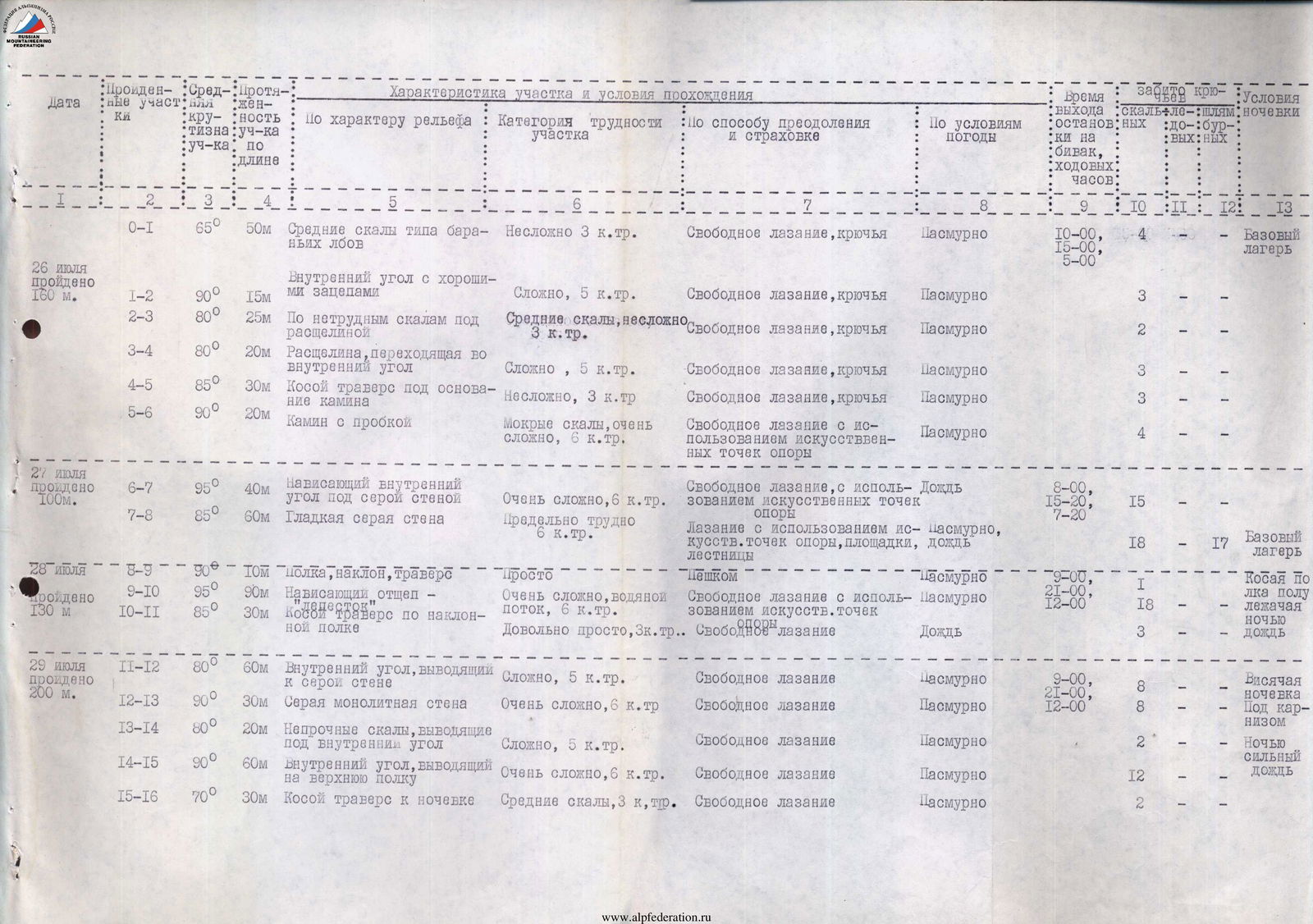
| Date | Sections Covered | Average Steepness of Section | Section Length | Relief Characteristics | Category of Difficulty | Climbing and Belaying Method | Weather Conditions | Departure Time, Climbing Hours | Rock Pitons Hammered | Ice Pitons Hammered | Bolted Pitons Hammered | Camping Conditions |
|---|---|---|---|---|---|---|---|---|---|---|---|---|
| July 26 | R0–R1 | 65° | 50 m | Medium rocks like ram's foreheads | 3 cat. sl. | Free climbing, pitons | Overcast | 10:00, 15:00 | 4 | — | — | Base camp |
| R1–R2 | 90° | 15 m | Internal corner with good handholds | 5 cat. sl. | Free climbing, pitons | Overcast | 3 | |||||
| R2–R3 | 80° | 25 m | Easy rocks under a crevice | Medium rocks, 3 cat. sl. | Free climbing, pitons | Overcast | 2 | |||||
| R3–R4 | 80° | 20 m | Crevice turning into an internal corner | 5 cat. sl. | Free climbing, pitons | Overcast | 3 | |||||
| R4–R5 | 85° | 30 m | Diagonal traverse under a chimney | 3 cat. sl. | Free climbing, pitons | Overcast | 3 | |||||
| R5–R6 | 90° | 20 m | Chimney with a plug | Wet rocks, 6 cat. sl. | Free climbing with artificial aids | Overcast | 4 | |||||
| July 27 | R6–R7 | 95° | 40 m | Overhanging internal corner under a grey wall | 6 cat. sl. | Free climbing with artificial aids | Rain | 8:00, 15:20 | 15 | |||
| R7–R8 | 85° | 60 m | Smooth grey wall | 6 cat. sl. | Climbing with artificial aids, ledges, ladders | Overcast, rain | 7:20 | 18 | 17 | Base camp | ||
| July 28 | R8–R9 | 90° | 5 m | Ledge, slope, traverse | Simple | Walking | Overcast | 9:00, 21:00 | 1 | — | — | Slanting ledge, semi-reclined camping |
| R9–R10 | 95° | 90 m | Overhanging flake — "petal" | 6 cat. sl. | Free climbing with artificial aids | Overcast | 12:00 | 18 | ||||
| R10–R11 | 85° | 30 m | Diagonal traverse along a sloping ledge | 3 cat. sl. | Free climbing | Rain | 3 | |||||
| July 29 | R11–R12 | 80° | 60 m | Internal corner leading to a grey wall | 5 cat. sl. | Free climbing | Overcast | 9:00, 21:00 | 8 | |||
| R12–R13 | 90° | 30 m | Grey monolithic wall | 6 cat. sl. | Free climbing | Overcast | 12:00 | 8 | ||||
| R13–R14 | 80° | 20 m | Fragile rocks leading under an internal corner | 5 cat. sl. | Free climbing | Overcast | 2 | — | — | Night with heavy rain | ||
| R14–R15 | 90° | 60 m | Internal corner leading to an upper ledge | 6 cat. sl. | Free climbing | Overcast | 12 | |||||
| R15–R16 | 70° | 30 m | Diagonal traverse to camp | Medium rocks, 3 cat. sl. | Free climbing | Overcast | 2 | |||||
| July 30 | R16–R17 | 85° | 85 m | Wall starting from an overhang | 6 cat. sl. | Free climbing | Clear | 10:00, 20:00 | 13 | |||
| R17–R18 | 80° | 30 m | Outer wall of a crack and slab | 4 cat. sl. | Free climbing | Earthquake at 11:15, clear | 10:00 | 3 | ||||
| R18–R19 | 80° | 55 m | Outer corner, 60-meter wall | 4 cat. sl. | Free climbing | Clear | 7 | |||||
| R19–R20 | 45° | 60 m | Snowfield in a rock funnel | 2 cat. sl. | Steps | Good weather | 2 | |||||
| July 31 | R20–R21 | 90° | 20 m | Wall leading under the first overhang | 5 cat. sl. | Free climbing | Clear | 9:45, 19:45, 10:00 | 3 | |||
| R21–R22 | 120° | 10 m | Wall with an overhang along a crevice | 6 cat. sl. | Free climbing with artificial aids | Clear | 9 | |||||
| R22–R23 | 90° | 8 m | Crevice oriented vertically | 5 cat. sl. | Free climbing | Clear | 2 | |||||
| R23–R24 | 85° | 20 m | Heavily dissected rocks | 5 cat. sl. | Free climbing | Clear |