
USSR ALPINISM CHAMPIONSHIP 1982. ICE-SNOW ASCENTS CLASS.
Report
REPORT ON THE ASCENT TO THE SUMMIT OF MIZHIRGI EAST, 4928 m, VIA THE CENTER OF THE NORTH FACE BY THE RS "AVANGARD" TEAM, TRUD SPORTS SOCIETY.
Team Leader: V.I. Grishchenko. Team Coach: L.V. Kensitsky. RS "AVANGARD", TRUD Sports Society, Kiev, ul. Volodarskogo, 1. Tel. 74-40-22. Team Leader V.I. Grishchenko: 25205, Kiev, ul. Peschanaya, 28/32, apt. 46. Work Tel. 44-10-65, Home Tel. 71-08-74.
Coach L.V. Kensitsky: Uzhgorod, ul. Shumnaya, 22/23. Tel. 90-51, ext. 3-53.
The heights of the summit and the start of the route were determined using a map; the heights of the bivouac sites were determined visually and by the number of ropes climbed.
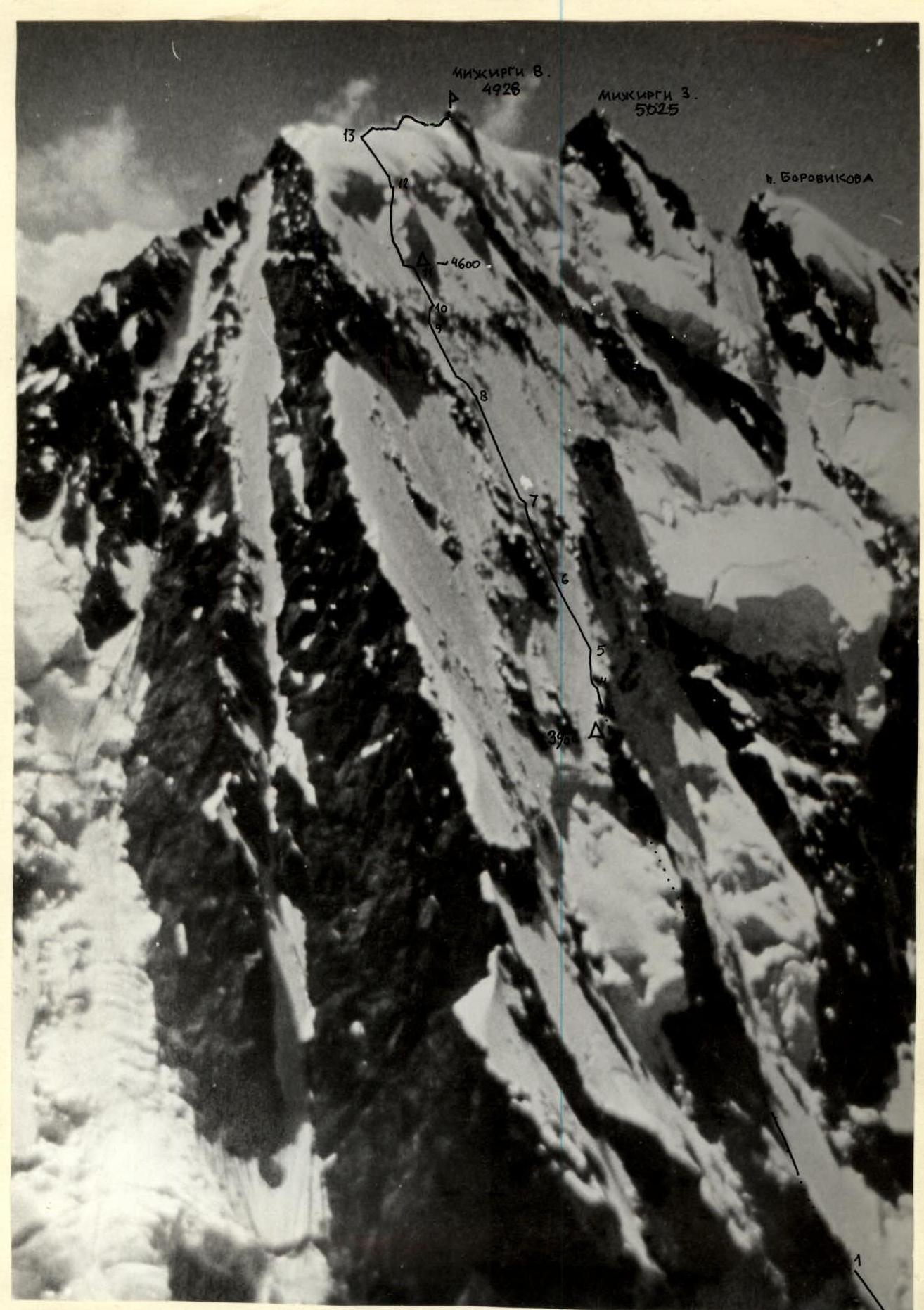
Profile of the wall from the left
Photo taken on August 16, 1981, at 11:00, using Industar-70 lens, distance to object 4.5 km, N 4, H 4500.
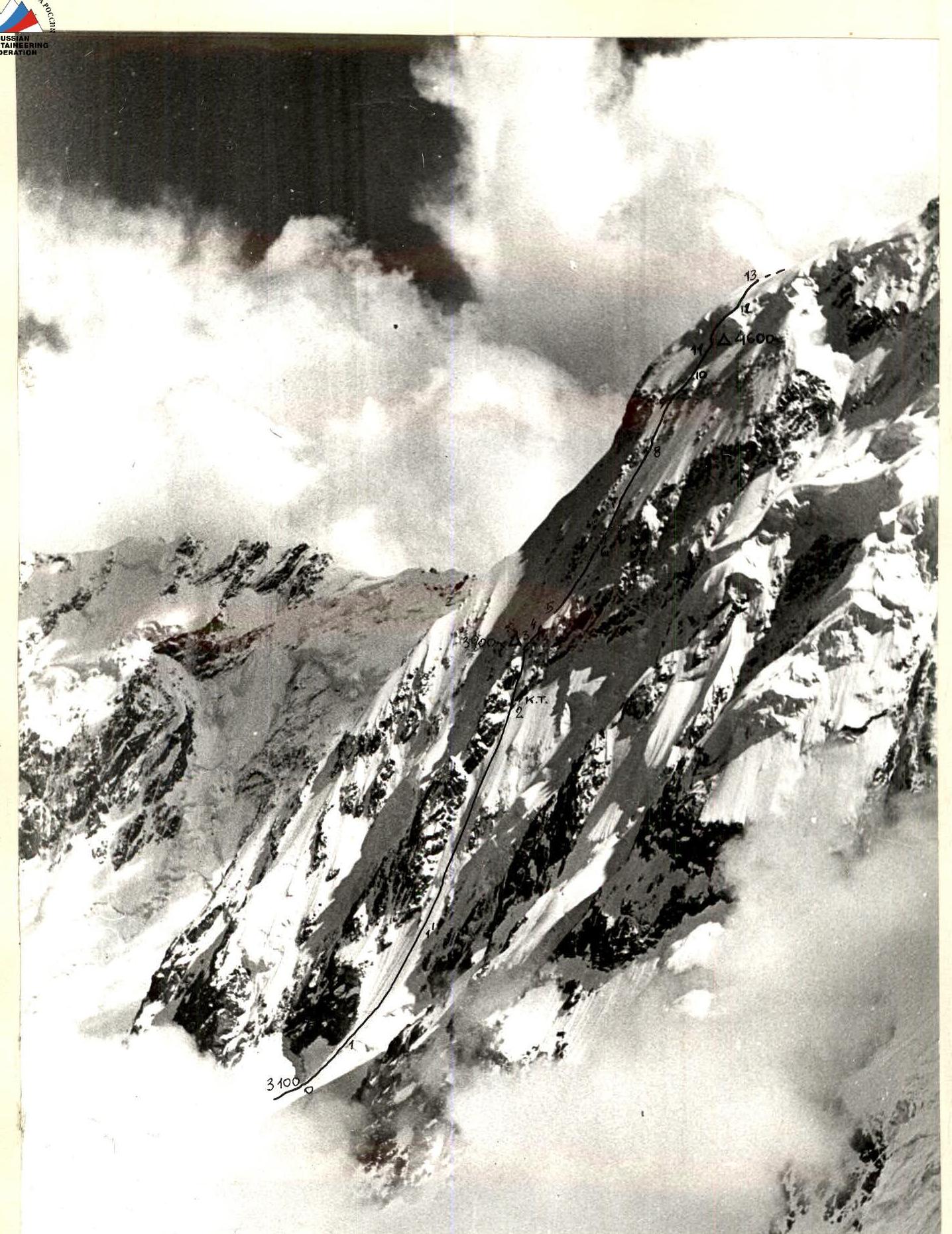
Profile of the wall from the right
Photo taken in August 1982, using Mir-1 3.5/37 lens, distance to object 3.5 km, N 1, H ≈ 4000, KP night.





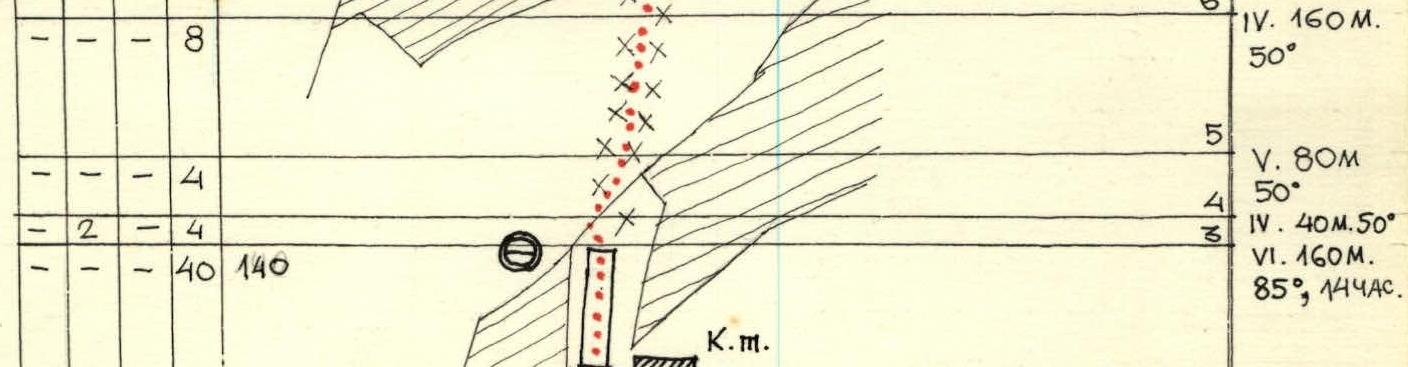
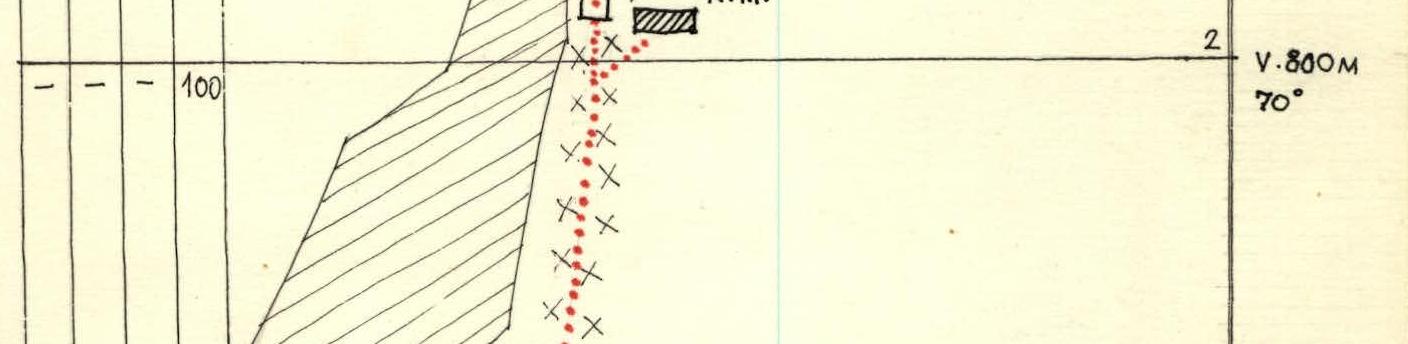


R0–R1. The section begins with crossing the bergschrund, followed by a snowy slope with a crust, beneath which lies powdery snow. The snow is hard in the gullies.
R1–R2. Steep ice slope on a rocky base (thick ice formation). The ice is covered with frost, and there are cavities beneath the upper layer. Several sections of 5–10 m have a steepness of 80–85°. Apparently, the ice follows the profile of the rocky base. In these areas, ice screws were difficult to screw in, and it was necessary to break through the upper layer of ice. There are sections with a thin layer of ice (10–15 cm).
R2–R3. Steep, sometimes up to 90°, rocky belt covered in ice. There is a fairly thick layer of ice in the inner corners and gullies.
R3–R4. Snow-covered, icy rocks. Protection is achieved using ice screws; pitons can also be used.
R4–R5. Snow-ice slope. Traverse upwards to the left beneath the rocks, then upwards through loose snow with ice outcrops. Exit onto a snow-ice slope.
R5–R6. Snow-ice slope. The snow is dry and winter-like; the upper part of the slope is icy. Move directly upwards towards the rocky belt, into an inner corner filled with ice.
R6–R7. Steep rocky belt (up to 80–85°), covered in ice. A system of inner corners and gullies with very hard ice; constant small avalanches occur (snow does not hold on the slopes). Move directly upwards; the last rope goes upwards to the left, exiting onto the second snow-ice slope.
R7–R8. Snow-ice section. Move directly upwards towards a rocky outcrop. The ice is steep near the outcrop.
R8–R9. Snow-ice slope; the upper part is icy. Move upwards to the left, then directly upwards to the rocky belt. Protection is achieved using ice screws (ice beneath the snow).
R9–R10. Steep rocky belt covered in an ice crust. Move upwards to the right, exiting onto a snow-ice slope.
R10–R11. Snow-ice slope. There is a crust on the snow, with ice beneath. Move directly upwards towards an ice slope.
R11–R12. Ice slope. Move upwards to the left, then upwards to the right, to the bergschrund.
R12–R13. Bergschrund, followed by a snowy slope leading to the ridge.
R13–R14. Snowy ridge. Ascend to the summit of Mizhirgi via snow-covered rocks.
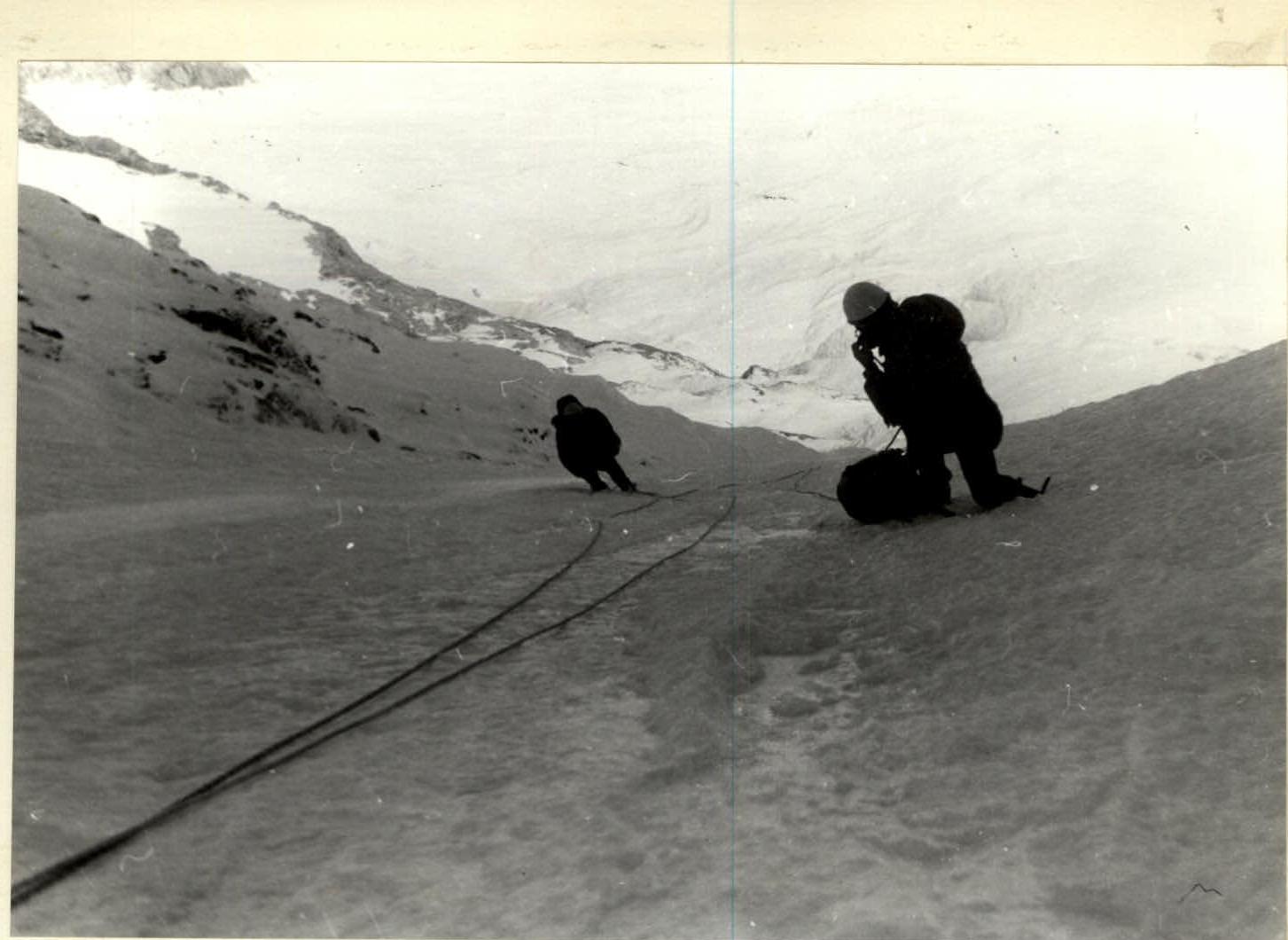
Photo taken on August 10, 1982, around 9:00, using T-43, 4/40 lens. Climbers Tolstousov (right) and Zasypkin are standing, leaning on their self-arrest devices.