

Ascent Passport
- Ascent class — ice and snow
- Ascent area — Central Tien Shan, Terskey-Alatau ridge
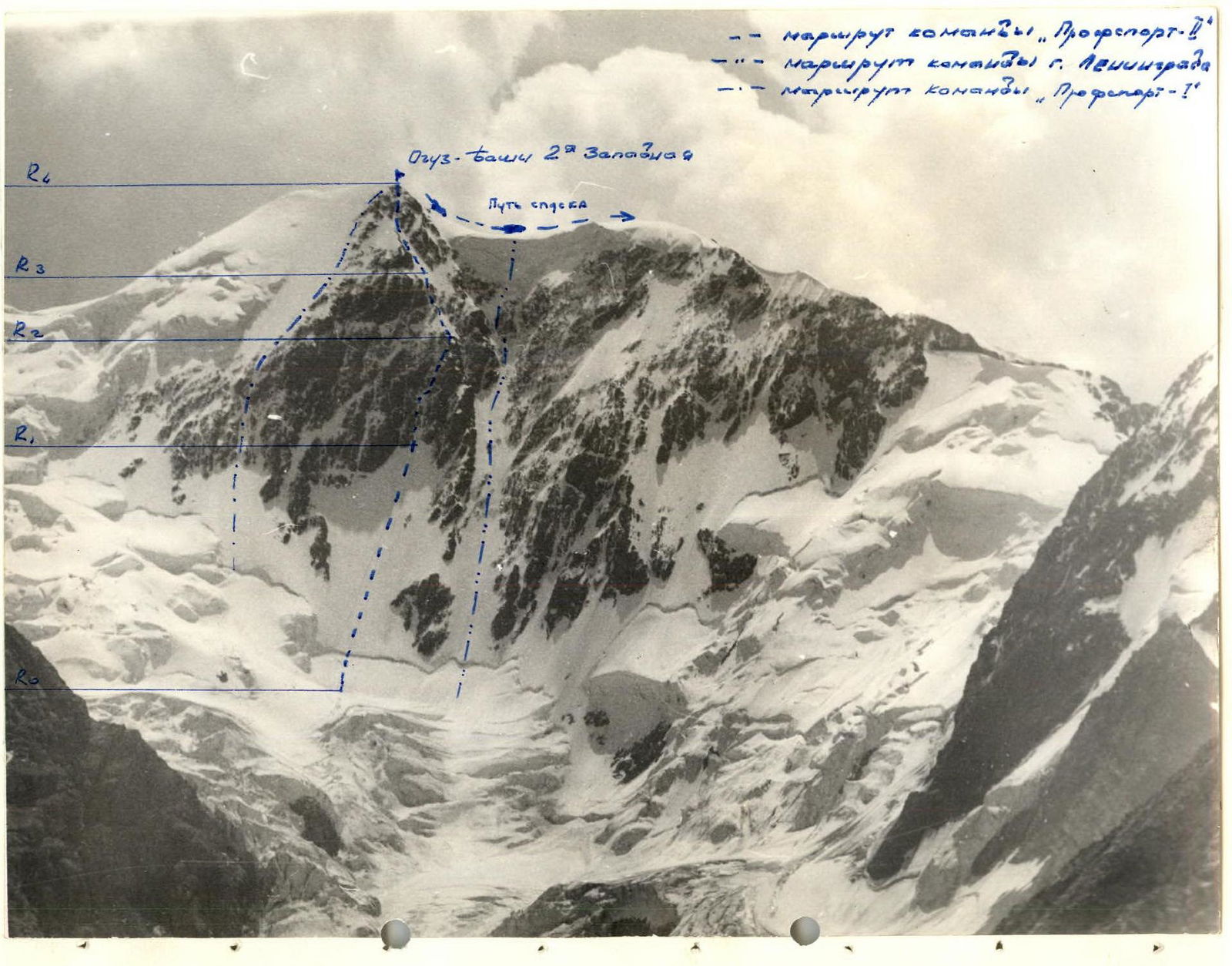
- Oguz-Bashi 2nd Western (5000 m) via N wall
- Estimated difficulty category — 6B. V. Leontiev's route (1984)
- Height difference — 665 m
- Distance — 880 m
Distance of sections with 5-6 difficulty category — 880 m. Average steepness — 50°. 6. Pitons hammered in:
| rock | bolt | chocks | ice |
|---|---|---|---|
| — / — | — / — | — / — | 255 / — |
-
Team's travel hours: 14
-
Overnight stays: 1 on descent
-
Team "ProfSport-P" of the All-Union Council of the All-Union Voluntary Sports Society of Trade Unions
-
Leader — Boyko V.G. Master of Sports of International Class; participants — Rynshin V.V. Candidate Master of Sports, Suvorov V.A. Candidate Master of Sports, Vakulo V.S. Candidate Master of Sports.
-
Team coach — Rozhkov Andrey Nikolaevich.
-
Departure to the route — August 15.
Reached the summit — August 15. Returned — August 16, 1988.


Team's Tactical Actions
The tactical plan for the ascent was to complete the route in one day with an overnight stay on the descent, which fully corresponded to the actual ascent. The route was completed on August 15 in 14 hours.
Considering the length of the ice sections and the limited rest areas, the team relied on prolonged loads, i.e., the high individual physical fitness of the participants. The team consisted of 4 people:
- Boyko V.G. — leader
- Vakulo V.S.
- Suvorov V.A.
- Rynshin V.V.
The team had experience of joint ascents of 6B difficulty category.
The tactical plan предусматривал beginning work from the bergschrund at 5:00. Due to the complex approach to the bergschrund on the glacier, they arrived at 5:00. The Boyko — Rynshin team led the way. The bergschrund proved difficult to cross. A thick layer of icicles mixed with snow, 0.5 m thick. They had to cut through this layer to organize belays. Therefore, they approached the second section 1 hour later. The teams worked autonomously.
On the second section, the Suvorov — Vakulo team led the way. The section is a series of frozen gullies. The ice was built-up, with the upper layer being hollow. To organize belays, they had to chop off the upper layer in many places. In addition, the passage was complicated by bad weather. A layer of fluffy snow flowed down the gullies and rocks. Belays were organized every 2–3 m on ice screws, as the steepness in some areas reached 90°. The first in the second team climbed free solo with belay through a knot on a fixed rope. They completed the second section with a total delay of 2 hours.
Features of the passage:
- The first in the second team climbed free solo with belay through a knot on a fixed rope.
- The second section was completed with a total delay of 2 hours.
On the third section, the Suvorov — Vakulo team led the way. The passage was complicated by continuing bad weather (strong wind, snow). However, despite this, they managed to complete it in 2 hours. At 17:00, they reached the pre-summit slope. They had a hot meal and began the ascent at 18:00.
On the final section, the Boyko — Rynshin team led the way. The bad weather continued. At 20:30, they reached the summit. The teams worked autonomously. They searched for the cairn for a long time due to the large amount of fresh snow. At 21:00, they began their descent. At 21:30, they stopped for the night.
On all sections, belay points were organized on 3 grouped pitons. When moving on ice, each participant used ice axes and ice hammers. When passing through gullies, the first climbed with 2 ice axes. Each had a high-calorie reserve of pocket food. There were no falls or injuries.
The rescue team was located in the base camp under the summit during the ascent. Communication was carried out by radios: "Lastochka" for the team, and "Kaktus" for the rescuers. All radio communication sessions were normal. The descent from the summit was carried out along the western ridge to the "Serebryanoe sedlo" pass and further down to the base camp.
Safety Measures During the Ascent
- High physical, technical, and psychological preparation of the team.
- Tactical plan.
- Material and technical support, including the use of modern equipment: titanium rock and ice pitons, lightweight carabiners, quickdraws, ice axes, ropes with UIAA certification.
- Presence of a group of rescuers under the route, who constantly monitored the team's actions with 8x binoculars.
- The route included two hot meals. The diet was calculated at 350 g of dry substance per person per day.