

REPORT
on the CS "Zenit" championship in alpinism 1972 on the traverse "Peak 40 let LKSM Ukrainy (6318 m) — Peak F. Engels (6510 m)" of the team from Dnepropetrovsk regional council of DSO "Zenit" (in the class of traverses)
Dnepropetrovsk 1972
5. Route Description
August 8. The group left the base camp (4200 m) at 9:00. Ascended by the moraine of the Kish-ty-Dzherob glacier, then through slushy snow on the right side of the glacier to the ridge (5200 m). Two relatively flat snow platforms were trampled and the group spent the night there.
August 9. Departure at 9:00. The weather was excellent. Ascended to the ridge at 5200 m in rope teams: VALIK—SEMENOV, NAZARENKO—KOZAK, SAMOYLENKO—GREBENKIN, PROTSENKO—SUSLOV. The rope teams remained unchanged thereafter. Movement was simultaneous; the snow was steep but not yet slushy up to the ridge. Descended from the ridge via a rappelled rope to the Zugvand glacier. Then ascended up the glacier. The slope was approximately 20°, but it was not very hot, and the snow began to slush, making it hard to move. Steps were alternately kicked. By 16:00, they reached the start of the route. The key section ahead was the traverse of the Western wall of Peak 40 let LKSMU. They set up a camp, had a snack. At 17:00, the rope team VALIK—SUSLOV went to reconnoiter the start of the route. The route begins with negotiating a bergschrund and exiting onto ice under the marble belt. The ice slope was 30–35° steep and 200 m long. There was a thin layer of slushy snow on the ice, making it difficult to move in crampons. The available daylight was used to process the ice section. The rope team VALIK—SUSLOV, without backpacks and with three 80-meter ropes, used ice screws for protection and fixed ropes up to the rocky outcrop under the marble belt. By 20:00, the team returned to the tents on the Zugvand glacier.
August 10. Departure at 9:00. It was cold. Boots, wet from the previous day, were frozen. The previously fixed ropes were very helpful. If they hadn't been fixed, they would have had to cut steps in the ice, as the thin layer of snow was covered with ice crust, and crampons didn't hold.
From the end of the fixed ropes, they ascended via destroyed rocks onto a small ledge under the marble belt. The rocks were of medium difficulty. All rope teams moved simultaneously. Further, they had to traverse right for 400–500 m across a steep (30–35°) snow-ice slope. It was still cold. The sun didn't reach the slope, and the snow was frozen. Kicking steps was very hard; they had to chop with an ice axe. They frequently changed the lead rope team. The pace was low. Finally, the slope ended, and they reached the ice-covered "ram's foreheads" made of white marble. Here, they were in the sun, and it was warm. The marble belt looked very beautiful in the morning sun. They took a short rest.
Further, they faced one of the key sections of the route. The rope team VALIK—SEMENOV led. The rocks were smooth, sometimes covered with ice; the slope was approximately 80–90° steep. However, a large set of pitons allowed them to use all micro-relief cracks without much time loss.
By fixing ropes, they traversed 80 m of the wall and then ascended left along steep ledges to a poorly defined rusty ridge. Here, under overhanging rocks, they found good platforms for two tents. There was no water, but snow lay not far from the platforms. The time was 14:00.
Ahead was the most challenging section of the route — the sheer wall of Peak 40 let LKSMU. They decided not to proceed further — it wasn't worth getting tired, as the next day would be demanding, and there were no nearby campsites.
At 15:00, two rope teams, NAZARENKO—PROTSENKO and VALIK—SAMOYLENKO, went to reconnoiter the wall. They took:
- three 80-meter ropes;
- 80 m of cordelette;
- a full set of pitons;
- ladders;
- two pairs of talash;
- other rock climbing gear.
The task of the reconnaissance group was to fix as much rope as possible to speed up the group's movement.
The group successfully completed the task, processed the most challenging section of the wall, fixed ropes, and descended to the tents by 19:50.
August 11. Departure at 9:00. The altitude was about 6000 m. Ahead was the most challenging part of the wall. Initially, they moved across relatively easy but steep rocks to a narrow horizontal ledge under the sheer wall of Peak 40 let LKSMU. The first rope team was VALIK—SEMENOV.
Ahead:
- a 40-meter rusty wall with complex climbing;
- then the wall turned into a smooth internal corner 15–20 m high — very complex climbing;
- they moved along fixed ropes with backpacks, using ascenders;
- after the internal corner, they traversed a small ledge, crossed a couloir, and ascended its right side for 30 m to a platform;
- then they ascended a 7-meter wall with very complex climbing;
- approached a narrow, 5-meter chimney filled with ice;
- after the chimney, they traversed "ram's foreheads" rightward and exited to the destroyed rocks of the ridge leading to Peak 40 let LKSMU.
Here, the fixed ropes ended. The "reconnaissance" team had done a great job! This section required significant effort, both moral and physical, from the participants.
Further, the path went along a steep rocky ridge, partially covered with snow, to the summit of Peak 40 let LKSMU. A strong, cold wind blew, but it was beneficial as the snow was covered with a thin crust, making it easier to move. Under the crust, the snow was dry and loose; if someone fell through, they sank up to their waist. The ridge eventually became gentler, and at 18:00, they reached the summit of Peak 40 let LKSMU. The wind intensified. After retrieving a note left by the BOZHUKOV group (1971) and leaving their own, they descended via a snow "cushion" to the ridge between Peak 40 let LKSMU and Peak ENGELSA and set up tents in a small depression on the snow. It became very cold by evening, due to the high altitude (6000 m), but no one showed signs of altitude sickness. They had completed a day of very challenging climbing; the next day, they would tackle one of the main peaks in the area — Peak ENGELSA.
August 12. Departure at 9:00. They left the tents with a small supply of food and warm clothing and began the ascent. The day was sunny but still cold, with a piercing wind. The rocky pre-summit shoulder of Peak ENGELSA was clearly visible ahead. From the ridge, they approached a bergschrund and crossed it via a snowy area. Then, they ascended a snow-ice slope with a 30–40° steepness for 150–200 m to the base of the pre-summit shoulder of Peak ENGELSA. Further, along a rocky ridge (40 m, rocks of medium complexity), they reached the snow "cushion" of Peak ENGELSA. The snow was loose, making it hard to move. But the summit was very close.
At 13:00, they reached the beautiful summit of Peak ENGELSA. They admired the wonderful panorama of the surrounding peaks, left a note, and began their descent.
The descent from the summit of Peak ENGELSA to the ridge followed the ascent route. The snow condition worsened. They frequently used fixed ropes, and descended the rocky ridge via rappelling. They reached the ridge by 16:00.
Considering the poor snow condition, they decided to descend via the Western ridge of Peak ENGELSA, following a 5A category route. During the descent onto the ridge from between Peak 40 let LKSMU and Peak ENGELSA, they encountered ice exposures and, with careful protection using ice screws and step-kicking, reached the rocky "island" of the Western ridge. Along the ridge, after 200 m, they found a good platform and stopped for the night.
August 13. Departure at 9:00. They began their descent to the Zugvand glacier. During the descent, they set up around 10 rappels and "sports" descents (vertical height 200–250 m). The last rappel was particularly good — 30 m high, with a 5–3 m free fall.
They descended to the glacier by 17:00. They decided to descend to the lower part of the glacier and, if time allowed, cross the 5200 m ridge. They accomplished and exceeded their plan, stopping for the night in the Kish-ty-Dzherob gorge on the 4700 m plateau.
August 14. They rose at 8:00, and by 12:00, they were congratulated on their success in the base camp.
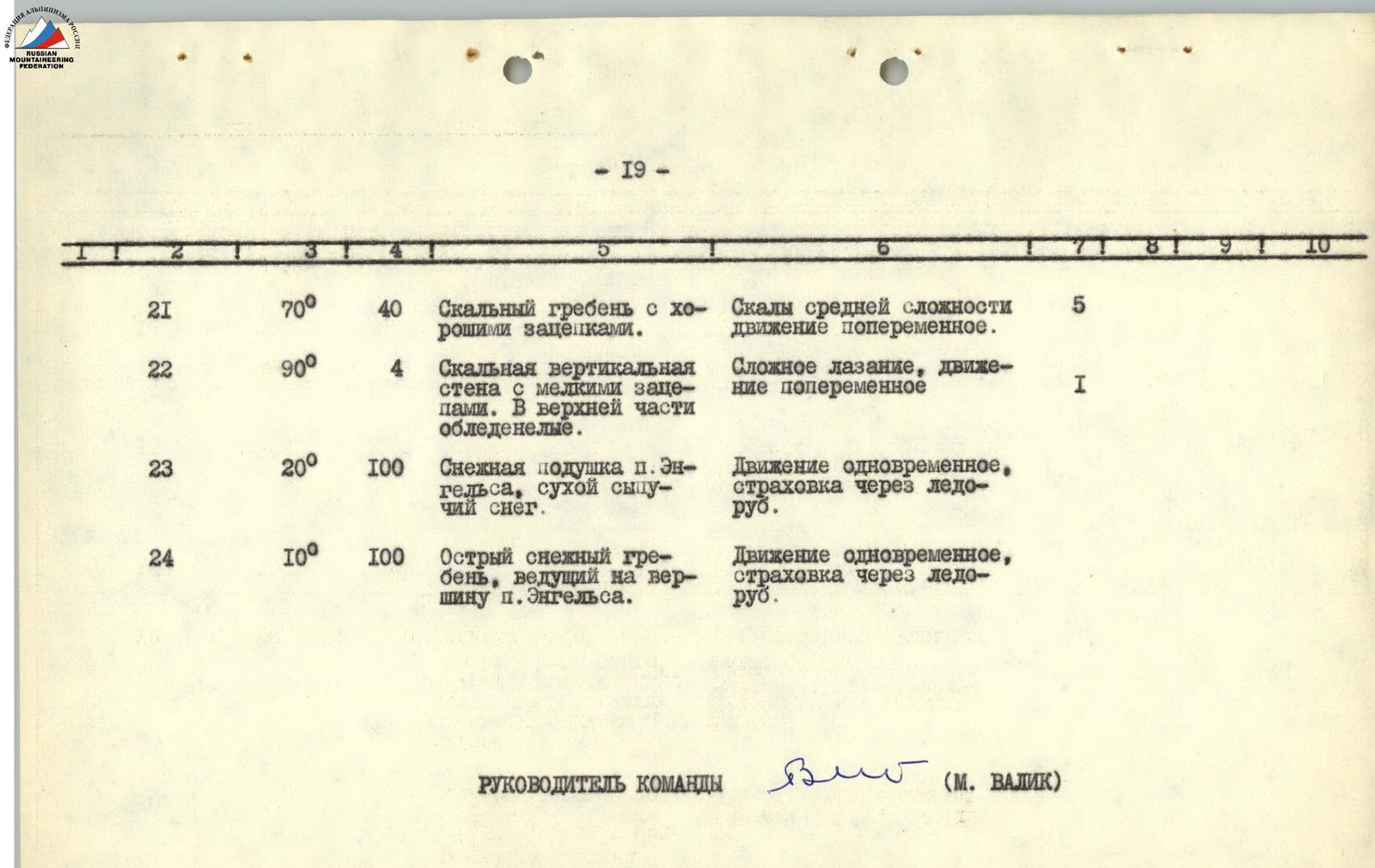
Table of Main Route Characteristics
Traverse of Peak 40 let VLKSMU — Peak ENGELSA with ascent via the Western wall of Peak 40 let LKSMU.
The ascent route was combined. The height difference was 1800 m, with an average steepness of 65°, including 600 m of very complex sections with an average steepness of 70–80°. On some sections, the steepness reached 90°, and rocks overhung in places.
| Date | Section | Steepness | Length in m | Terrain Characteristics | Technical Difficulty | Pitons (rock) | Pitons (ice) | Pitons (shlyambur) | Notes |
|---|---|---|---|---|---|---|---|---|---|
| 8.8 | 1 | 10–20° | 2500 | Path along the moraine of Kish-ty-Dzherob glacier, Kish-ty-Dzherob glacier | Easy. Simultaneous movement. | ||||
| 9.9 | 2 | 40° | 200 | Snow-ice slope, destroyed rocks at the top. | Protection via ice axe, snow holds well. | ||||
| 3 | 30–50° | 150 | Snow-ice slope leading to Zugvand glacier. | Rappelling, alternating movement below, protection via ice axe. | |||||
| 4 | 20° | 1000 | Tongue of Zugvand glacier, slushy snow. | Simultaneous movement. | |||||
| 5 | 10° | 200 | Snowy plateau at the top of Zugvand glacier. | Simultaneous movement. | |||||
| 10.8 | 6 | 35° | 200 | Ice slope covered with a thin layer of snow. Bergschrund at the bottom. | Alternating movement using previously fixed ropes. | 4 | |||
| 7 | 60° | 50 | Steep, fragile rocks. | Transverse movement. | 4 | ||||
| 8 | 10° | 500 | Traverse of a snow-ice slope with 40° steepness | Alternating movement, step-kicking, protection via ice axe, ice screws. | 2 | ||||
| 9 | 70–80° | 100 | Ice-covered "ram's foreheads". | Very difficult climbing. One of the key sections, using petal pitons. | 10 | ||||
| 11.9 | 10 | 70° | 100 | Heavily destroyed rocks, some snow and ice patches. | Climbing of medium complexity. Steep snow-ice slope at the top. | 8 | 1 | ||
| 11 | 10° | 50 | Narrow rocky ledge under a monolithic wall. | Simultaneous movement. | 3 | ||||
| 12 | 80–90° | 120 | Vertical monolithic wall turning into a smooth internal corner, a small couloir, and again a wall. A narrow, ice-filled chimney. | Very difficult climbing, the most complex part. Climbing with petal pitons, ladders, shlyambur pitons. Recommended without backpacks. | 15 | 2 | |||
| 13 | 60–70° | Smooth "ram's foreheads", destroyed ice-covered rocks at the top. | Difficult climbing complicated by ice on rocks. | 4 | |||||
| 14 | 30° | 100 | Snowy slope, loose snow, sometimes crusted. | Simultaneous movement, protection via ice axe. | |||||
| 12.8 | 15 | 50–60° | 80 | Steep rocky ridge, strong rocks with good holds. | Climbing of medium complexity. | 4 | |||
| 16 | 20° | 200 | Snowy ridge, dry, loose snow; no snow at the summit of Peak 40 let LKSMU. | Simultaneous movement. Hard due to snow condition. | |||||
| 17 | 20–30° | 200 | Snowy slope descending to the ridge between Peak 40 let LKSMU and Peak ENGELSA. | Not difficult but tiring descent. Sink up to waist. | |||||
| 18 | 10° | 150 | Snow "cushion", dry, loose snow. | Easy ascent complicated by poor snow. | |||||
| 19 | 40° | 200 | Ice slope covered with dry snow, rocky outcrops visible. Bergschrund at the bottom. | Alternating movement, sometimes in three steps. Protection via rock and ice pitons. | |||||
| 20 | 10° | 50 | Snowy ridge with rocky outcrops leading to the pre-summit shoulder of Peak ENGELSA. | Simultaneous movement, protection via ice axe. | |||||
| 21 | 70° | 40 | Rocky ridge with good holds. | Climbing of medium complexity, alternating movement. | 5 | ||||
| 22 | 90° | 4 | Vertical rocky wall with small holds, ice-covered at the top. | Complex climbing, alternating movement. | 1 | ||||
| 23 | 20° | 100 | Snow "cushion" of Peak ENGELSA, dry, loose snow. | Simultaneous movement, protection via ice axe. | |||||
| 24 | 10° | 100 | Sharp snowy ridge leading to the summit of Peak ENGELSA. | Simultaneous movement, protection via ice axe. |
7. Assessment of Team Members' Actions
During the traverse of Peak 40 let LKSMU — Peak ENGELSA, all team members acted skillfully and correctly. Their physical, technical, and moral preparation was adequate for this challenging route.
The team's success was facilitated by their ability to provide reliable protection and self-protection at all sections of the route. All participants were serious, thoughtful climbers and good companions.
8. Conclusions on the Route
The traverse of Peak 40 s LKSMU — Peak ENGELSA with ascent via the Western wall of Peak 40 let LKSMU is an original, logical, and very beautiful route.
The height difference is 1800 m, including 600 m of very complex sections. The average steepness is up to 65°, and the complex sections up to 85°. The wall itself has a steepness of 90°, with rocks overhanging in places.
Free, complex climbing is done at high altitudes on steep, sheer rocks. The route requires specially selected gear and excellent mastery of all rock, ice, and snow climbing techniques. A total of:
- 56 rock pitons;
- 13 ice pitons;
- 2 shlyambur pitons were used on the route.
This route is not recommended for climbers without sufficient experience in wall ascents and good high-altitude acclimatization.
The team's moral preparation for this route must be very high.
The significant complexity, length, and altitude of the route allow us to confidently classify it as 5B category.
TEAM CAPTAIN (M. VALIK) ALPINIAD LEADER MERITED SPORTSMASTER OF THE USSR, HONORED TRAINER OF THE UKRAINIAN SSR (A. ZAYDLIER) TEAM COACHES: MERITED SPORTSMASTER OF THE USSR (V. SHABOKHIN), HONORED COACH OF THE USSR (SAMOYLENKO)