

- Climbing category is altitude-technical.
- Climbing area — South-West Pamir, Kyshty-Dzherob gorge.
- Climbing route with indication of peaks and their heights: peak Engels. South summit 6318 m East wall.
- Estimated difficulty category 6B.
- Characteristics of the ascent: Height difference 1318 m Walls 1170 m Average steepness 80° Length of complex sections (5–6 cat. diff.) — 900 m.
- Number of hooks driven: for belaying, for creating artificial points of support: Rock 360/16, ice 0, bolt 20/11.
- Number of chocks used 77/16.
- Number of bivouacs and their characteristics — 8. Shelves are normal.
- Number of climbing hours 87.
- Surname, name, patronymic of the leader, participants and their qualification:
- SHOPIN V.G. MS — leader
- SURZHIK M.V. MS — deputy leader
- OSHE E.A. MS
- KRYUKOV V.P. MS
- GLADKIKH B.V. MS
- LIKHACHEV V.G. CMS
- KOSMACH G.I. CMS
- POLYAKOV G.A. CMS
- Team coach — ZAKHAROV P.P. MS.
- Date of departure on the route and return: from July 21 to July 31, 1979.
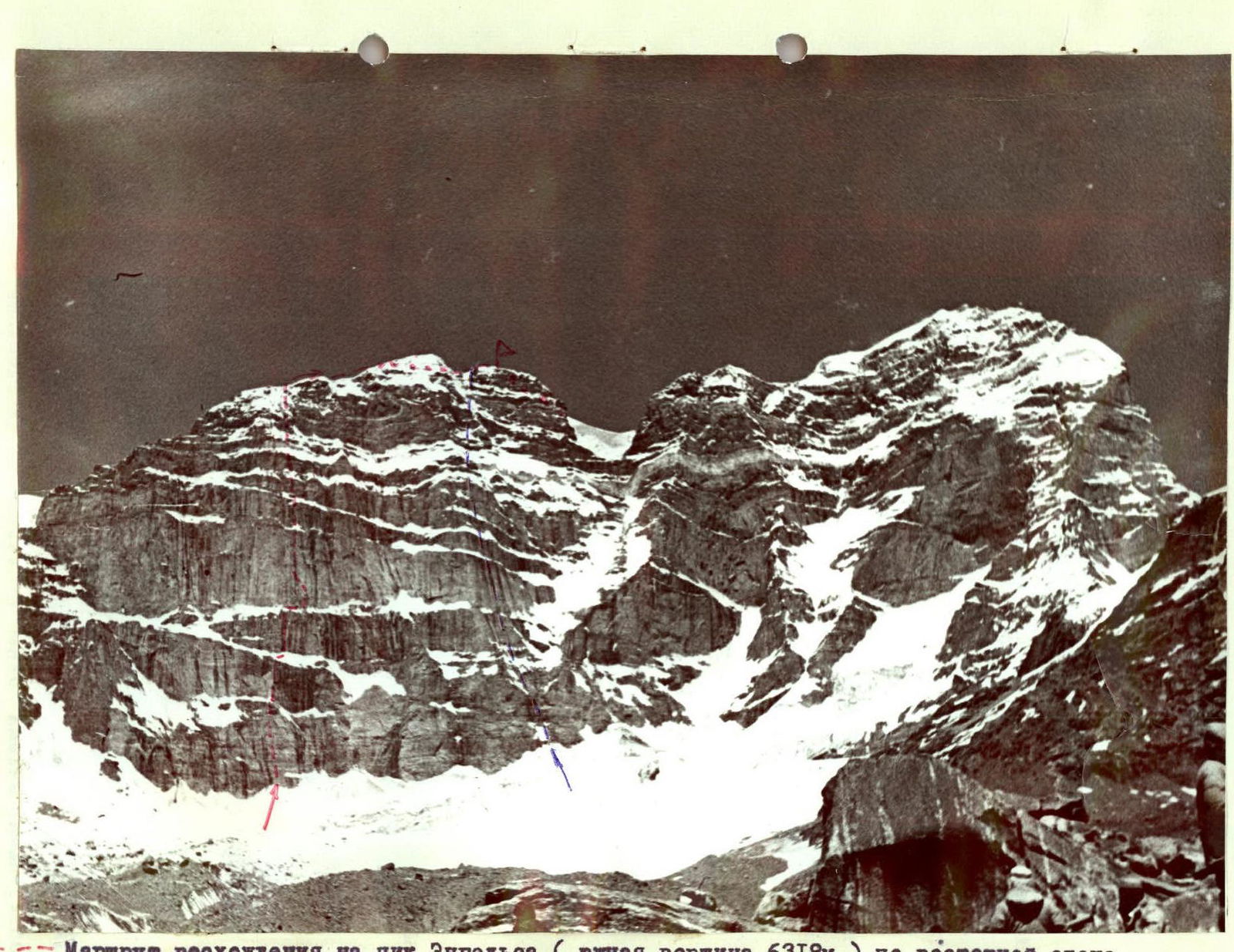
- Ascent route to peak Engels (south summit 6318 m) via the east wall.
- Bogomolov's route.
2. Route description
The wall is a series of vertical belts separated by steep shelves covered with ice and snow. During the day, as a result of thawing, water flows flood many sections of the wall, which are covered with an icy crust with the sunset.
The entire planned route can be represented as consisting of three main parts (photo sheet 12; diagram sheet 13): I. Lower part (sections R0–R8) — smooth walls, with insignificant relief, steepness — at the bottom 70°; at the top up to 80°, length 450 m. In terms of rock character and complexity, this part resembles the lower bastion on the NW wall in Chapdara, but raised to a height of 5000–5450 m. The rocks are monolithic, with few cracks. Significant areas are wetted by water by midday. II. Bastion (sections R8–R17) — the most complex part, steepness 85°–90°, length 340 m. In our practice, a section of such extended complexity has not been encountered. The route passes through a wall with numerous overhangs. The wall is cut through its entire height by a periodically interrupted cleft. Individual sections of the wall in terms of relief and complexity resemble the upper part of the N wall in Dalar and the middle part of the NW wall in B. N Khar, but these sections are longer and at a higher absolute height (5450–5800 m). III. Upper part (sections R17–R26) — a more gentle and dissected massif, with a steepness of 75°–80°, 400 m long. The entire upper part is crossed by a light belt. The exit to the ridge is via a firn slope with a steepness of 55°–60°, 160 m long, through a cornice. The ridge is cut off towards the Kyshty-Dzherob gorge by a continuous snow cornice.
3. Organization of movement on the route
The organization of movement on individual sections of the route was built depending on which part of the route was planned to be climbed.
When passing the first two parts of the route, the work was structured as follows: the first rope team goes out in the morning for processing, having with them: one rope and 2-3 climbing ropes, two hammers, thirty various rock pitons, ten bolt pitons, 4-6 chocks such as "stopper" and "hex", "snack", individual first-aid kit and radio. All work by the teams is done on a double rope. The first in the rope team works without a backpack, in galoshes. If necessary, the working rope team can communicate with the bivouac by radio (every hour the bivouac is on the air), report the situation and call the second rope team to continue processing, adjust the quantity and nomenclature of equipment necessary for passing a particular section of the route, or give the order to pack up the bivouac, in case the problem of reaching the next planned bivouac site is solved.
Equipment available to the rope team:
- one rope and 2-3 climbing ropes
- two hammers
- thirty various rock pitons
- ten bolt pitons
- 4-6 chocks such as "stopper" and "hex"
- "snack"
- individual first-aid kit
- radio
The first in the rope team, having passed a certain section of the route, secures one of the ropes, used later as a fixed rope. The second (in the first rope team), passing the processed section on the fixed ropes with top belay, knocks out some of the intermediate pitons, straightens the fixed ropes. He carries with him a rope, which is used in further advancement as a second rope.
Upon receipt of the command from the working rope team above, the rest:
- pack up the bivouac;
- start moving on the fixed ropes with backpacks using jumar.
The weight of the backpack for the "transport group" at the beginning of the ascent was 12–16 kg. Movement, in order to ensure safety, was carried out on fixed ropes in rope teams. Such an organization of movement was worked out and applied, taking into account:
- the potential possibility of stones being knocked off by falling ice on the ropes;
- the possible need for members of the rope team to help each other (the second in each rope team has a backpack weighing 3–5 kg more than the first).
When passing the upper part of the route on sections R18–R21, the work was structured on the same principle, on the remaining sections it was supposed to move in the usual manner "rope team by rope team" with alternate belaying; on the ridge — simultaneous movement of rope teams.
4. Movement schedule
Based on the complexity of individual sections, their length, as well as in order to ensure uniform movement and distribution of loads, the plan provided for 6 bivouacs on the route. (photo sheet 12). The locations of the planned bivouacs were carefully studied through a 60x magnification telescope from the point of view of their safety.
The height difference of the route is 1318 m (height of the South summit of p. Engels 6318 m, level of the glacier under the wall 5000 m). The height difference of the wall was determined to be 1170 m.
The movement schedule was developed as follows:
- July 21: approach to the route and processing of the firn slope. Overnight stay under the route. (section R0–R1)
- July 22: processing of the lower part of the route to bivouac No. 1. Overnight stay under the route. (sections R1–R4)
- July 23: passing the lower part of the route to bivouac No. 1 and processing the route above. Bivouac No. 1. (sections R0–R4 and above)
- July 24: passing the route to bivouac No. 2 under the bastion. Bivouac No. 2. (sections R4–R8)
- July 25: Processing of the lower part of the bastion. The bastion is the most technically complex section, distinguished by its steepness, presence of cornices and paucity of relief. There were no visible shelves suitable for organizing even a sitting bivouac on it. Therefore, it was supposed to initially process it from bivouac No. 2, 3 under the bastion. Bivouac No. 3. (above section R8)
- July 26: Passing the lower part of the bastion to bivouac No. 4. Bivouac No. 4. (section R8–R14)
- July 27: Passing the upper part of the bastion to bivouac No. 5. Bivouac No. 5. (sections R14–R21)
- July 28: passing the upper part of the route, exit to the ridge or to the summit, depending on the state of the snow when exiting to the ridge. Bivouac No. 6 (on the ridge). (sections R21–R26, R27)
- July 29: passing the ridge and ascending to the South summit of p. Engels. (In case the ascent is not completed the day before). Descent from the summit to the Zughvand pass. Overnight stay on the pass (diagram sheet 2). (sections R26–R27)
- July 30: return via the 5200 m pass to the Kyshty-Dzherob gorge.
- July 31 and August 1: spare days for bad weather.
The tactical plan of the ascent was largely adhered to by the team. The deviations allowed were caused by a number of objective reasons set out in the section "Order of passage of the route", and did not affect the total number of climbing hours, only increasing the number of bivouacs and the number of days spent on the ascent.
5. Distribution of responsibilities among participants
Most of the team members in the same composition made a number of complex ascents, participated in the USSR alpine championship. They have passed routes:
- on v. Nakhar via the NW wall — 6B cat. diff. (III place, 1974);
- on Dalar via the N wall and through the center of the bastion — first ascents 5B–6B cat. diff. (IX place in the USSR championship and 1st place in the Leningrad city championship);
- on v. Chapdara via the NW wall — 6B cat. diff.;
- on Zindon via the NW wall — 6B cat. diff. (II place, 1977).
Oshe E.A. was a member of the team that took 1st place in the USSR championship in the rock climbing category (1978) with an ascent on v. Zamok via the S wall. Most of the team members are qualified rock climbers: Shopin V.G. and Kosmach G.I. — CMS in rock climbing; Surzhik M.V., Kryukov V.P., Oshe E.A. and Likhachev V.G. — 1st sports category.
Taking into account the personal qualities and experience of the team members, during the ascent, responsibilities were distributed among the participants as follows:
- SHOPIN V.G. — overall leadership of the ascent, coordination of the actions of the rope teams, alternate work in the first rope team during processing.
- SURZHIK M.V. — radio communication, knocking out pitons, alternate work in the first rope team during processing.
- OSHE E.A., LIKHACHEV V.G., KOSMACH G.I., POLYAKOV G.A., KRYUKOV V.P., GLADKIKH B.V. — alternate work in the first rope team during processing and at other positions during movement.
In addition, Kryukov V.P. was entrusted with keeping records during the passage of the route, Kosmach G.I. — with organizing food, Gladkikh B.V. — with "medical support".
All the listed responsibilities are interchangeable, and each participant is able to perform any function.
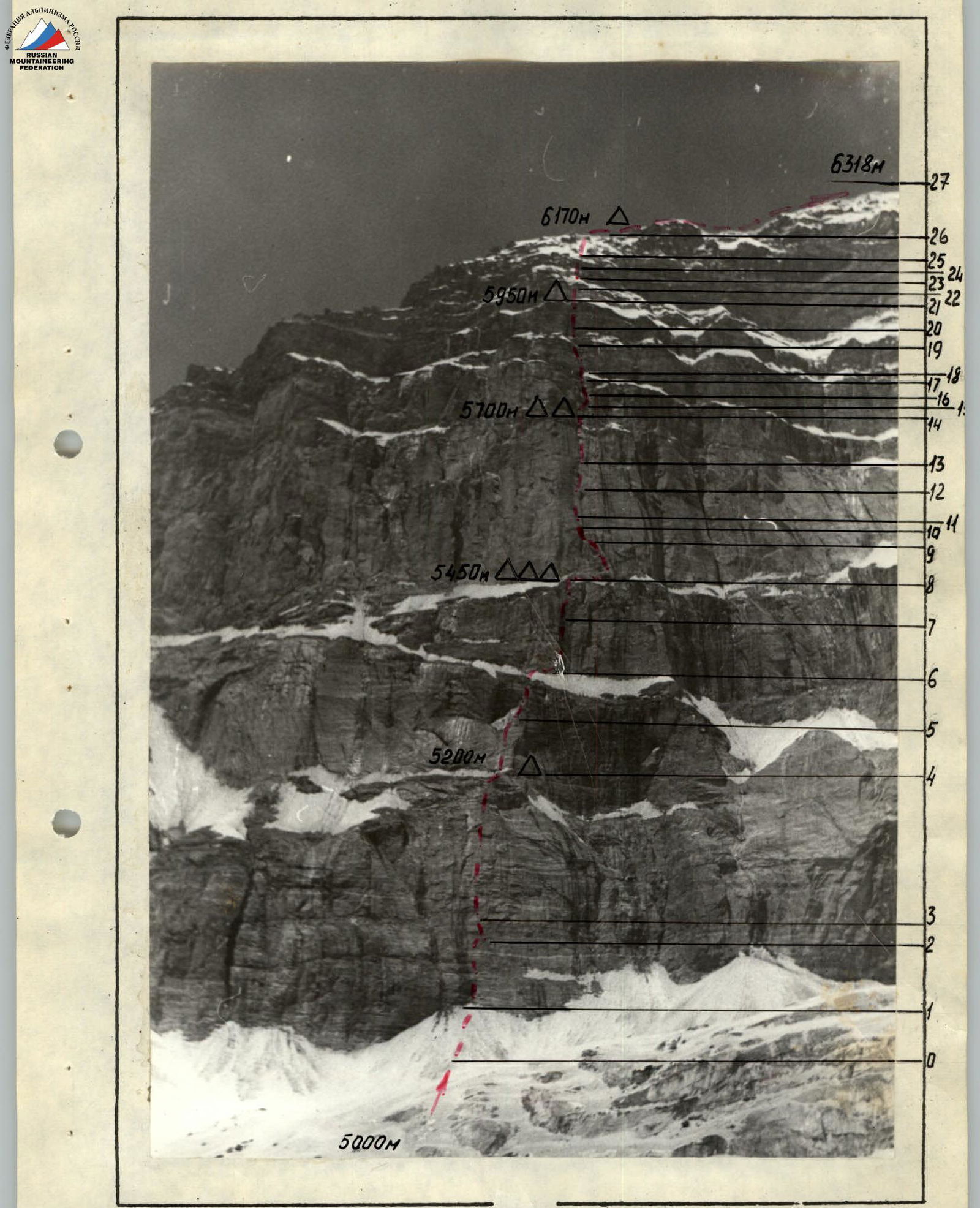 Ascent route to peak Engels (south summit) via the east wall.
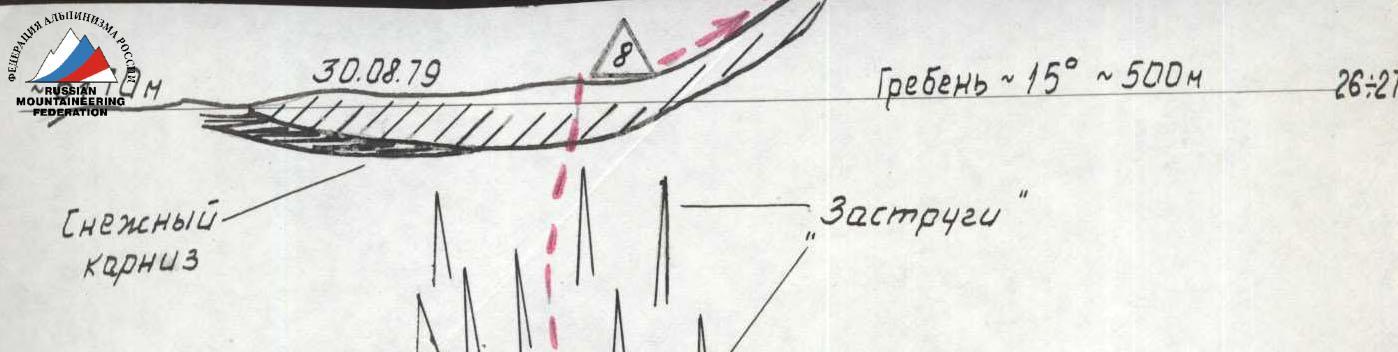


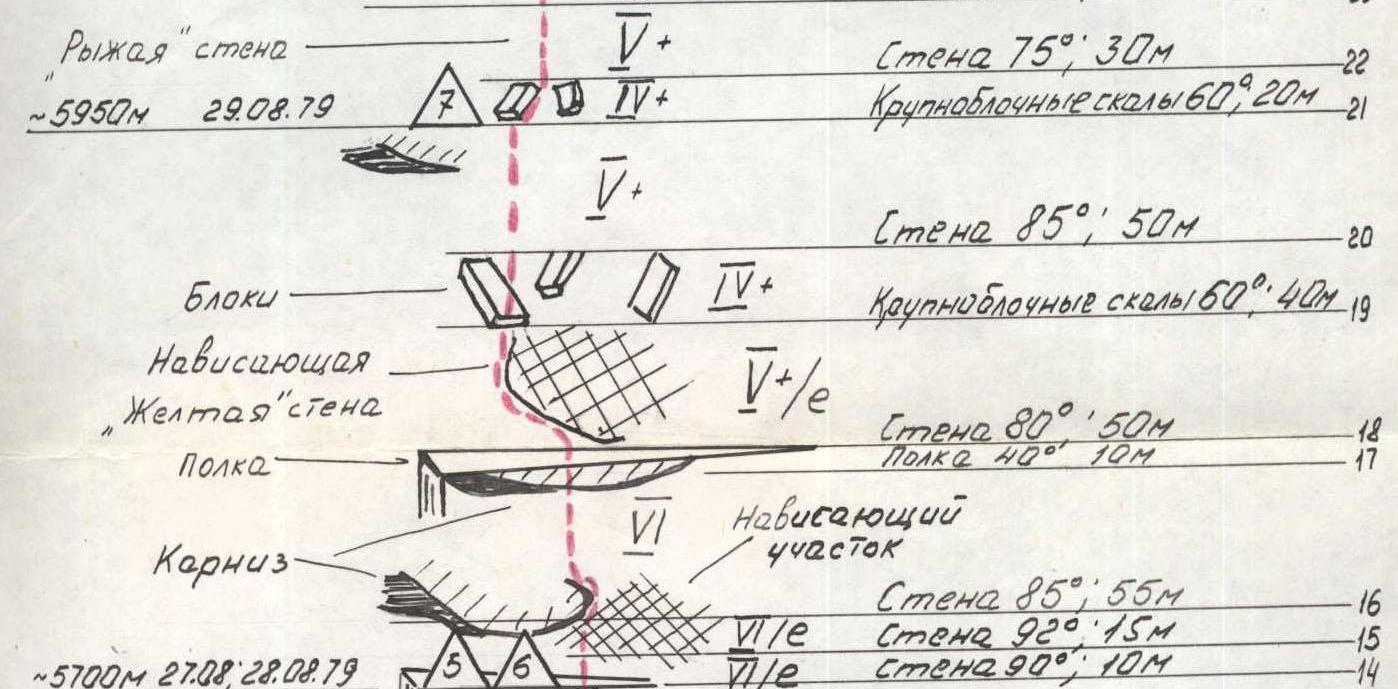
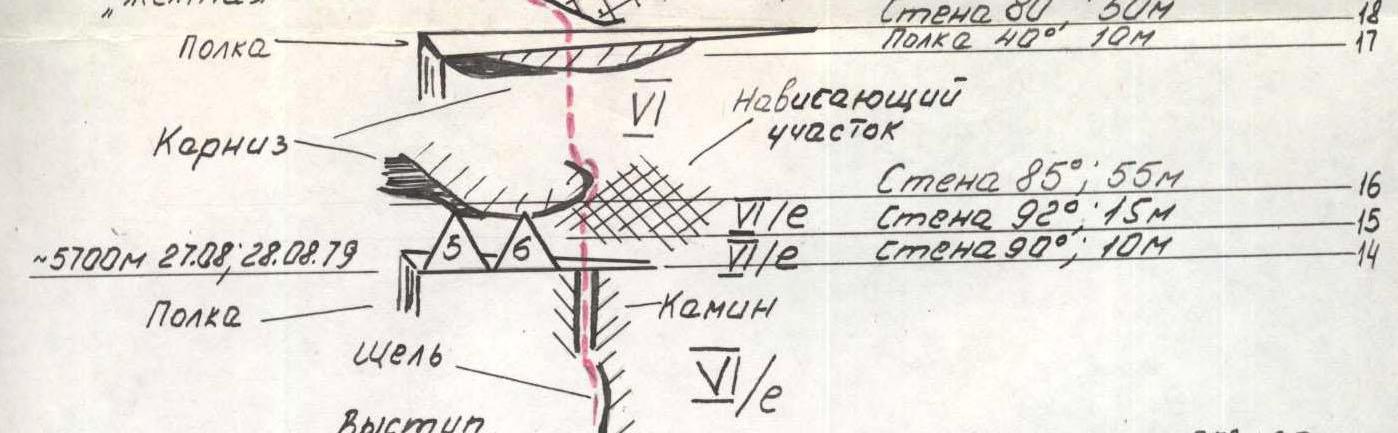

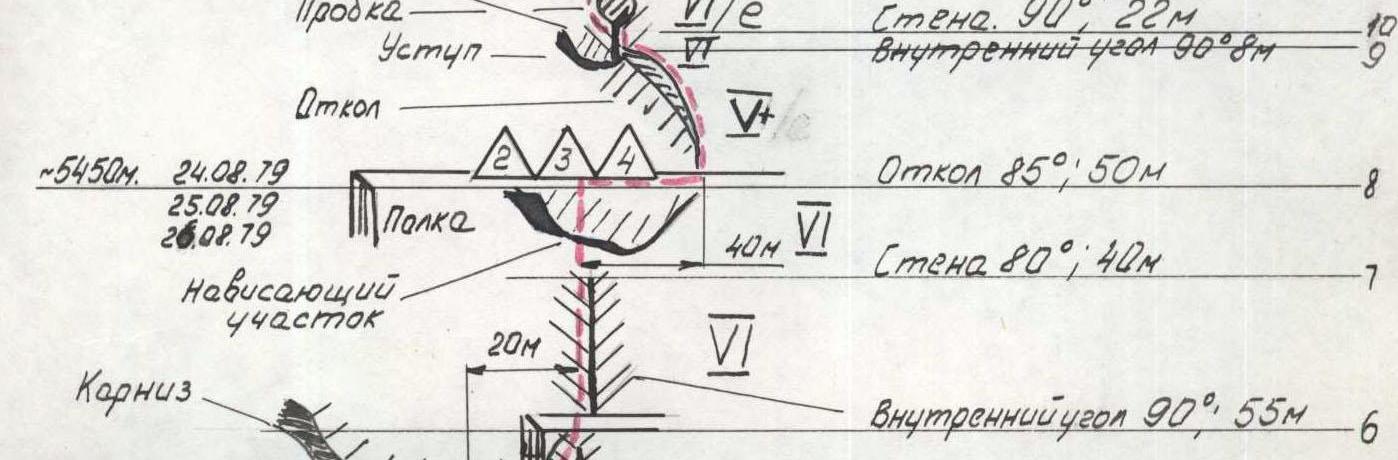
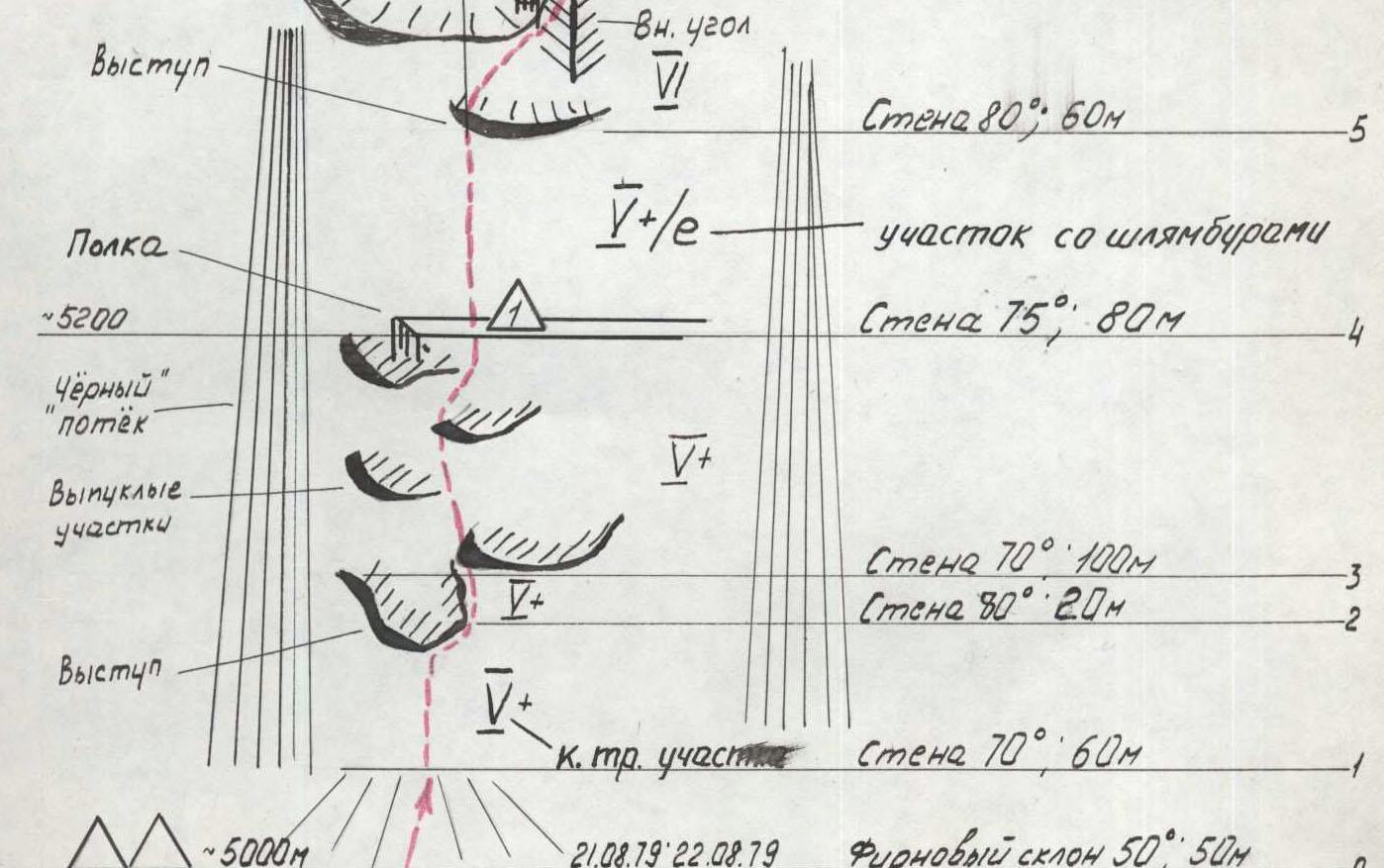 Route diagram
- Ridge ~ 15° ~ 500 m, Snow drifts (R26–R27)
- R25: Firsk slope, 160 m, 55°
- R24: Large-blocky rocks, 30 m, 70°
- R23: Wall, 20 m, 75°
- R22: Wall, 30 m, 75°
- R21: Large-blocky rocks, 20 m, 60°
- R20: Wall, 50 m, 85° (4)
- R19: Large-blocky rocks, 40 m, 60° (5)
- R18: Wall, 50 m, 80° (5)
- R17: Shelf, 70 m, 20°
- Overhanging section, Cornice
- R16: Wall, 55 m, 85° (6)
- R15: Wall, 15 m, 92° (6)
- R14: Wall, 10 m, 90° (6)
- Chimney, cleft, ledge, cleft
- R13: Wall, cleft-chimney, 80 m, 85° (6)
- R12: Wall, cleft, 40 m, 85° (6)
- Overhang, cleft
- R11: Wall, cleft, 60 m, 85° (5)
- R10: Wall, 22 m, 90° (5)
- R9: Inner corner, 8 m, 90° (5)
- Crack
- R8: Crack, 50 m, 85° (6)
- Shelf
- R7: Wall, 40 m, 80° (6)
- Overhanging section
- Cornice
- Ledge
- Inner corner
- R6: Inner corner, 55 m, 90° (6)
- R5: Wall, 60 m, 80° (5)
- Shelf
- R4: Section with bolts, wall, 80 m, 75° (5)
- R3: Wall, 100 m, 70° (5)
- R2: Wall, 20 m, 80° (5)
- R1: Wall, 60 m, 70° (5)
- R0: Firsk slope, 50 m, 50° Ascent route to peak Engels (south summit) via the east wall.
8. Food
28 kg of food were taken on the route, calculated at 400 g per person per day. The participants had two hot meals a day and a "snack". The selection of products was made as much as possible taking into account the taste of each participant. Various vitamins were available.
IV. Order of passage of the route
July 21. The day is cloudy. Low clouds cover the wall. 12:00. We set off under the route in full force. The bivouac site under the wall was chosen in advance, and supplies were made. In the remaining daylight, we clarify the start of the route: two black streaks, clearly visible on the wall slightly to the left of the not very pronounced counterfort extending from the summit ridge. 14:00. The duo Oshe-Polyakov went out to tramp out the tracks on the firn slope (50 m, 50°), (section R0–R1), while the snow had not yet frozen. We outline the plan for the first day — the day of processing the lower part of the wall. At 20:00, we conducted a radio session, the audibility is good.
July 22. The Oshe-Polyakov rope team went out at 8:00 to process the first two ropes of the route. The task for today is to process the section of the wall to the site of the planned bivouac No. 1. The approach from the bivouac under the wall took 1 hour. The start of the route on the wall, along the left black streak — 60 m, 70°, section R1–R2. The first one immediately had to put on galoshes. The wall is quite smooth, with few cracks, covered in dust, so that the galoshes constantly slip. 60 m up free climbing in the direction of a small inclined ledge (35° to the plane of the wall) under a steep wall with an overhanging forehead. To the right along the wall, up and around the overhang — 20 m, 80°, section R2–R3. Had to use a ladder.
The rope teams changed. Likhachev-Kosmach, through a half-meter ledge and further along the smoothed wall (100 m, 70°, section R3–R4) reached the site of the planned bivouac No. 1 by 18:00. Having secured the fixed ropes, the rope team descends to the bivouac. On this day, the group worked on the route for 10 hours, processing 180 m, and driving 52 pitons.
July 23. 8:00. Today's task is to pass the processed section, set up a bivouac, and if possible, process the route above bivouac No. 1. The scheme of movement along the route is planned and worked out in advance. The Oshe-Polyakov rope team heads up. By 14:00, everyone was already at the bivouac site. The shelf is inclined. We had to build up a foundation of stones to accommodate two tents. Meanwhile, the first rope team, leaving their backpacks, taking ropes and pitons, began processing the wall (80 m, 75°–80°, section R4–R5). After fruitlessly searching for a crack for a piton, they drove the first bolt piton, on which they hung a can with a note the next day: "first control tour". Having passed a few meters of very difficult climbing on a smooth convexity of the wall, Oshe was forced to drive a second bolt piton and use a ladder. The rising wind began to scatter the water flowing from the upper cornices along the entire wall. On the smoothed rocks, it became uncomfortable. Having reached a small ledge (for one) and securing the rope, the rope team returned to the bivouac.
On this day, the group worked on the route for 9 hours, passed 80 m, and drove 32 pitons.