

 RUSSIAN MOUNTAINEERING FEDERATION
5A first ascent Protocol No. 287 21.1.69
N. Snegirev collection 32. passed
RUSSIAN MOUNTAINEERING FEDERATION
5A first ascent Protocol No. 287 21.1.69
N. Snegirev collection 32. passed  TADJIK COUNCIL OF THE SPARTAK VOLUNTARY SPORTS SOCIETY 108 (South-Western Pamir)
REPORT
on the ascent of Peak 6300 via the western edge by the team from the Ukrainian Council of the Spartak Voluntary Sports Society 6318 Peak Engels 60
 Peak Komosomola Ukrainy
Peak Tajikistan 10?
Peak Komosomola Ukrainy
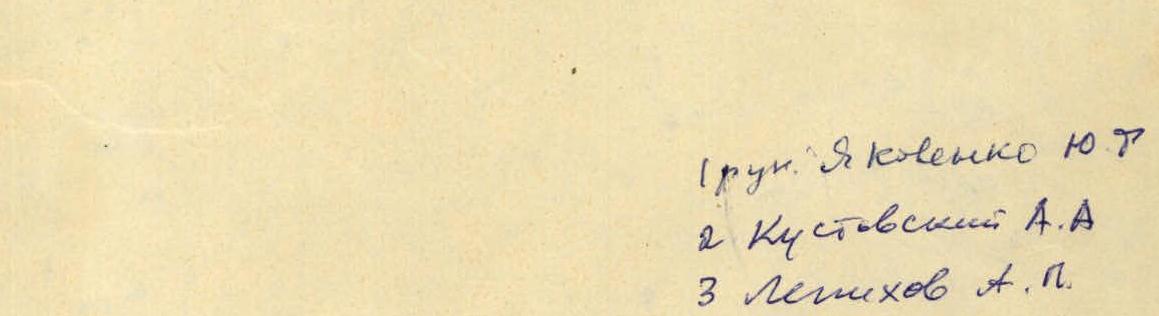
Peak Tajikistan 10? Team: Yakovenko Yu.R.
2. Kustovsky A.A.
3. Lepikhov A.P.
4. Cherevko V.L.
Team: Yakovenko Yu.R.
2. Kustovsky A.A.
3. Lepikhov A.P.
4. Cherevko V.L.
Ukrainian SSR Championship 1964
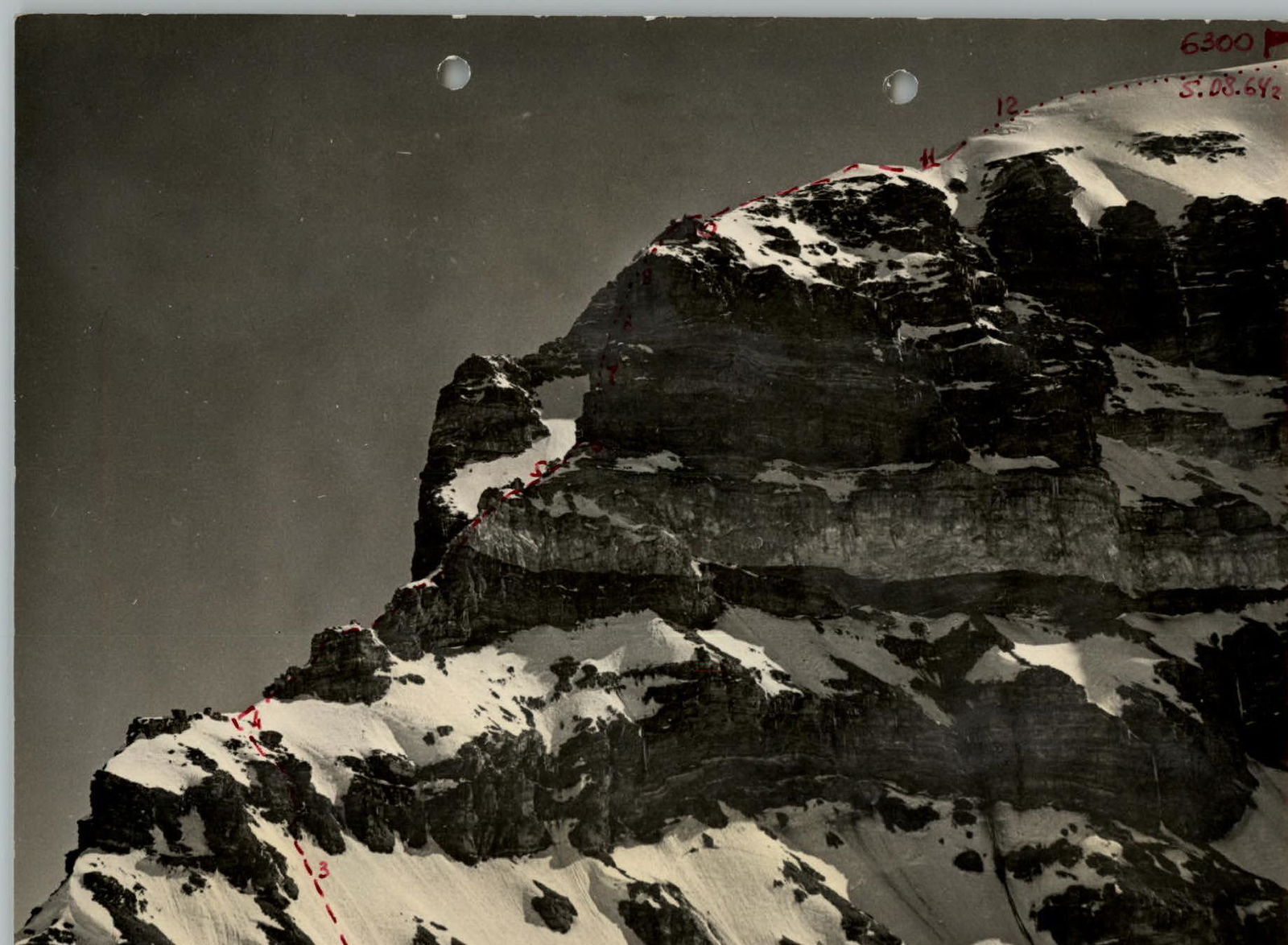 Ridge and exit to the cliff
 Cliff
Cliff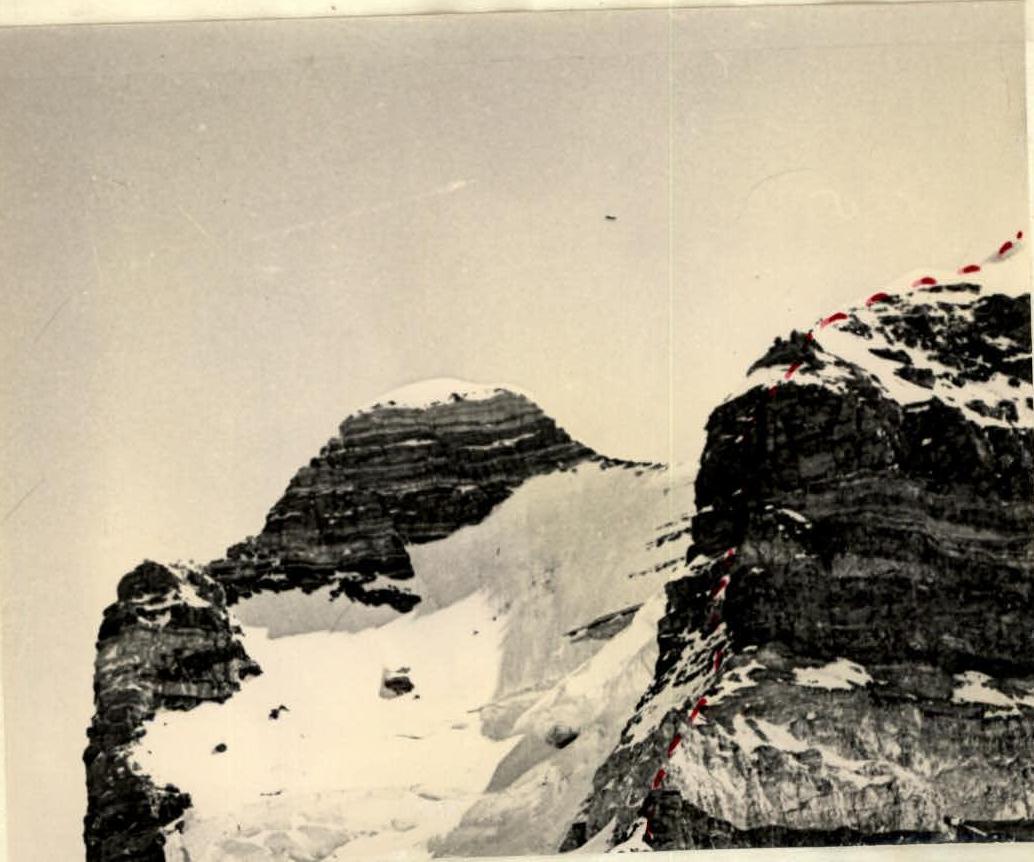
III. Description of the Ascent
August 1st. In the second half of the day, we leave the assault camp at an altitude of 5000 m and cross the ridge between Peak 6075 and 6300 into the Vung valley. The height of this ridge is about 5100 m. We spend the night in a tent under the icefall.
August 2nd. We depart at 3:00. We cross the icefall in crampons (R0–R1). In some places, we have to cut steps. From the top of the icefall begins a snowy-icy slope (R1–R2). We meet a group consisting of V.M. Abalakov, Kletsko, Yakovina, Razmakhnin, and Borisenko, who were supposed to ascend Peak 6300 a day earlier. They returned from the route, as, in their opinion, the ascent to Peak 6300 is a 5B category route, and some of the participants did not formally have the right to ascend higher than 5A.
On this day, we managed to reach the ridge between Peak Marx and Peak 6300 (R2–R3), and a team of two processed the exit to the ridge (R3–R4). We spend the night together on the ridge.
August 3rd. We depart at 3:00. Via the processed section (R3–R4) with ladder ropes in the lower part and rime ice at the top, we reach the ridge. Movement along the ridge (R4–R5) does not present particular difficulties, except for short (4–5 m) wall sections, which the first climber ascends without a backpack. The ridge leads to a 200-meter cliff, which is not feasible to climb directly and requires continuous movement with piton placement. To the left, a relatively simpler exit to the cliff is visible, led by a system of icy inclined shelves (R5–R6). From here begins the ascent up the cliff (R6–R7). Climbing is very challenging. We pull up backpacks using a block-brake. We organize a bivouac sitting on an inclined shelf.
August 4th. From the overnight stay, a 40-meter vertical wall with few holds and an overhanging top section leads upwards. We mainly move using ladders, and under the overhang, we have to use pitons. This section (R7–R8) is the key point of the route; the altitude (around 6000 m here) further exacerbates the difficulty.
The further ascent up the cliff goes along a steep, slippery groove filled with ice (R8–R9). The groove gradually widens and transitions into a snowy-icy couloir with rock outcrops (R9–R10), leading to the top of the entire cliff. Here, we organize a bivouac in a tent.
August 5th. Further technical difficulties of the ascent are related only to the altitude, except for a 60-meter ice ascent (R11–R12), where we had to go in crampons, cut steps, and place ice screws.
At 13:00, we reach the summit of Peak 6300. Without delay, we begin our descent via the ascent route. During the descent from the cliff, on sections R6–R10, four rappels were set up.
We spend the night on the ridge (R2–R3) and return to the assault camp the next day.
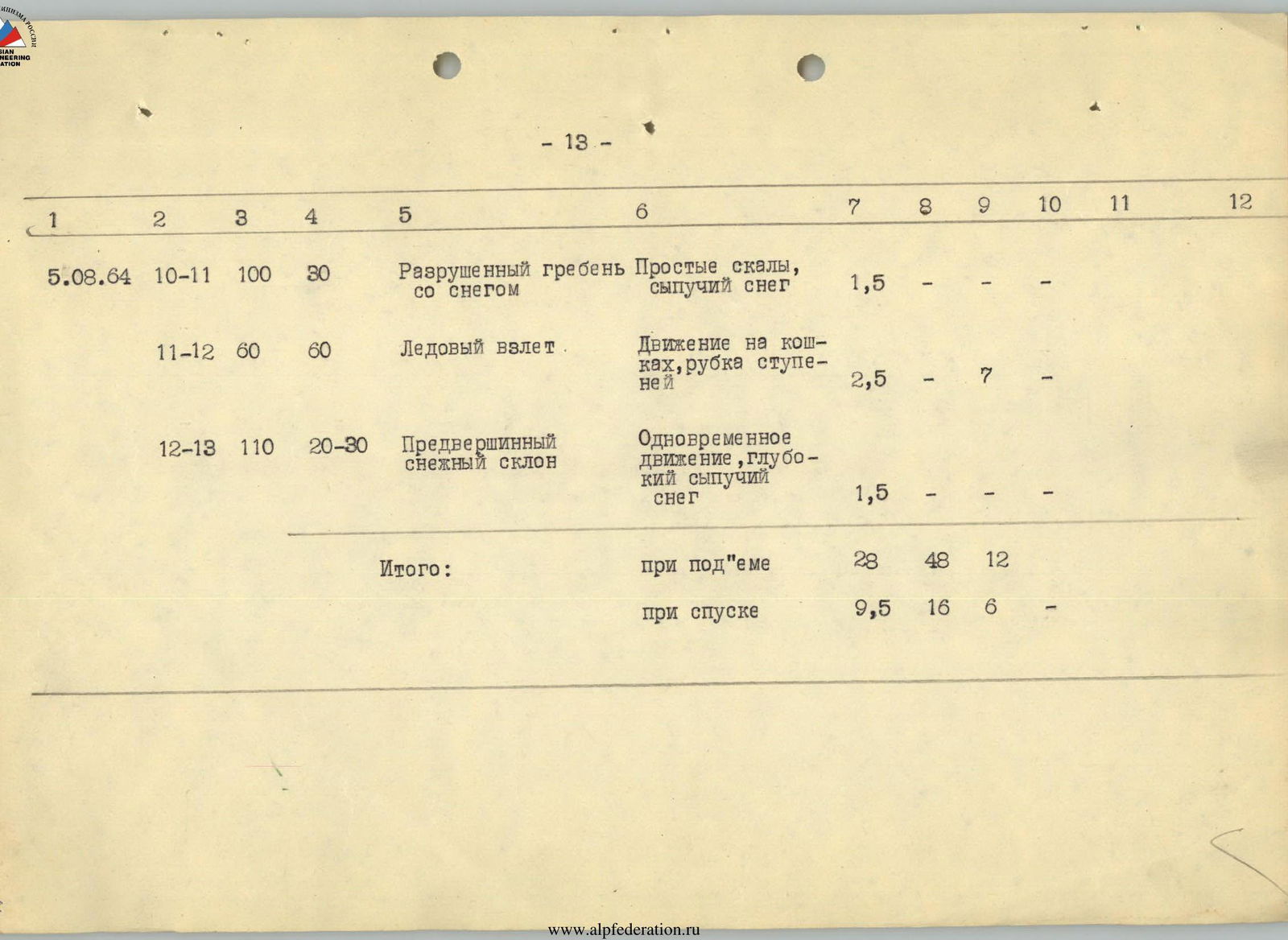
TABLE
of the main characteristics of the route to Peak 6300 via the western edge Height difference 1200 m. Including the most challenging sections 300 m. Overall steepness. Including the most challenging sections 80–90°
| Date | Section Number | Length in m | Steepness in degrees | Characteristics of the section by relief | Characteristics of the section by technical complexity | Time taken | Rock pitons driven | Ice pitons driven | Pitons screwed | Bivouac conditions | Note |
|---|---|---|---|---|---|---|---|---|---|---|---|
| 2.08.64 | R0–R1 | 150 | 30–40 | Icefall | Movement in crampons | 2.5 | – | 2 | – | – | |
| R1–R2 | 300 | 20–30 | Snow slope | Simultaneous movement | 3.0 | – | – | – | – | ||
| R2–R3 | 50 | 15 | Exit to the ridge between Peak Marx and Peak 6300 | – | 0.5 | – | – | – | Overnight in a tent | ||
| 3.08.64 | R3–R4 | 120 | 50 | Exit to the western ridge, snowy rocks, rime ice | Rocks of medium difficulty | 2.0 | 4 | 1 | – | – | |
| R4–R5 | 70 | 30 | Destroyed rocky ridge, short wall sections | In some areas, the first without a backpack | 2.5 | 6 | – | – | – | ||
| R5–R6 | 20 | 20 | Traverse along icy shelves under the cliff | Challenging climbing, the first without a backpack | 1.5 | 8 | – | – | – | ||
| R6–R7 | 60 | 85 | Challenging rocks, rime ice | Challenging climbing, backpacks pulled up | 3.0 | 11 | – | – | Sitting bivouac | ||
| 4.08.64 | R7–R8 | 40 | 90 | Rocky wall, overhanging exit | Challenging climbing using ladders, backpacks pulled up | 3.5 | 11 | – | 2 | – | |
| R8–R9 | 50 | 60 | Ice groove | Movement in crampons, step cutting | 1.5 | 2 | 4 | – | – | ||
| R9–R10 | 70 | 50 | Snowy-icy couloir with rocky outcrops | Powdery snow, complexity of organizing belays | 2.5 | 6 | – | – | Overnight in a tent | ||
| 5.08.64 | R10–R11 | 100 | 30 | Destroyed ridge with snow | Simple rocks, loose snow | 1.5 | – | – | – | – | |
| R11–R12 | 60 | 60 | Ice ascent | Movement in crampons, step cutting | 2.5 | – | 7 | – | – | ||
| R12–R13 | 110 | 20–30 | Pre-summit snowy slope | Simultaneous movement, deep loose snow | 1.5 | – | – | – | – | ||
| Total: | during ascent | 28 | 48 | 12 | – | ||||||
| during descent | 9.5 | 16 | 6 | – |

V. Conclusion
In preparation for the ascent of Peak 6300 in the mountains and during the pre-season period, the group conducted extensive preparatory work. Good physical and technical preparation, as well as years of experience in joint ascents, ensured the successful overcoming of the route. All participants confidently and reliably overcame challenging sections; three of them were part of the team that made the ascent for the USSR Championship.
In the opinion of all participants, the route to Peak 6300 via the western edge is undoubtedly a 5B category route in terms of technical complexity and length. The technical difficulty is further exacerbated by the altitude.
The CSKA team led by Nekrasov, who traversed part of the western ridge of Peak 6300 while descending from Peak Engels, also evaluated it as a fifth category route.
The ascent to Peak 6300 was made for the first time. By right of the first ascenders, the group named Peak 6300 as Peak Komsomola Ukrainy and filed a corresponding petition.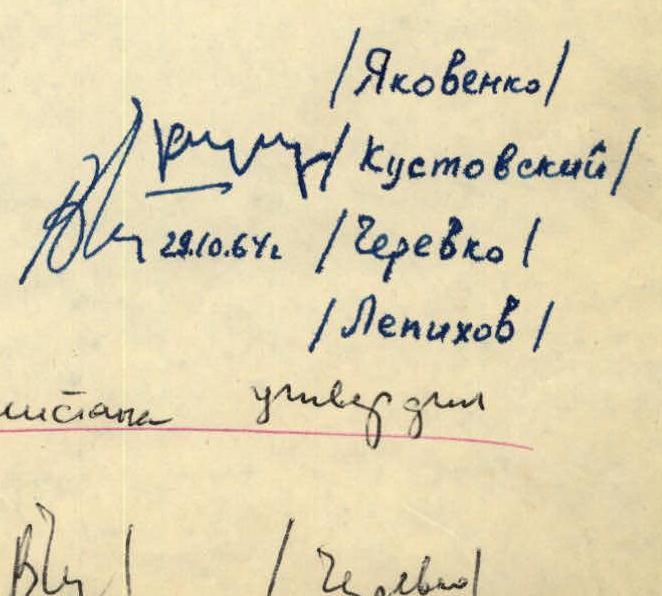 /Yakovenko/
/Kustovsky/
/Cherevko/
/Lepikhov/
The Council of Ministers of Tajikistan approved
the name in 1965
24.04.67
/Yakovenko/
/Kustovsky/
/Cherevko/
/Lepikhov/
The Council of Ministers of Tajikistan approved
the name in 1965
24.04.67