

Ascent Passport
- Climbing season — winter
- Climbing area — Central Caucasus
- Peak — Shkhelda Centralnaya 4295 m via the right edge of the northern wall.
- Complexity category — 5B
- Height difference — 1265 m. Length — 1635 m. Length of sections with 5–6 complexity category — 644 m.
- Pitons driven:
| Rock | Nuts | Bolts | Ice screws |
|---|---|---|---|
| 43 | 40 | - | 52 |
- Number of climbing hours/days — 8.
- Overnight stays — 2 at a bivouac.
- Leader: Muravlyov A. N., Candidate for Master of Sports. Participants: Slepnev P. I., Candidate for Master of Sports. Senior coach: Tinin Yu. P., Candidate for Master of Sports.
- Approach to the route — February 3, 1996. Summit — February 5, 1996. Return — February 7, 1996.
- Organization: FAIS Moscow.
The object of our ascent was the mountain Shkhelda Centralnaya via Martynov's route. The trip to the mountains was preceded by an active training process, which included:
- weekly cross-country runs;
- climbing on artificial training equipment;
- walking in crampons on trees.
Before attempting the ascent, a study of the area and the object of the ascent was conducted. For this purpose, as well as to ensure a reliable base under the slopes of Vullya peak (opposite the intended route), a cave was dug.
The presence of a cave under the route allowed for the creation of a base with the necessary supply of equipment and provisions for:
- making the ascent;
- waiting out bad weather;
- conducting reconnaissance and monitoring the state of the route.
From January 16, 1996, to January 31, 1996, a study of the area, observation, and in-depth reconnaissance of the route were carried out.
It is known that the rock part of the route, especially in the second half of the day, is prone to rockfall. In this regard, it was logical to attempt to climb this route in winter conditions, as the consistently low temperatures throughout the day minimize the potential danger of rockfall. However, the presence of snow and ice on the rock part of the route complicated it due to difficulties in organizing reliable insurance under such conditions.
The logic and beauty of the route, which passes along the right edge of the northern wall of Shkhelda Centralnaya, as well as the possibility of descending from any point on the route via the ascent path, ultimately confirmed our choice of this route as the object for the ascent.
Thanks to in-depth reconnaissance — approaching the rocky part of the route (section R8–R24) — we were able to confirm the feasibility of passing this route and make a final decision on selecting the necessary equipment.
Observing the route at different times of day, as well as in various weather conditions, allowed us to draw the necessary conclusions about the avalanche danger of the route.
The greatest avalanche danger on the route is posed by the descent of snow masses from the "board" (section R28–R32). Frequent but "dry" snowfalls, low temperatures, and constant wind did not allow large snow masses to accumulate on the "board". During snowfalls, snow constantly flowed off the "board" along the left part (closer to the "mirror") of the rocks. Therefore, we tried to adhere to the faintly expressed edge when overcoming the rocky belt (R8–R24).
The ascent to the summit of Kurmychi via a 1B category route on January 20, 1996, the conduct of in-depth reconnaissance of the route to Shkhelda Centralnaya, and observations of its condition from January 21, 1996, to January 30, 1996, as well as all preparatory work related to organizing a reliable base under the route and studying the climbing area, allowed the team to acquire the necessary acclimatization, sufficient for making the ascent to the summit of Shkhelda Centralnaya via the chosen route.
It is necessary to note the cyclical nature of the acclimatization process:
- sequential gain in altitude;
- descents to rest at the base camp (Elbrus UMC).
Such an acclimatization regime contributes to the most complete and deep adaptation of the body to altitude.
During the preparatory work preceding the ascent, the team's stay in the high-altitude zone did not exceed three days, as prolonged exposure to low temperatures:
- does not have a beneficial effect on the climber's body;
- leads to excessive exhaustion;
- is extremely undesirable, especially during the preparatory period.
We would like to express our deep gratitude for the enormous assistance in organizing the ascent to the group of assistants-observers: Sinyushin N. G., Tinin Yu. P., Khokhlov Yu. V., Babitsky A. V., and doctor Sdobnikova S. — without them, carrying out this event would have been hardly possible.
In addition to registering with the KSP of the Shkhelda region at each exit into the high-altitude zone and maintaining radio communication with it, the team was provided with observers from among the group of assistants who had constant radio contact with the team during the ascent.
As a result of observing the route, studying the area, and consultations, it was decided to descend via the ascent path.
Tactical Actions of the Team
On February 2, 1996, the team arrived at the cave to set out on the route in the morning. The team was provided with food for five days, calculated at 400 g of dry product per person per day, and a necessary supply of fuel:
- 5 × 250 g gas canisters.
On the morning of February 3, 1996, at 7:00, they left the cave. Crossing the "Shkhelda" glacier, they approached the zone of bergschrunds on the northern wall of Shkhelda Centralnaya — the start of the route.
All bergschrunds were snowed over. The section involved simultaneous movement on the entire rope with insurance through ice screws.
Having passed a rope length of несложных скал, засыпанных снегом (участок R4–R6), they reached the overnight stay location — 11:00.
After setting up the tent and having a snack, they began processing the rocky belt — 12:00. Unfortunately, the weather deteriorated, and it started snowing.
Due to the heavy snow cover and icy conditions on the rocks, the first person climbed using ice axes, nuts, and piton insurance. Snow flowing down the rocks slowed down the movement due to the worsening conditions for organizing reliable insurance. By 17:00, they had fixed four ropes, and by 17:30, they were back in the tent.
On February 4, 1996, leaving the bivouac at 7:00, by 8:30, they reached point R15 at the end of the fourth fixed rope. Having passed two ropes in two hours, they reached a snow patch. The section involved pitons and nuts.
After passing two rope lengths of snowy slope (simultaneous movement on the entire rope with insurance through ice screws), they found themselves under the last rocky belt before reaching the "board" (section R25–R28) — 11:30.
An hour and a half later, at 13:00, they reached the "board".
Section R25–R27:
- glacial roches moutonnées with rime ice;
- piton insurance.
February 4: strong frost and wind in the morning, snow grains in the afternoon with strong wind.
The section involved simultaneous movement with insurance through ice screws, ice in places with snow. By 18:30, they reached a ridge where they set up a site and pitched a tent.
On February 5, 1996 — strong frost, wind. At 7:30, they left the ridge for the summit of Shkhelda Centralnaya's tower. The rocks were covered in rime ice; insurance was provided by pitons and nuts. At 12:30 — the summit. Weather: cold, windy, snow grains began.
Descent was made via the ascent path.
The safety of the ascent was ensured by:
- regular communication with KSP, the observation group, who also visually tracked the team on the route and the rescue team.
Radio communication sessions:
- 8:30;
- 12:00;
- 16:00.
- the team had a first-aid kit with a set of anti-shock and pain-relieving medications, as well as means against frostbite;
- the presence of a transportation team (20 people) in the Adyl-Su gorge;
- fuel (gas) and food were taken with a one-day reserve, and there was also a spare set of power sources for headlamps;
- overnight stays were equipped with mandatory piton insurance;
- before the ascent, team members underwent medical examination by doctor Sdobnikova S. I., and qualified medical assistance could be provided by the event's doctor upon descent to the cave.
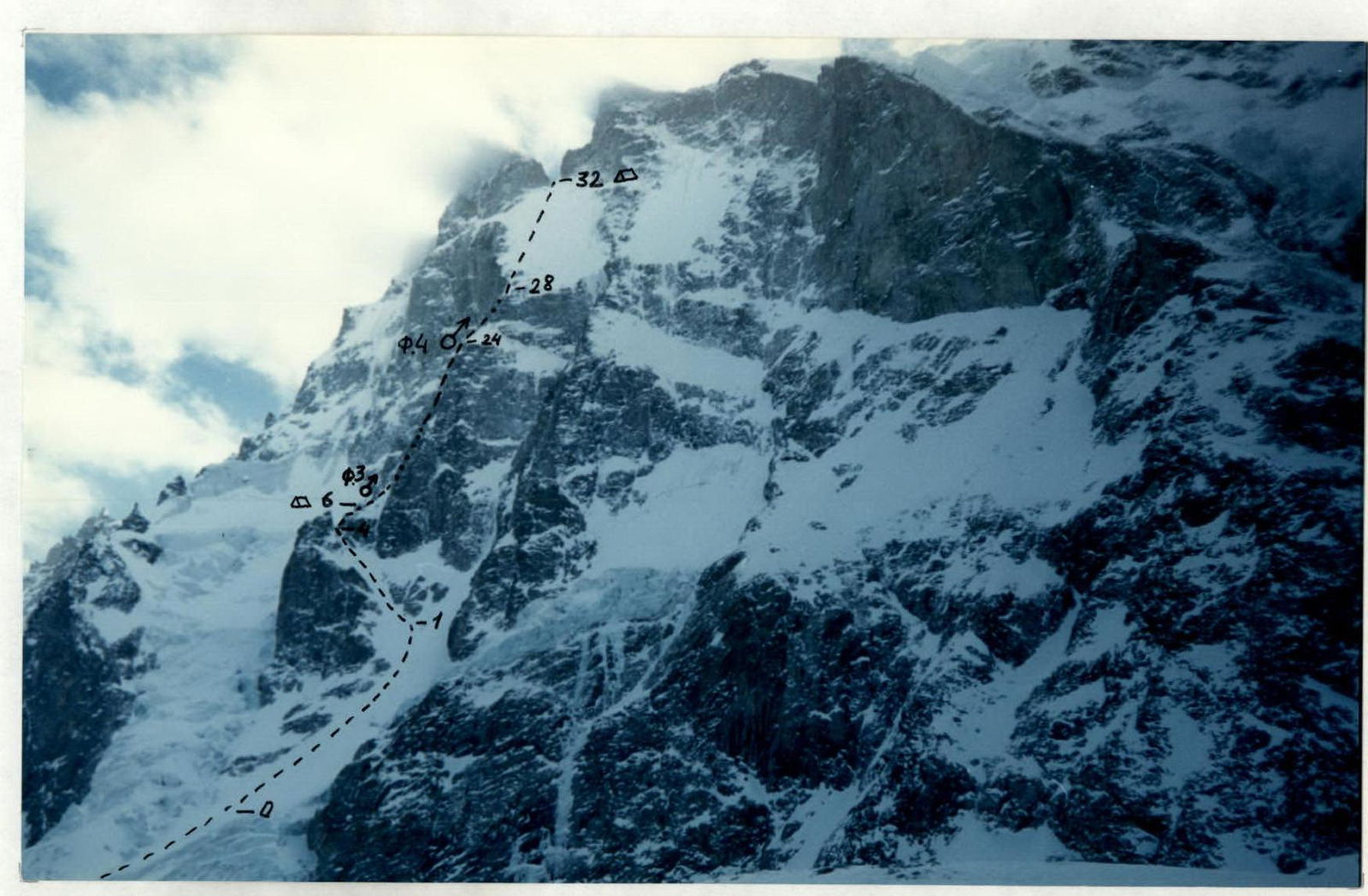 Photo #1. Taken from Aristov's overnight stay.
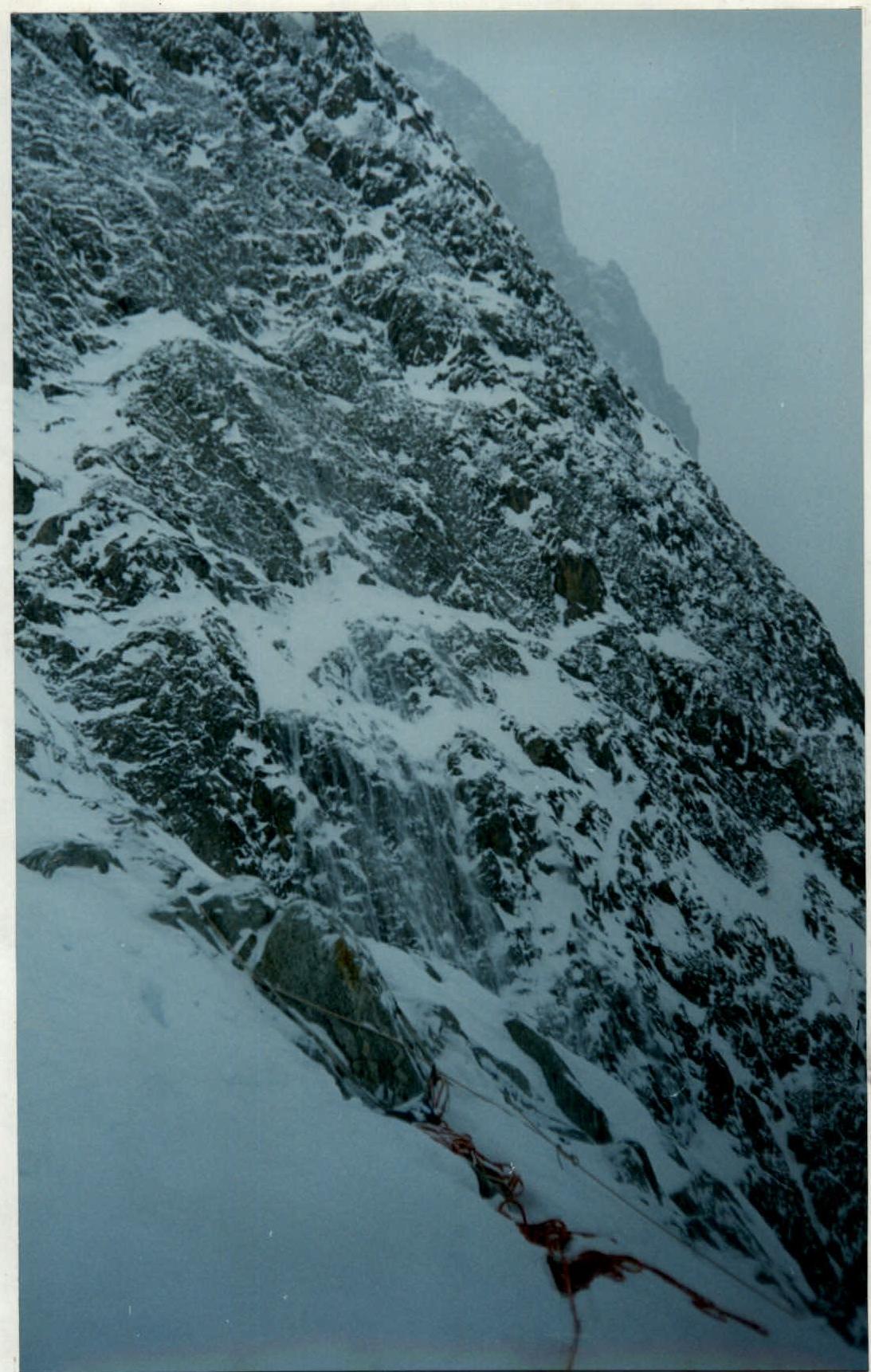 Photo #2. Taken on February 3, 1996, at 12:00, section R7–R14.

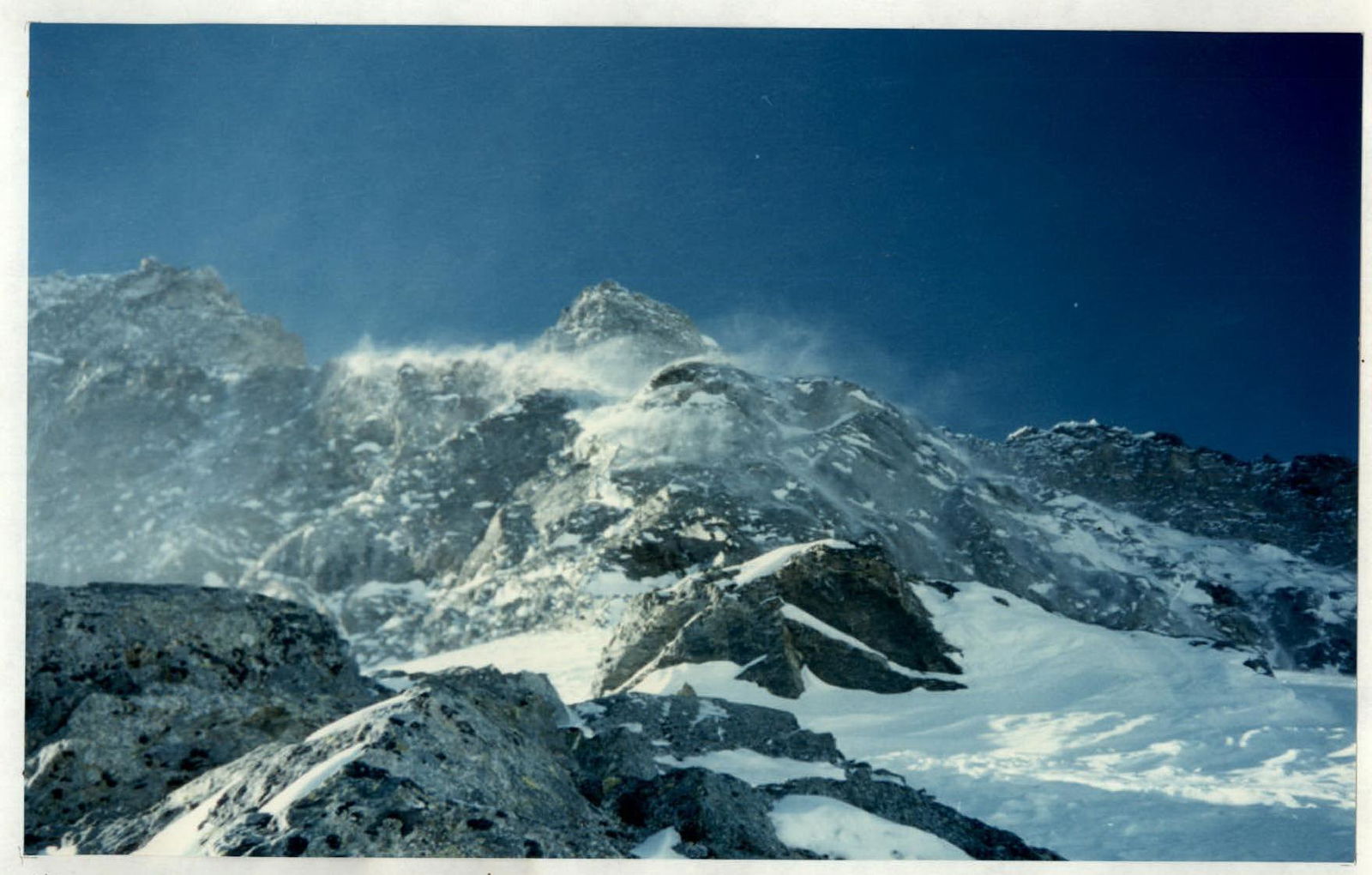 Photo #3. Taken on February 4, 1996, at 10:30, section R24–R28.